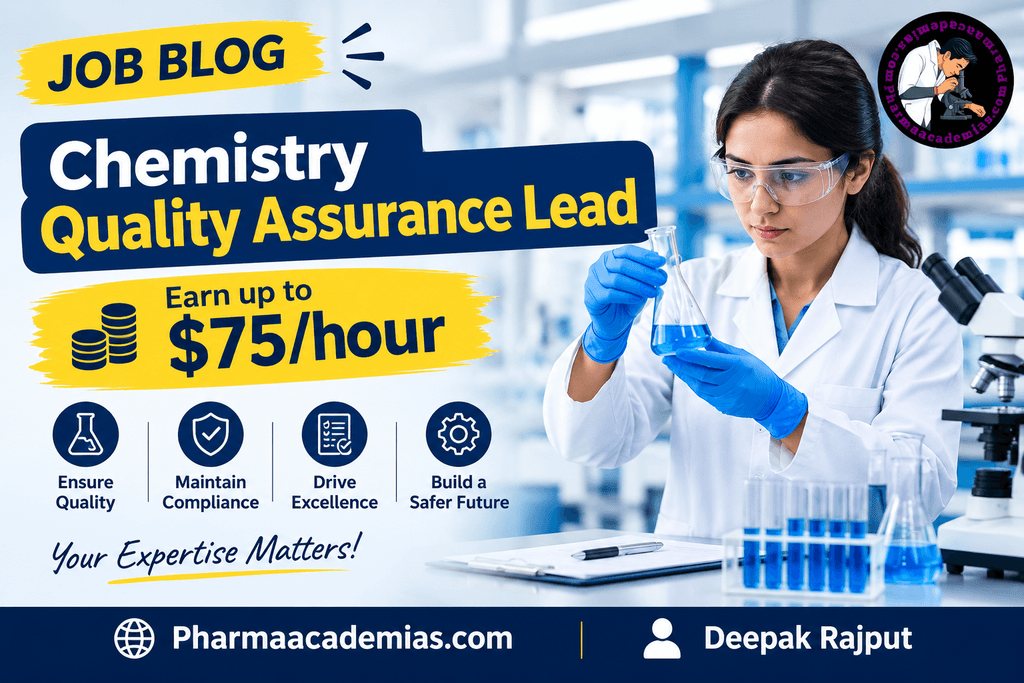
Chemistry Quality Assurance Lead: The rapid growth of artificial intelligence is creating new opportunities for scientists to contribute their expertise beyond traditional laboratory and academic environments. One such opportunity is the Chemistry Quality Assurance Lead (QAL) role, which combines chemistry expertise, scientific quality assurance, technical review, and AI training.
Job ID: CHEMISTRYQAL-25-505
Job Type: Contract
Qualification: Chemistry, Biochemistry, Pharmaceutical Chemistry
Location: Remote
Rate: Up to $75/hour
Interview: Required
Interview Language: English
About the Role Chemistry Quality Assurance Lead
The Chemistry Quality Assurance Lead will be responsible for maintaining the quality, scientific accuracy, consistency, and reliability of chemistry-related AI training data.
In this role, the professional will review AI-generated chemistry content as well as the work completed by trainers and quality assurance contributors. The objective is to ensure that chemistry training materials meet established scientific and project-specific standards.
The role requires more than general chemistry knowledge. A successful candidate should be able to identify subtle scientific errors, evaluate chemical reasoning, check calculations, assess reaction mechanisms, identify safety concerns, and determine whether an answer follows the required rubric and instructions.
The Chemistry QAL will also provide written feedback, communicate quality updates to trainers and QAs, support onboarding, maintain project documentation, and identify recurring quality problems.
📸 Follow us on Instagram 📱 Join WhatsApp Channel ✈️ Join Telegram ChannelWhy This Role Is Important
AI systems are increasingly being used for scientific education, research assistance, laboratory reasoning, drug discovery, chemical analysis, and other technical applications. However, AI-generated scientific information can sometimes contain incorrect calculations, hallucinated facts, chemically impossible reactions, inappropriate assumptions, or unsafe recommendations.
This makes scientific quality assurance essential.
A Chemistry QAL helps ensure that AI training data is:
- Scientifically accurate
- Chemically logical
- Correctly calculated
- Properly formatted
- Clearly explained
- Consistent with project guidelines
- Safety-aware
- Supported by appropriate scientific reasoning
The work therefore provides an opportunity for chemistry professionals to contribute directly to the development and improvement of advanced AI models.
Key Responsibilities
1. Quality Monitoring
The QAL will regularly review chemistry-related items and identify quality problems. They will provide precise feedback to trainers and QAs and escalate serious or recurring issues when necessary.
2. Scientific Review
The professional will evaluate AI-generated chemistry responses involving areas such as:
- General chemistry
- Organic chemistry
- Inorganic chemistry
- Physical chemistry
- Analytical chemistry
- Biochemistry
- Stoichiometry
- Thermodynamics
- Chemical kinetics
- Chemical equilibrium
- Spectroscopy
- Reaction mechanisms
- Chemical nomenclature
- Laboratory reasoning
Calculations, units, formulas, assumptions, reaction pathways, and explanations must be carefully examined.
3. Trainer and QA Communication
An important part of the position is communicating with trainers and quality reviewers through remote collaboration tools.
The QAL may provide updates regarding:
- New chemistry guidelines
- Project changes
- Quality expectations
- Review standards
- Workflow changes
- Chemistry-specific issues
- Common mistakes
Clear and professional English communication is therefore essential.
4. Handling Chemistry-Related Questions
Trainers and QAs may require clarification about chemical concepts, calculations, reactions, terminology, units, safety, or rubric interpretation.
The Chemistry QAL will help resolve these questions accurately and consistently.
5. Documentation and Quality Systems
The QAL will create and maintain project documentation, including:
- Chemistry style guides
- FAQs
- Quality trackers
- Quality notes
- Examples
- Honeypots
- Calibration tasks
- Onboarding materials
- Training resources
Strong organizational skills are particularly valuable for this responsibility.
6. Onboarding and Training
The role may involve conducting onboarding and training sessions for new trainers and QAs.
These sessions can cover project expectations, workflows, rubrics, chemistry standards, quality requirements, and review procedures.
7. Safety and Risk Review
Chemistry-related AI content can sometimes involve laboratory procedures, chemical handling, hazardous substances, reactions, or health and environmental considerations.
The QAL must identify responses that are:
- Unsafe
- Misleading
- Scientifically unsupported
- Overconfident
- Incomplete from a safety perspective
Safety awareness is therefore an important component of the role.
8. Process Improvement
The Chemistry QAL will also look for recurring quality problems and help develop scalable solutions.
This may include improving review workflows, creating better calibration materials, updating guidelines, and establishing more consistent QA processes.
📸 Follow us on Instagram 📱 Join WhatsApp Channel ✈️ Join Telegram ChannelWho Can Apply?
The position is suitable for professionals with educational and practical backgrounds in fields such as:
- Chemistry
- Chemical Sciences
- Biochemistry
- Materials Chemistry
- Pharmaceutical Chemistry
- Related scientific disciplines
A Bachelor’s, Master’s, or PhD degree in a relevant field is acceptable.
The role also requires approximately 3+ years of relevant professional experience in areas such as:
- Chemistry research
- Laboratory work
- Teaching
- Scientific writing
- Technical review
- Quality control
- Formulation
- Analytical chemistry
- Scientific content evaluation
Important Skills for a Chemistry QAL
A strong candidate should have excellent knowledge of chemistry as well as the ability to critically evaluate scientific content.
Important skills include:
Chemical Reasoning
The candidate should understand why a chemical reaction or process occurs rather than simply recognizing the final answer.
Calculation Verification
The ability to independently check calculations involving stoichiometry, concentrations, molarity, dilution, molecular weight, thermodynamics, kinetics, and related concepts is important.
Reaction Mechanisms
A strong understanding of organic and inorganic reaction mechanisms helps identify chemically incorrect or unrealistic AI-generated explanations.
Scientific Communication
The ability to explain errors clearly and provide constructive feedback is essential.
Attention to Detail
Small mistakes involving units, significant figures, nomenclature, formulas, reaction conditions, or assumptions can substantially affect scientific accuracy.
Safety Awareness
The professional should recognize potentially dangerous or misleading recommendations involving chemicals, laboratory procedures, reactions, or hazardous materials.
Remote Collaboration
Because the position is remote, candidates should be comfortable working with tools such as:
- Discord
- Google Docs
- Google Sheets
- Trackers
- Dashboards
- Project-management systems
AI and LLM Experience
Previous experience with AI training, data annotation, large language models, prompt/response evaluation, scientific content QA, or rubric-based LLM evaluation is considered a strong advantage.
However, the role is fundamentally built around strong chemistry expertise combined with quality assurance and communication skills.
This makes it particularly interesting for chemistry professionals who want to enter the rapidly expanding field of AI-assisted science and scientific data quality.
📸 Follow us on Instagram 📱 Join WhatsApp Channel ✈️ Join Telegram ChannelCareer Potential
The emergence of AI in scientific fields is creating demand for subject-matter experts who can evaluate whether AI-generated information is actually scientifically correct.
Chemistry professionals can potentially contribute to areas such as:
- AI model evaluation
- Scientific data annotation
- Chemistry AI training
- LLM evaluation
- Scientific quality assurance
- AI-assisted drug discovery
- Computational chemistry workflows
- Scientific content development
- Technical AI safety
The Chemistry QAL role represents one example of how traditional scientific expertise can be applied to emerging AI technologies.
Selection Process
According to the job description, the selection process includes:
- AI interview
- Domain-specific chemistry task
- Recruiter interview
Candidates should therefore be prepared for both technical chemistry evaluation and communication-based assessment.
The domain-specific task may require candidates to demonstrate their ability to evaluate chemistry content, identify errors, explain scientific reasoning, and apply quality standards.
Apply now
Important Note About the Position
There is no immediate project for this particular role.
However, qualified candidates may become part of the expert network and may be among the first professionals contacted when relevant chemistry opportunities become available in the future.
This makes the position particularly relevant for chemistry experts interested in building experience in the growing intersection of chemistry, AI, scientific evaluation, and training data quality.
📸 Follow us on Instagram 📱 Join WhatsApp Channel ✈️ Join Telegram ChannelFinal Thoughts
The Chemistry Quality Assurance Lead position is an interesting opportunity for experienced chemistry professionals who want to move beyond conventional laboratory, teaching, or research roles.
It combines chemistry expertise, scientific reviewing, quality assurance, technical communication, team coordination, and artificial intelligence.
For professionals with strong chemistry fundamentals and an interest in AI, this type of role can provide exposure to an emerging career pathway where scientific knowledge directly contributes to improving the reliability and quality of advanced AI systems.
With a compensation rate of up to $75 per hour, remote working arrangements, and the opportunity to join an expert network for future projects, the role may be particularly attractive to experienced chemistry educators, researchers, scientific reviewers, analytical professionals, and pharmaceutical chemistry specialists.
Editorial Note
This article has been carefully researched and written by Deepak Rajput with a focus on accuracy, clarity, and evidence-based healthcare information. Pharmaacademias.com