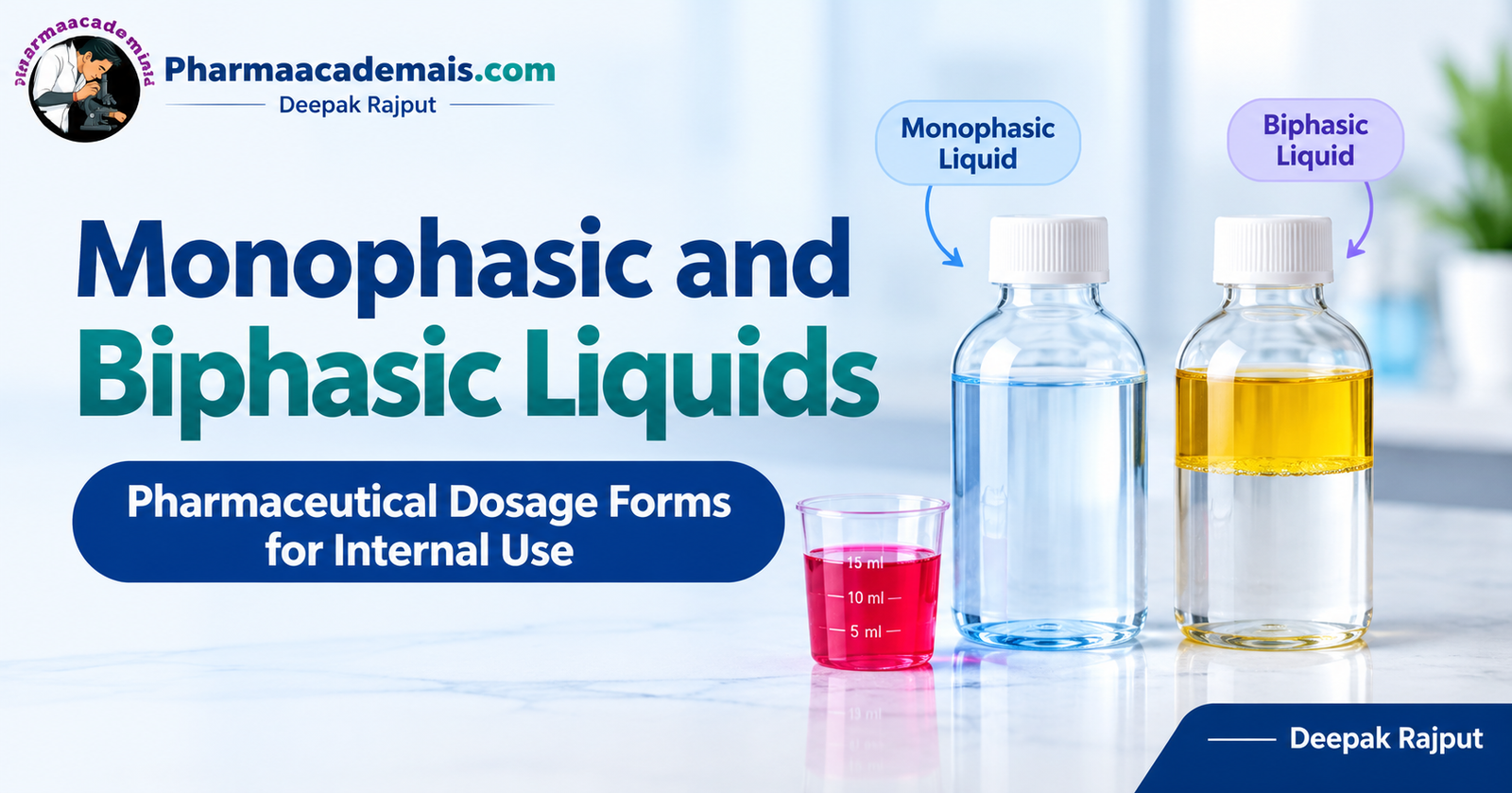
An emulsion is a biphasic liquid dosage form in which one immiscible liquid is dispersed as fine droplets throughout another liquid with the help of an emulsifying agent.
The liquid present as droplets is called the dispersed phase or internal phase, while the surrounding liquid is called the continuous phase or external phase.
Emulsions are thermodynamically unstable systems that require suitable formulation and processing to achieve acceptable physical stability.
Examples:
- Liquid paraffin emulsion.
- Cod liver oil emulsion.
- Oral oil-in-water emulsions.
- Oil-in-water creams and lotions.
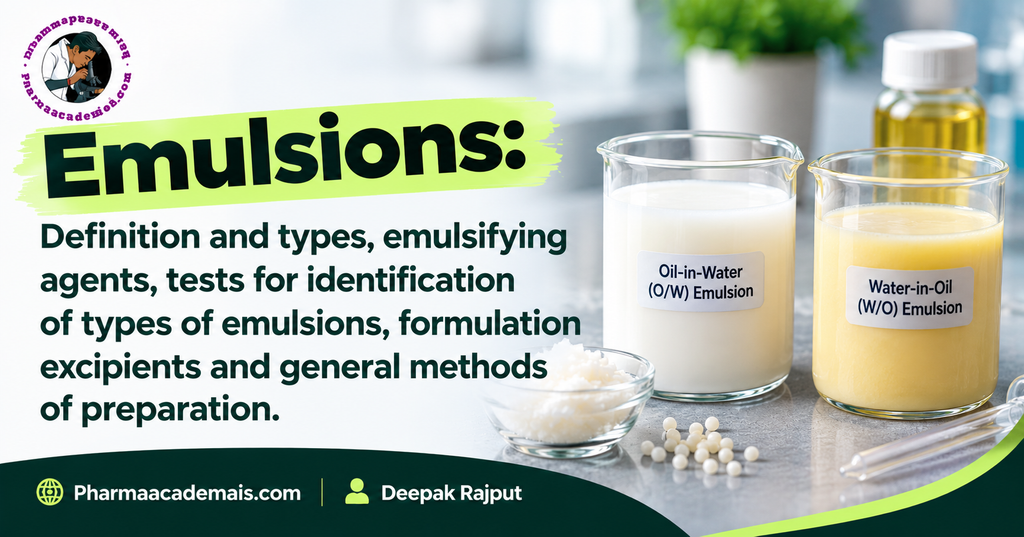
2. Types of Emulsions
Emulsions are mainly classified into two types according to the nature of their dispersed and continuous phases.
A. Oil-in-Water (O/W) Emulsion
Definition: An emulsion in which oil droplets are dispersed throughout a continuous aqueous phase.
Characteristics:
- Water is the external phase.
- Generally, it can be diluted with water.
- Usually less greasy and easier to wash off.
- Suitable for many oral emulsions and topical preparations.
Examples: Milk, liquid paraffin emulsion, and many moisturizing lotions.
B. Water-in-Oil (W/O) Emulsion
Definition: An emulsion in which water droplets are dispersed throughout a continuous oil phase.
Characteristics:
- Oil is the external phase.
- Generally, it can be diluted with oil.
- Usually more greasy and water-resistant.
- Can help reduce water loss from the skin.
Examples: Butter and certain cold creams.
Multiple Emulsions
Multiple emulsions contain droplets within droplets and have more complex structures.
- W/O/W: Water droplets are dispersed in oil droplets, which are themselves dispersed in water.
- O/W/O: Oil droplets are dispersed in water droplets, which are themselves dispersed in oil.
These systems are used in specialized drug delivery and controlled-release formulations.
3. Emulsifying Agents
Emulsifying agents are substances that help form and stabilize an emulsion by reducing interfacial tension between immiscible liquids and/or forming a protective film around dispersed droplets.
They help prevent or reduce droplet coalescence and improve the physical stability of the formulation.
Types of Emulsifying Agents
| Type | Examples | Main function |
| Natural agents | Acacia, tragacanth, gelatin | Form protective films around droplets |
| Synthetic surfactants | Polysorbate 80, sorbitan monooleate | Reduce interfacial tension |
| Finely divided solids | Bentonite, colloidal silica | Stabilize droplets through particle adsorption |
| Fatty alcohols and related materials | Cetostearyl alcohol | Support emulsion structure and consistency |
| Protective colloids | Certain cellulose derivatives | Improve stability and viscosity |
| Phospholipids | Lecithin | Stabilize suitable emulsion systems |
Classification by Ionic Nature
1. Anionic emulsifying agents: Carry a negative charge in solution.
Examples: Sodium lauryl sulfate and certain soaps.
2. Cationic emulsifying agents: Carry a positive charge in solution.
Examples: Cetrimide and certain quaternary ammonium compounds.
3. Nonionic emulsifying agents: Generally do not carry an ionic charge.
Examples: Polysorbates and sorbitan esters.
4. Amphoteric emulsifying agents: Can exhibit positive or negative charge depending on the pH and chemical environment.
Examples: Certain phospholipids and amphoteric surfactants.
Selection of an Emulsifying Agent
The selection depends on:
- The required emulsion type (O/W or W/O).
- The properties of the oil and aqueous phases.
- Compatibility with the drug and other excipients.
- Required viscosity and physical stability.
- Intended route of administration.
- Safety and tolerability requirements.
The hydrophilic–lipophilic balance (HLB) system can help select suitable surfactants. Higher-HLB surfactants generally favour O/W emulsions, while lower-HLB surfactants generally favour W/O emulsions.
4. Tests for Identification of Emulsion Types
The following tests are used to identify whether an emulsion is oil-in-water or water-in-oil.
4.1 Dilution Test
Principle: An emulsion can generally be diluted with its continuous phase without breaking the emulsion.
Procedure:
- Take a small quantity of the emulsion in a clean container.
- Add a small quantity of water and mix gently.
- Observe whether the emulsion remains uniform.
- In a separate sample, add a suitable oil and observe the behaviour.
Interpretation:
- An O/W emulsion can generally be diluted with water.
- A W/O emulsion can generally be diluted with oil.
4.2 Dye Solubility Test
Principle: A dye preferentially soluble in one phase colours that phase.
Procedure:
- Place a small quantity of the emulsion on a glass slide or in a suitable container.
- Add a small quantity of a water-soluble dye, such as methylene blue.
- Mix gently and observe the distribution of colour.
- Alternatively, use a suitable oil-soluble dye on a separate sample.
Interpretation:
- O/W emulsion: A water-soluble dye tends to colour the continuous phase uniformly.
- W/O emulsion: A water-soluble dye tends to colour the dispersed water droplets rather than the continuous oil phase.
4.3 Electrical Conductivity Test
Principle: Water conducts electricity much more readily than oil under ordinary test conditions.
Procedure:
- Place the emulsion in a suitable container.
- Insert appropriate conductivity electrodes.
- Measure the electrical conductivity.
- Compare the result with suitable controls or reference formulations.
Interpretation:
- O/W emulsion: Generally shows appreciable electrical conductivity because water is the continuous phase.
- W/O emulsion: Generally shows low conductivity because oil is the continuous phase.
The presence of electrolytes and the nature of the formulation can affect the result.
4.4 Filter Paper or Wetting Test
Principle: The continuous phase determines how an emulsion interacts with a suitable surface.
Procedure:
- Place a small drop of emulsion on clean filter paper.
- Observe its spreading and wetting behaviour.
- Compare the result with known O/W and W/O controls.
Interpretation:
- O/W emulsions generally spread and wet hydrophilic paper more readily.
- W/O emulsions generally spread less readily on hydrophilic paper and may leave an oily mark.
This is a supportive test rather than a definitive identification method.
4.5 Fluorescence Test
Principle: Some oils fluoresce under ultraviolet light, whereas water does not show the same behaviour.
Procedure:
- Place a small amount of emulsion on a suitable slide.
- Examine it under an appropriate fluorescence microscope or ultraviolet observation system.
- Observe whether fluorescence appears continuously or as separate regions.
Interpretation:
- W/O emulsion: A fluorescent oil phase may appear continuous.
- O/W emulsion: Fluorescence may appear as separate oil droplets in a non-fluorescent aqueous phase.
This test is most useful when the oil phase has suitable fluorescence properties.
Summary of Identification Tests
| Test | O/W emulsion | W/O emulsion |
| Dilution test | Diluted with water | Diluted with oil |
| Water-soluble dye | Colours the continuous phase | Colours dispersed water droplets |
| Electrical conductivity | Generally higher | Generally lower |
| Filter paper test | Usually wets paper more readily | Usually leaves a more oily mark |
| Fluorescence test | Oil droplets may fluoresce separately | Oil phase may fluoresce continuously |
5. Formulation Excipients Used in Emulsions
Excipients are added to emulsions to support stability, improve appearance, adjust consistency, and enhance patient acceptability.
| Excipient | Function | Examples |
| Oil phase | Forms the oil component | Liquid paraffin, mineral oil, suitable vegetable oils |
| Aqueous vehicle | Forms the water component | Purified water |
| Emulsifying agents | Stabilize the oil–water interface | Acacia, polysorbates, lecithin |
| Thickening agents | Increase viscosity and slow creaming | Xanthan gum, cellulose derivatives |
| Preservatives | Control microbial growth when required | Sodium benzoate, suitable parabens |
| Antioxidants | Reduce oxidation of susceptible oils | Tocopherol, suitable antioxidants |
| Buffers | Maintain the desired pH | Citrate or phosphate buffer systems |
| Sweeteners | Improve the taste of oral emulsions | Sucrose, sorbitol |
| Flavouring agents | Improve palatability | Orange or peppermint flavour |
| Humectants | Retain moisture in topical products | Glycerol, propylene glycol |
| Chelating agents | Bind certain metal ions that can promote degradation | Disodium edetate |
Not every emulsion requires all these excipients. Their selection depends on the drug, route, oil phase, desired emulsion type, and stability requirements.
6. General Methods of Preparation of Emulsions
Three classical methods commonly described in pharmaceutics are the dry gum method, wet gum method, and bottle method. Industrial preparation may additionally use high-shear mixing or homogenization.
6.1 Dry Gum Method (Continental Method)
Principle: The emulsifying agent, usually acacia in the classical method, is first mixed with the oil before the water is added.
For the traditional primary emulsion using fixed oils with acacia, a commonly taught oil:water:gum ratio is 4:2:1. The ratio is not universal for all oils or emulsifying agents.
Procedure:
- Place the required quantity of acacia in a dry mortar.
- Add the measured oil and triturate until the gum is uniformly wetted.
- Add the required quantity of water rapidly.
- Triturate vigorously until a primary emulsion forms.
- Add other ingredients that are compatible with the emulsion.
- Add the remaining vehicle gradually to the required final volume.
- Mix thoroughly and transfer into a suitable container.
Advantages:
- Relatively quick to perform.
- Suitable for many fixed oils when the classical formula applies.
Example: Preparation of a primary emulsion using acacia.
6.2 Wet Gum Method (English Method)
Principle: The emulsifying agent is first mixed with water to form mucilage, after which the oil is added gradually.
Procedure:
- Place the required quantity of acacia in a mortar.
- Add the prescribed water and triturate to form a uniform mucilage.
- Add the oil gradually in small portions while triturating continuously.
- Continue mixing until a primary emulsion forms.
- Add other compatible ingredients as required.
- Add the remaining vehicle to the required final volume.
- Mix thoroughly and package appropriately.
Advantages:
- Allows controlled incorporation of oil into the aqueous gum phase.
- Can be useful when formation of a uniform mucilage is important.
6.3 Bottle Method (Forbes Method)
Principle: The oil and emulsifying agent are shaken together in a bottle, followed by the gradual addition of water. This method is particularly suitable for certain volatile or low-viscosity oils.
Procedure:
- Place the appropriate quantity of a suitable emulsifying agent in a dry bottle.
- Add the oil and shake to distribute the agent.
- Add a small quantity of water and shake vigorously.
- Add the remaining water in portions, shaking after each addition.
- Add other compatible ingredients as required.
- Adjust to the final volume and label appropriately.
Limitations:
- Less suitable for highly viscous oils.
- Requires adequate shaking and appropriate selection of the emulsifying agent.
6.4 Mechanical Mixing and Homogenization
This method is widely used in industrial manufacturing.
Procedure:
- Prepare the oil phase and aqueous phase separately.
- Dissolve or disperse the appropriate excipients in their respective phases.
- Bring the phases to suitable temperatures when the formulation requires heating.
- Combine the phases gradually under controlled agitation.
- Use high-shear mixing or homogenization to reduce droplet size.
- Cool the preparation under controlled conditions, if applicable.
- Add heat-sensitive ingredients at a suitable stage.
- Adjust the final quantity and evaluate physical stability.
- Fill into suitable containers.
Advantages:
- Suitable for large-scale production.
- Provides better control over droplet size and batch uniformity.
- Can improve physical stability when the formulation and process are appropriately designed.
7. Instability of Emulsions
Emulsions may undergo several physical changes during storage.
- Creaming: Dispersed droplets move upward or downward under gravity, forming a concentrated layer. It is often reversible by shaking.
- Flocculation: Droplets form loose aggregates without necessarily merging.
- Coalescence: Droplets merge to form larger droplets.
- Cracking or breaking: The emulsion separates into distinct bulk oil and water layers and generally cannot be restored by simple shaking.
- Phase inversion: An O/W emulsion changes to W/O, or vice versa, under certain formulation or processing conditions.
Methods to Improve Stability
- Select an appropriate emulsifying agent and concentration.
- Reduce droplet size using a suitable process.
- Adjust the viscosity of the continuous phase.
- Avoid incompatible ingredients.
- Control temperature and storage conditions.
- Use suitable antioxidants or preservatives when required.
- Select appropriate packaging.
8. Evaluation Tests for Emulsions
In addition to identifying the emulsion type, quality evaluation may include:
- Appearance: Colour, odour, homogeneity, and visible separation.
- Globule size: Measurement of dispersed droplet size.
- Viscosity: Assessment of flow and consistency.
- pH: Measurement where relevant to drug stability and tolerability.
- Creaming index: Assessment of the extent of creaming.
- Phase separation: Observation of physical instability.
- Drug content: Assay of the active ingredient when present.
- Microbial quality: Testing appropriate to the intended route and product.
Conclusion
Emulsions are biphasic liquid dosage forms consisting of two immiscible liquids, one dispersed as droplets in the other. The two main types are oil-in-water and water-in-oil emulsions. Emulsifying agents such as acacia, polysorbates, and lecithin help stabilize the dispersed droplets.
The dilution, dye solubility, electrical conductivity, filter paper, and fluorescence tests can help identify the emulsion type. Common preparation methods include the dry gum method, wet gum method, bottle method, and mechanical homogenization. Appropriate excipient selection and control of droplet size, viscosity, and storage conditions are important for maintaining emulsion quality.
References
- Aulton, M. E., and Taylor, K. M. G. Aulton’s Pharmaceutics: The Design and Manufacture of Medicines. Elsevier.
- Allen, L. V. Ansel’s Pharmaceutical Dosage Forms and Drug Delivery Systems. Wolters Kluwer.
- Remington: The Science and Practice of Pharmacy. Pharmaceutical Press.
- Indian Pharmacopoeia. Indian Pharmacopoeia Commission.
Editorial Note
This article has been carefully researched and written by Deepak Rajput with a focus on accuracy, clarity, and evidence-based healthcare information. Pharmaacademias.com