Monophasic and Biphasic Liquids: Liquid dosage forms are pharmaceutical preparations in which the active pharmaceutical ingredient (API) is dissolved, suspended, or dispersed in a suitable liquid vehicle. They are commonly used for oral administration because they are easy to swallow, convenient for children and elderly patients, and allow flexible dose adjustment.
Liquid dosage forms are classified into two main types:
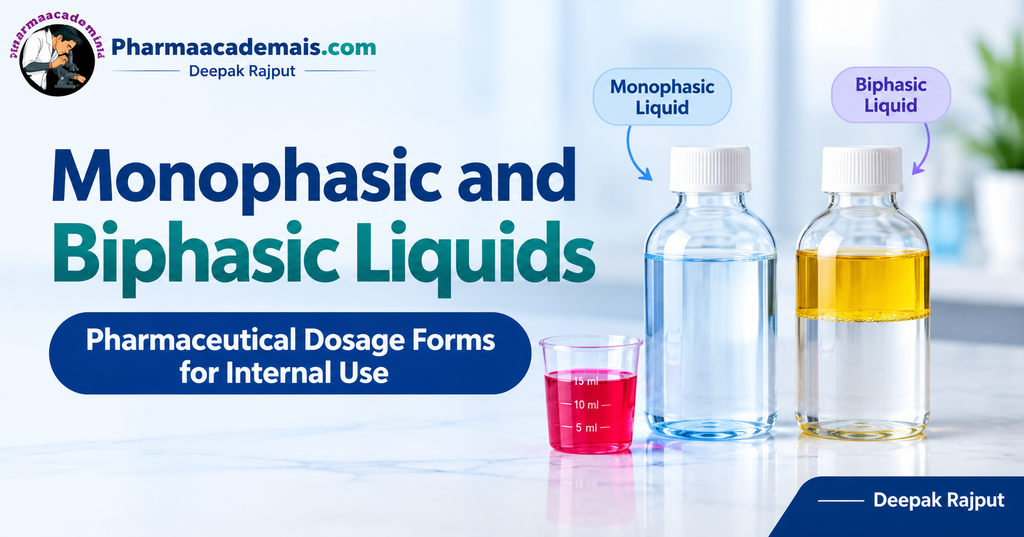
- Monophasic liquid dosage forms: These contain only one homogeneous phase.
- Biphasic liquid dosage forms: These contain two distinct phases, such as a solid dispersed in a liquid or one liquid dispersed in another liquid.
2. Monophasic Liquid Dosage Forms
Monophasic liquid dosage forms are homogeneous liquid preparations in which the drug and other ingredients are completely dissolved in a suitable solvent or mixture of solvents, forming a single phase.
Examples: Aromatic waters, syrups, elixirs, linctuses, and oral solutions.
Characteristics
- They contain a single, uniform phase.
- The dissolved drug is distributed uniformly throughout the preparation.
- They generally do not require shaking before use.
- They may provide rapid drug availability because the drug is already dissolved.
- They must be formulated to maintain chemical and physical stability.
The following monophasic liquid preparations are commonly used for internal administration.
3. Aromatic Waters
Aromatic waters are clear, saturated aqueous solutions of volatile oils or other aromatic substances. They possess a pleasant odour and taste and are used mainly as flavouring agents, vehicles, or mild therapeutic preparations.
Examples: Peppermint water, rose water, and orange-flower water.
Uses
- To improve the taste and odour of pharmaceutical preparations.
- To act as vehicles for oral liquid medicines.
- To provide mild carminative effects in certain formulations.
- To improve patient acceptability.
Methods of Preparation
Aromatic waters can be prepared by the following methods.
1. Distillation method
This method is suitable for aromatic substances that can be distilled with water.
Procedure:
- Take the appropriate quantity of the aromatic plant material and water.
- Place the ingredients in a suitable distillation apparatus.
- Distil the mixture to obtain the aqueous distillate containing volatile aromatic constituents.
- Collect the distillate and allow it to cool.
- Filter if necessary to obtain a clear preparation.
- Transfer it into a suitable, well-closed container.
2. Solution method
This method is suitable when the aromatic substance can be dissolved or dispersed in water with appropriate processing.
Procedure:
- Take the required quantity of a suitable volatile oil or aromatic substance.
- Mix it with a suitable dispersing agent, if required.
- Add purified water gradually with continuous mixing.
- Allow the mixture to equilibrate as appropriate.
- Filter to remove undissolved material and obtain a clear preparation.
- Make up to the required final volume and store in a well-closed container.
3. Simple dilution method
- Take a concentrated aromatic water.
- Dilute it with purified water in the required proportion.
- Mix thoroughly.
- Filter if necessary and store in a suitable container.
Precautions
- Use freshly prepared or appropriately preserved aromatic water.
- Protect the preparation from excessive heat and light.
- Store in a well-closed container to minimize the loss of volatile constituents.
- Avoid contamination during preparation and storage.
4. Syrups
Syrups are concentrated, viscous aqueous preparations containing sugar, usually sucrose, or a suitable sugar substitute, with or without medicinal substances, flavouring agents, and preservatives.
A conventional sucrose syrup contains a high concentration of sucrose, commonly about 66.7% w/w, although the exact concentration depends on the formulation.
Examples: Simple syrup, paracetamol syrup, and cough syrup.
Types of Syrups
- Simple syrup: Contains sucrose and purified water without an active medicinal ingredient.
- Medicated syrup: Contains one or more active pharmaceutical ingredients.
- Flavoured syrup: Contains flavouring agents and is mainly used to improve the taste of medicines.
Uses
- To mask the unpleasant taste of drugs.
- To provide a palatable oral dosage form.
- To administer medicines to children and patients who have difficulty swallowing tablets.
- To serve as a vehicle for oral medicinal preparations.
Methods of Preparation
1. Solution with heat
This method is suitable for ingredients that are stable at the temperature used.
Procedure:
- Take the required quantity of purified water in a suitable vessel.
- Add the calculated quantity of sucrose.
- Heat gently with stirring until the sucrose dissolves.
- Avoid excessive heating to prevent caramelization or decomposition.
- Allow the solution to cool.
- Add heat-sensitive ingredients, flavours, or preservatives as appropriate.
- Add purified water to make up the required final quantity.
- Mix well and transfer into a suitable, well-closed container.
2. Agitation without heat
This method is suitable for heat-sensitive ingredients or when heating is unnecessary.
Procedure:
- Take purified water in a suitable vessel.
- Add sucrose gradually with continuous stirring.
- Continue stirring until the sugar dissolves completely.
- Add any required medicinal ingredients, flavouring agents, or preservatives.
- Make up to the required final volume or mass.
- Mix thoroughly and package appropriately.
3. Addition of medicated liquid
This method is used when a medicinal liquid is incorporated into a syrup base.
Procedure:
- Prepare the syrup base separately.
- Prepare the medicinal solution or liquid concentrate.
- Mix the medicinal liquid with the syrup base gradually.
- Stir until uniform.
- Adjust the final quantity and verify the preparation’s quality.
- Transfer into a suitable container.
Precautions
- Avoid excessive heating.
- Ensure complete dissolution of sucrose.
- Use suitable preservation when required by the formulation.
- Prevent microbial contamination.
- Store according to the formulation’s stability requirements.
5. Elixirs
Elixirs are clear, sweetened, flavoured hydroalcoholic liquid preparations intended for oral administration. They contain water and alcohol as solvents and may contain medicinal substances, sweeteners, and flavouring agents.
Alcohol helps dissolve certain drugs and flavouring substances that have limited solubility in water.
Examples: Diphenhydramine elixir and certain vitamin elixir formulations.
Characteristics
- They are clear and generally less viscous than syrups.
- They contain both water and alcohol.
- They are usually sweetened and flavoured.
- They can dissolve ingredients with different solubility characteristics.
- Their alcohol content must be appropriate for the intended patient population.
Uses
- To administer drugs that are poorly soluble in water but soluble in alcohol-water mixtures.
- To improve the taste of oral medicines.
- To provide a convenient oral liquid dosage form.
- To maintain the solubility of suitable medicinal and flavouring ingredients.
Method of Preparation
Elixirs are commonly prepared by the simple solution method.
Procedure:
- Weigh or measure all ingredients accurately.
- Dissolve alcohol-soluble ingredients in the alcoholic portion.
- Dissolve water-soluble ingredients separately in purified water.
- Add the aqueous solution gradually to the alcoholic solution, or combine the solutions in the order specified by the formulation.
- Mix thoroughly to obtain a clear preparation.
- Add sweeteners, flavours, and other excipients as required.
- Allow the preparation to stand if necessary to permit clarification.
- Filter if required.
- Make up to the final volume with the specified vehicle.
- Package in a suitable, well-closed container.
Precautions
- Use the specified alcohol concentration.
- Add the aqueous and alcoholic portions carefully to reduce precipitation.
- Avoid excessive evaporation of alcohol.
- Check the clarity and stability of the final preparation.
- Consider alcohol-related safety concerns in children and other vulnerable patients.
6. Linctuses
Linctuses are thick, viscous oral liquid preparations intended primarily to relieve cough and soothe irritated mucous membranes of the throat. They commonly contain soothing agents, sweeteners, and sometimes cough-suppressant or other medicinal ingredients.
Examples: Simple linctus and medicated cough linctuses.
Characteristics
- They have a high viscosity.
- They are usually sweet and palatable.
- They are intended to be swallowed slowly in small quantities.
- They help provide a soothing effect on the throat.
- Their composition depends on the intended therapeutic action.
Uses
- To relieve cough symptoms.
- To soothe irritation of the throat.
- To provide a prolonged local soothing effect.
- To improve the acceptability of medicines with unpleasant tastes.
Method of Preparation
Procedure:
- Accurately weigh or measure the required ingredients.
- Dissolve water-soluble medicinal ingredients in a suitable quantity of purified water or another specified vehicle.
- Prepare the viscous base using suitable sweetening or thickening agents, such as syrup or glycerol, according to the formula.
- Add the medicinal solution gradually to the base with continuous mixing.
- Add flavouring agents and other excipients, if required.
- Mix thoroughly until a uniform, viscous preparation is obtained.
- Adjust the final quantity and check the preparation for uniformity and stability.
- Transfer into a suitable, well-closed container.
Precautions
- Maintain the required viscosity and uniformity.
- Ensure that the active ingredients are adequately dissolved or uniformly distributed.
- Use suitable preservation when necessary.
- Follow the recommended dose and storage instructions.
- Administer slowly according to the product directions.
7. Biphasic Liquid Dosage Forms
Biphasic liquid dosage forms are pharmaceutical preparations that contain two distinct phases. One phase is dispersed throughout the other phase.
The dispersed phase may be a solid or a liquid, while the continuous phase is usually a liquid.
Types
1. Suspensions: Insoluble solid particles are dispersed in a liquid vehicle.
Examples: Antacid suspensions and certain antibiotic oral suspensions.
2. Emulsions: One immiscible liquid is dispersed as droplets in another liquid with the help of an emulsifying agent.
Examples: Oral oil-in-water emulsions and certain medicinal oil emulsions.
Characteristics
- They contain two distinct phases.
- The dispersed phase is not completely dissolved in the continuous phase.
- Suspensions may settle during storage.
- Emulsions may separate into layers if they are physically unstable.
- They often require shaking before administration.
General Method of Preparation
For suspensions
- Reduce the particle size of the insoluble drug when necessary.
- Wet the particles with a suitable wetting agent or vehicle.
- Prepare the liquid vehicle containing suitable suspending agents and other excipients.
- Add the drug gradually with continuous mixing.
- Homogenize or mix thoroughly to ensure uniform dispersion.
- Make up to the required final volume and package appropriately.
For emulsions
- Select the oil phase, aqueous phase, and suitable emulsifying agent.
- Prepare the phases separately as required.
- Incorporate the emulsifying agent using an appropriate emulsification method.
- Add one phase to the other gradually with continuous mixing.
- Homogenize if required to obtain the desired droplet size.
- Add other ingredients and adjust the final quantity.
- Package in a suitable container and evaluate physical stability.
8. Difference Between Monophasic and Biphasic Liquids
| Feature | Monophasic liquids | Biphasic liquids |
| Number of phases | One | Two |
| Nature | Homogeneous | Heterogeneous |
| Drug state | Usually dissolved | Dispersed as solid particles or liquid droplets |
| Uniformity | Uniform throughout | May require mixing before dosing |
| Shaking | Generally not required | Often required |
| Examples | Aromatic waters, syrups, elixirs, linctuses | Suspensions and emulsions |
| Physical stability concern | Precipitation or changes in solubility | Sedimentation, creaming, or phase separation |
Summary
Monophasic liquids are homogeneous preparations in which ingredients are generally dissolved in a suitable vehicle. Aromatic waters are aqueous preparations containing volatile aromatic constituents; syrups are concentrated sweetened aqueous preparations; elixirs are sweetened hydroalcoholic preparations; and linctuses are viscous oral preparations used mainly for cough relief.
Biphasic liquids contain two distinct phases and include suspensions and emulsions. Proper formulation, preparation, packaging, and storage are essential to maintain their quality, stability, and therapeutic effectiveness.
Suggested References
- Aulton, M. E., and Taylor, K. M. G. Aulton’s Pharmaceutics: The Design and Manufacture of Medicines. Elsevier.
- Allen, L. V. Ansel’s Pharmaceutical Dosage Forms and Drug Delivery Systems. Wolters Kluwer.
- Indian Pharmacopoeia. Indian Pharmacopoeia Commission.
- British Pharmacopoeia. British Pharmacopoeia Commission.
- Remington: The Science and Practice of Pharmacy. Pharmaceutical Press.
Editorial Note
This article has been carefully researched and written by Deepak Rajput with a focus on accuracy, clarity, and evidence-based healthcare information. Pharmaacademias.com