Lipids as Primary Plant Metabolites: Lipids are an important group of primary metabolites present in plants. They are organic compounds that are generally insoluble or poorly soluble in water but soluble in non-polar organic solvents such as ether, chloroform, benzene, and some alcohols.
Lipids are essential for the normal growth and development of plants. They serve as energy reserves, structural components of cell membranes, protective substances, and precursors for several biologically important compounds.
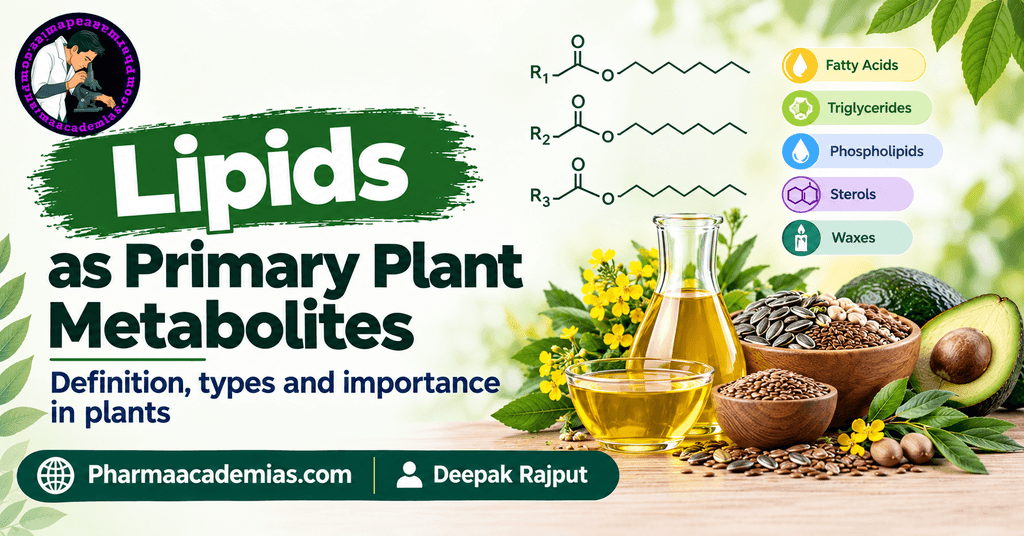
Plant lipids are particularly abundant in seeds, fruits, and other storage tissues. Many medicinal and edible plants contain fixed oils and fats that are important in pharmacy, nutrition, and pharmaceutical formulations.
Examples include castor oil, olive oil, sesame oil, coconut oil, linseed oil, and sunflower oil.
2. Definition of Lipids
Lipids are a heterogeneous group of naturally occurring organic compounds that are generally insoluble in water but soluble in non-polar organic solvents.
They mainly contain:
- Carbon (C)
- Hydrogen (H)
- Oxygen (O)
Some complex lipids may also contain:
- Nitrogen (N)
- Phosphorus (P)
- Sulphur (S)
Lipids include fats, oils, waxes, phospholipids, glycolipids, sterols, and related compounds.
3. Why are Lipids Called Primary Metabolites?
Lipids are classified as primary plant metabolites because they are directly involved in essential physiological processes necessary for plant survival, growth, and reproduction.
They perform several important functions:
Energy storage: Lipids contain a large amount of chemical energy and are important storage materials, especially in seeds.
Structural function: Phospholipids and glycolipids are essential components of cellmembranes.
Protection: Waxes and cuticular lipids form protective layers on plant surfaces and reduce water loss.
Metabolic function: Lipids participate in various biochemical pathways and provide precursors for the synthesis of several other compounds.
Growth and development: Certain lipid-derived molecules are involved in plant growth, signalling, and regulation.
4. Chemical Composition of Lipids
Many common plant lipids are composed of fatty acids and alcohols, particularly glycerol. A common type of plant lipid is a triglyceride or triacylglycerol.
It is formed by the combination of:
Glycerol + 3 Fatty acids → Triglyceride + Water
The fatty acids may be:
- Saturated
- Unsaturated
- Polyunsaturated
The type and arrangement of fatty acids determine many properties of the lipid.
5. Fatty Acids
Fatty acids are important building blocks of many plant lipids. They contain a long hydrocarbon chain with a terminal carboxylic acid (-COOH) group.
A. Saturated fatty acids: They contain no carbon-carbon double bonds.
Examples:
- Palmitic acid
- Stearic acid
B. Unsaturated fatty acids: They contain one or more carbon-carbon double bonds.
Examples:
- Oleic acid
- Linoleic acid
- Linolenic acid
Plant oils are generally rich in unsaturated fatty acids.
6. Classification of Plant Lipids
Plant lipids can broadly be classified into:
1. Simple lipids
2. Compound/complex lipids
3. Derived lipids
A. Simple Lipids
Simple lipids are esters of fatty acids with alcohols.
Fats and oils: They are mainly esters of glycerol and fatty acids.
The main difference between fats and oils is their physical state at room temperature.
- Fats → generally solid
- Oils → generally liquid
Examples of plant oils
- Castor oil
- Olive oil
- Sesame oil
- Coconut oil
- Sunflower oil
- Groundnut oil
- Linseed oil
These are important in pharmacy and pharmaceutical formulations.
B. Waxes
Waxes are esters of long-chain fatty acids and long-chain alcohols. They are generally solid and water-repellent.
Examples include waxes found on:
- Leaves
- Fruits
- Stems
The waxy layer helps reduce water loss and environmental damage.
C. Compound or Complex Lipids
These lipids contain fatty acids and alcohols along with additional groups.
Phospholipids: Phospholipids contain a phosphate group and are major components of biological membranes.They help form the phospholipid bilayer of cell membranes.
Glycolipids: Glycolipids contain a carbohydrate component along with lipid components.They are important components of plant membranes, particularly photosynthetic membranes.
7. Derived Lipids
Derived lipids are substances obtained from the hydrolysis or metabolism of simple and complex lipids.
Examples include:
- Fatty acids
- Sterols
- Steroids
- Glycerol
Some lipid-derived compounds have important roles in plant growth, signalling, and metabolism.
8. Major Functions of Lipids in Plants
8.1 Energy Storage: Lipids are an important source of stored energy.They provide more energy per gram than carbohydrates or proteins.This makes them particularly useful as reserve food materials.
Seeds of plants such as:
- Groundnut
- Sesame
- Sunflower
- Soybean
- Castor
contain considerable amounts of fixed oils.
During seed germination, stored lipids can be broken down and used to provide energy and carbon for the developing plant.
8.2 Structural Components of Cell Membranes: Lipids are essential components of plant cell membranes.Phospholipids and glycolipids form the basic structure of biological membranes.
The membrane:
- Separates the cell from its surroundings
- Controls movement of substances
- Provides an environment for membrane proteins
- Maintains cellular organization
8.3 Protection Against Water Loss: Plant surfaces are covered by a protective layer called the cuticle, which contains waxes and other lipid-related substances.
This layer helps:
- Reduce water loss
- Protect against environmental conditions
- Prevent excessive wetting
- Provide a barrier against certain pathogens
8.4 Role in Photosynthesis: Lipids are important components of chloroplast membranes.Certain glycolipids and other membrane lipids are essential for maintaining the structure of photosynthetic membranes where the light reactions of photosynthesis occur.
8.5 Role in Plant Growth and Development: Some lipid-derived molecules act as signalling molecules and participate in the regulation of:
- Growth
- Development
- Stress responses
- Defence mechanisms
Lipids therefore have functions beyond simply serving as energy reserves.
8.6 Source of Essential Fatty Acids: Plant oils can provide important unsaturated fatty acids, including:
- Linoleic acid
- α-Linolenic acid
These fatty acids are nutritionally important and serve as precursors for various biological molecules.
9. Distribution of Lipids in Plants
Lipids are present in different parts of plants, but their concentration varies.
| Plant part | Important lipid forms |
| Seeds | Fixed oils, fats |
| Fruits | Fixed oils |
| Leaves | Membrane lipids, waxes |
| Flowers | Oils and waxes |
| Roots | Storage lipids in some plants |
| Plant surface | Waxes and cuticular lipids |
| Chloroplasts | Glycolipids and phospholipids |
Seeds are particularly important commercial sources of plant oils.
10. Examples of Important Plant Lipids
Castor oil: Obtained from the seeds of Ricinus communis.It contains a high proportion of ricinoleic acid.
Pharmaceutical importance: Used as a pharmaceutical and industrial oil and historically as a stimulant laxative.
Olive oil: Obtained from the fruits of Olea europaea.It is rich in oleic acid.
Sesame oil: Obtained from the seeds of Sesamum indicum.It is used as a pharmaceutical and edible oil.
Coconut oil: Obtained from the kernel of Cocos nucifera.
It contains a relatively high proportion of saturated fatty acids.
Linseed oil: Obtained from the seeds of Linum usitatissimum.
It is rich in α-linolenic acid.
11. Important Properties of Plant Lipids
1. Solubility
Most lipids are:
- Insoluble or poorly soluble in water
- Soluble in organic solvents
2. Energy-rich: Lipids provide approximately 9 kcal of energy per gram, making them concentrated energy reserves.
3. Physical state
Their physical state depends on the fatty acid composition.
- More saturated lipids → generally higher melting point
- More unsaturated lipids → generally lower melting point
Therefore, many plant oils remain liquid at room temperature.
4. Oxidation: Unsaturated oils are susceptible to oxidation, particularly when exposed to:
- Oxygen
- Heat
- Light
Oxidation may lead to rancidity.
5. Hydrolysis: Triglycerides can undergo hydrolysis to form:
Glycerol + Fatty acids
Hydrolysis with alkali is known as saponification and produces soap and glycerol.
12. Pharmaceutical Importance of Plant Lipids
Plant lipids have numerous applications in pharmaceutical sciences.
As pharmaceutical ingredients
Plant oils may be used as:
- Vehicle
- Solvent
- Emollient
- Ointment base
- Carrier for active ingredients
As therapeutic agents: Some plant oils have direct medicinal applications.
As nutritional agents: Vegetable oils provide energy and essential fatty acids.
In formulations
Lipids are used in:
- Creams
- Ointments
- Emulsions
- Capsules
- Topical preparations
As sources of bioactive compounds: Some plant lipids provide fatty acids and other lipid-derived compounds that have biological importance.
13. Factors Affecting Lipid Content in Plants
The quantity and composition of plant lipids can be influenced by:
Genetic factors: Different plant species and varieties produce different types and amounts of oils.
Plant maturity: Lipid accumulation may increase during seed maturation.
Environmental conditions: Temperature, rainfall, light, and soil conditions can influence lipid composition.
Plant part: Seeds generally contain higher concentrations of storage lipids than many vegetative tissues.
Storage conditions: Heat, light, oxygen, and moisture can influence the stability of plant oils.
14. Carbohydrates vs Lipids as Primary Metabolites
| Carbohydrates | Lipids |
| Major immediate energy source | Concentrated energy reserve |
| Starch is a major storage form | Oils and fats are major storage forms |
| Cellulose provides structural support | Membrane lipids provide membrane structure |
| Generally more hydrophilic | Generally hydrophobic |
| Examples: glucose, sucrose, starch | Examples: oils, fats, phospholipids, waxes |
Conclusion
Lipids are essential primary metabolites of plants that play important roles in energy storage, membrane formation, protection, photosynthesis, growth, and cellular signalling. Plant lipids are particularly abundant in seeds and fruits in the form of fixed oils and fats. Because of their nutritional, therapeutic, and pharmaceutical applications, plant-derived lipids are important constituents studied in pharmacognosy and pharmaceutical sciences.
Editorial Note
This article has been carefully researched and written by Deepak Rajput with a focus on accuracy, clarity, and evidence-based healthcare information. Pharmaacademias.com