Coping Strategies Resilience and Stress Management Techniques: Life involves many situations that can create stress. Academic pressure, work responsibilities, financial problems, relationship difficulties, illness, loss, uncertainty, and major life changes can affect a person’s physical and psychological well-being. Stress is a normal part of life, but when it becomes excessive or continues for a long time, it can affect sleep, concentration, mood, relationships, and physical health. Pharmaacademias.com
People respond differently to stressful situations. Some people may become anxious or discouraged, while others may remain calm and try to solve the problem. These differences are partly related to coping strategies and resilience.
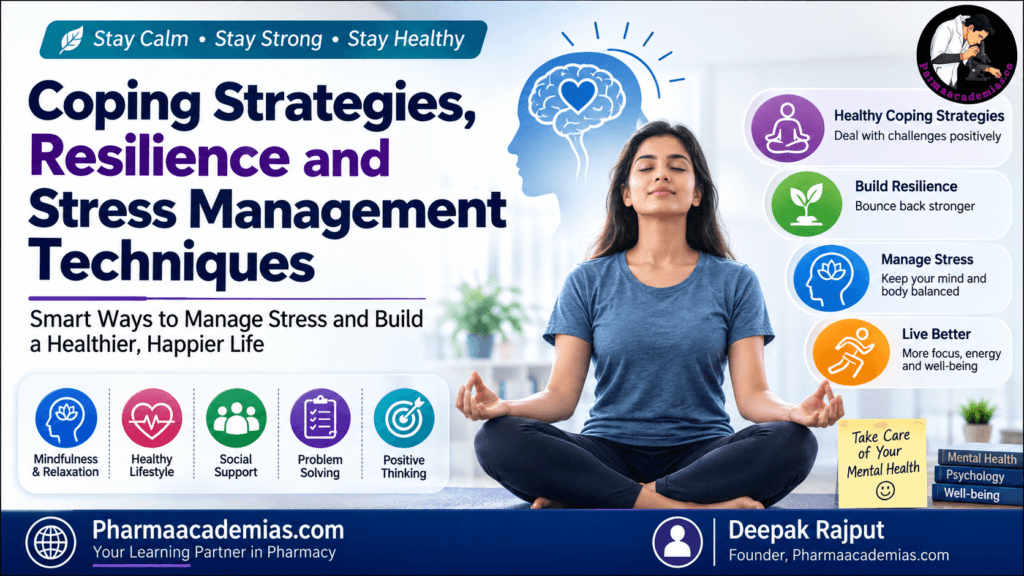
Coping strategies are the methods a person uses to deal with stressful or difficult situations. Resilience is the ability to adapt to difficulties, recover from setbacks, and continue functioning despite challenges. Stress management techniques are practical methods used to reduce unnecessary stress and improve the ability to handle stressful situations.
Together, coping, resilience, and stress management are important for maintaining good mental health and improving the ability to deal with illness and other challenges.
1. Meaning of Coping
Coping refers to the thoughts, behaviours, and actions that a person uses to manage stressful situations and emotional difficulties.
For example, when a student faces examination pressure, the student may create a study schedule, discuss difficulties with a teacher, take short breaks, and practice relaxation. These are coping behaviours.
Coping does not always mean removing the stressful situation. Sometimes the situation cannot be changed. In such cases, coping helps the person manage emotions and adjust to the situation.
For example, a person cannot change the fact that a family member has a serious illness, but the person can learn how to manage fear, seek support, communicate with healthcare professionals, and maintain healthy daily activities.
2. Types of Coping Strategies
Coping strategies can generally be divided into problem-focused coping and emotion-focused coping. In real life, people often use a combination of both.
Problem-Focused Coping
Problem-focused coping involves taking practical steps to deal with the source of stress.
For example, if a person is stressed because of poor academic performance, the person may:
- Identify weak subjects.
- Prepare a study timetable.
- Ask a teacher for help.
- Practice difficult topics.
- Reduce unnecessary distractions.
Similarly, if a patient is worried about managing a chronic illness, the person may learn about the disease, organize medicines, attend medical appointments, and follow the recommended lifestyle changes.
Problem-focused coping is especially useful when the stressful situation can be changed or managed through practical action.
Emotion-Focused Coping
Emotion-focused coping aims to manage the emotional response to stress rather than directly changing the stressful situation.
Examples include:
- Talking to a trusted person
- Relaxation exercises
- Meditation
- Deep breathing
- Prayer or spiritual practices, when meaningful to the person
- Listening to music
- Engaging in enjoyable activities
- Taking adequate rest
- Writing down thoughts and feelings
Emotion-focused coping can be particularly useful when a situation cannot be immediately changed.
For example, a patient waiting for an important medical report cannot control when the report will be available. However, the patient can manage anxiety through breathing exercises, supportive conversation, relaxation, and other healthy activities.
3. Healthy and Unhealthy Coping Strategies
Not every coping method is beneficial. Some behaviours may provide temporary relief but create additional problems later.
Healthy coping strategies include:
- Talking to supportive people
- Physical activity
- Proper sleep
- Relaxation techniques
- Planning and time management
- Seeking professional help
- Maintaining a balanced routine
- Problem-solving
- Positive and realistic thinking
Unhealthy coping strategies may include:
- Excessive alcohol or substance use
- Avoiding every difficult situation
- Social isolation
- Excessive sleeping
- Aggressive behaviour
- Constant worrying
- Overeating or severely restricting food
- Ignoring important responsibilities
- Refusing necessary medical care
Healthy coping does not mean that a person will never feel stressed. It means that the person has safer and more effective ways to deal with stress.
4. Meaning of Resilience
Resilience is the ability of a person to adapt to difficult circumstances, recover from setbacks, and continue functioning despite stress or adversity.
A resilient person is not someone who never feels sad, afraid, or worried. Resilient people also experience difficult emotions. The difference is that they are generally able to adapt, seek support, learn from experiences, and gradually move forward.
For example, a person who loses a job may initially feel disappointed and worried. A resilient response may involve accepting the situation, seeking support, learning new skills, searching for new opportunities, and gradually rebuilding confidence.
Resilience can develop over time. It is not simply a fixed personality characteristic.
5. Importance of Resilience in Healthcare
Resilience is especially important when dealing with illness. A diagnosis of a disease can create fear, uncertainty, and changes in daily life.
A resilient patient may be better able to:
- Accept the diagnosis realistically
- Learn about the illness
- Follow treatment
- Adjust to lifestyle changes
- Manage temporary setbacks
- Seek help when needed
- Maintain hope
- Continue daily activities as much as possible
For healthcare professionals, resilience is also important because healthcare work can involve long hours, emotional situations, difficult decisions, and repeated exposure to suffering.
6. Factors That Build Resilience
Resilience develops through a combination of personal, social, and environmental factors.
Positive Relationships: Supportive relationships with family, friends, teachers, colleagues, and healthcare professionals can provide emotional strength during difficult times.
A person who knows that someone is available to listen and help may feel better able to face stressful situations.
Self-Confidence: Confidence in one’s ability to handle difficulties helps build resilience. A person who believes, “I have handled difficult situations before, and I can take this one step at a time,” may be more willing to face challenges.
Realistic Thinking: Resilient people generally try to look at situations realistically. They recognize problems without automatically assuming the worst possible outcome.
For example, instead of thinking:
“Everything is going to fail.”
a person may think:
“This is difficult, but I can identify what I can control and take one step at a time.”
Flexibility: Life does not always follow our plans. Flexibility helps people adjust when circumstances change.
A person who can change plans, learn new methods, and accept uncertainty may handle stress more effectively.
Purpose and Goals
Having meaningful goals can provide motivation during difficult periods. Goals do not have to be very large. Small daily goals can also give a person a sense of progress.
7. Stress Management
Stress management refers to the methods used to prevent unnecessary stress, reduce excessive stress, and improve the ability to cope with stressful situations.
Stress management does not mean eliminating every source of stress. Some stress is unavoidable. The aim is to develop healthy ways of responding to stress.
Effective stress management generally involves a combination of physical, psychological, behavioural, and social approaches.
8. Deep Breathing and Relaxation
Deep breathing is a simple technique that can help a person become calmer during periods of stress.
A person can slowly breathe in, allow the abdomen to expand, and then breathe out slowly. Repeating this for several minutes can encourage relaxation.
Relaxation techniques can be useful during:
- Anxiety
- Examination stress
- Work pressure
- Medical procedures
- Emotional distress
- Sleep preparation
Regular practice is generally more useful than using relaxation techniques only during severe stress.
9. Progressive Muscle Relaxation
Progressive muscle relaxation involves deliberately tightening and then relaxing different muscle groups.
For example, a person may gently tighten the muscles of the hands for a few seconds and then relax them. The process can be repeated with other muscle groups.
This technique helps a person recognize physical tension and practice releasing it.
It may be particularly useful for people who experience stress-related muscle tension.
10. Physical Activity
Regular physical activity is an important part of stress management.
Walking, stretching, cycling, swimming, sports, or other suitable physical activities can help improve mood and reduce physical tension.
Physical activity can also support better sleep and overall physical health.
The activity should be appropriate for the person’s age, physical condition, and medical situation. Patients with medical conditions should follow appropriate professional advice regarding exercise.
Conclusion
Coping strategies, resilience, and stress management are important components of psychological well-being. Coping strategies help individuals deal with difficult situations, resilience helps them adapt and recover from adversity, and stress management techniques help reduce the harmful effects of excessive stress.
Healthy coping may include problem-solving, emotional expression, social support, physical activity, relaxation, mindfulness, time management, adequate sleep, and seeking professional help when necessary. Resilience can be strengthened through supportive relationships, realistic thinking, self-confidence, flexibility, meaningful goals, and learning from difficult experiences.
In healthcare, these concepts are particularly important because illness can create physical, emotional, social, and financial challenges. Helping patients develop healthy coping mechanisms and resilience can improve their ability to manage illness, follow treatment, maintain quality of life, and adapt to changes.
Ultimately, effective stress management does not mean living a life without stress. It means developing the knowledge, skills, support, and confidence needed to face stressful situations in a healthy and balanced way.
Editorial Note
This article has been carefully researched and written by Deepak Rajput with a focus on accuracy, clarity, and evidence-based healthcare information.