Structural and Functional Classification of Joints: Joints, also known as articulations, are the places where two or more bones meet. They are essential components of the skeletal system because they provide flexibility, stability, and movement to the body. Without joints, the skeleton would be a rigid framework, making body movements impossible. Joints not only connect bones but also allow different types of movements such as bending, straightening, rotation, gliding, and circular movements. In addition, they help absorb mechanical stress, maintain posture, and distribute body weight during movement. Pharmaacademias.com
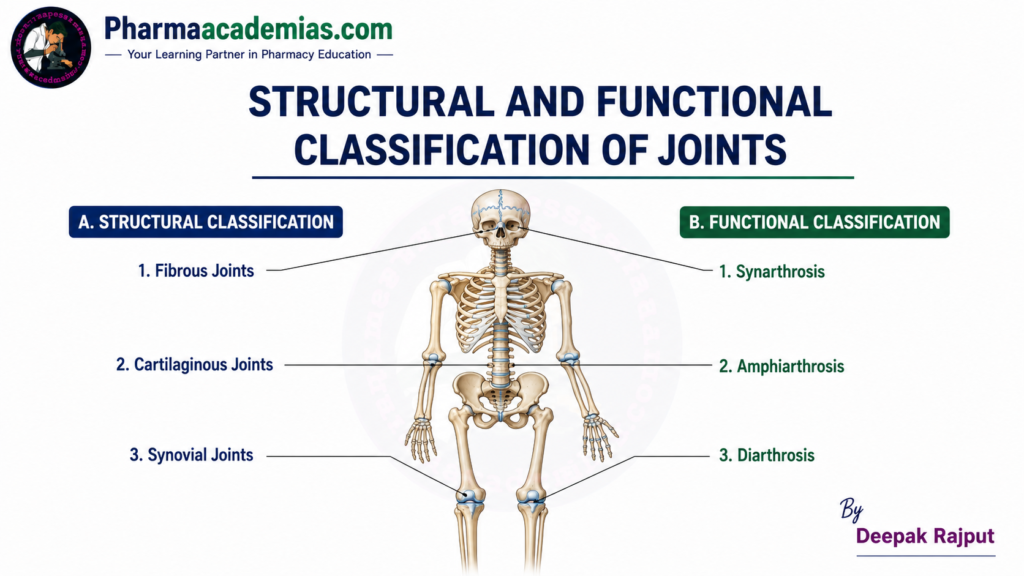
Joints are classified in two main ways:
- Structural Classification – Based on the type of connective tissue joining the bones and the presence or absence of a joint cavity.
- Functional Classification – Based on the amount of movement permitted by the joint.
Although these two classifications are different, they are closely related. For example, fibrous joints generally allow little or no movement, whereas synovial joints are freely movable.
Structural Classification of Joints
Structural classification depends on the type of tissue connecting the bones and whether a joint cavity is present. According to this classification, joints are divided into three main types:
- Fibrous Joints
- Cartilaginous Joints
- Synovial Joints
1. Fibrous Joints
Fibrous joints are joints in which the bones are connected by dense fibrous connective tissue. These joints do not have a joint cavity and usually permit little or no movement. Their main function is to provide strength, stability, and protection.
Because the bones are tightly joined, fibrous joints are especially important in areas where movement would be harmful, such as the skull.
Characteristics
- Connected by dense fibrous connective tissue.
- No joint cavity is present.
- Strong and stable.
- Allow little or no movement.
- Mainly provide protection and support.
Types of Fibrous Joints
Sutures: Sutures are immovable joints found only between the bones of the skull. They firmly hold the cranial bones together, protecting the brain. In infants, the sutures are flexible to allow brain growth and facilitate childbirth, but they gradually fuse with age.
Examples: Sutures between the frontal, parietal, and occipital bones.
Syndesmosis: In syndesmosis, bones are connected by ligaments or interosseous membranes. These joints allow slight movement and provide stability while maintaining flexibility.
Examples:
- Joint between the tibia and fibula.
- Interosseous membrane between the radius and ulna.
Gomphosis: A gomphosis is a peg-and-socket type fibrous joint in which a tooth is anchored into its socket in the jaw by the periodontal ligament.
Example: Tooth attached to the alveolar socket of the maxilla or mandible.
2. Cartilaginous Joints
Cartilaginous joints are joints in which bones are connected by cartilage. These joints do not have a joint cavity and allow limited movement. They provide flexibility while maintaining strength and are particularly important in weight-bearing regions.
Characteristics
- Bones connected by cartilage.
- No joint cavity.
- Limited movement.
- Strong but flexible.
- Absorb shock and distribute pressure.
Types of Cartilaginous Joints
Synchondrosis (Primary Cartilaginous Joint): In synchondrosis, bones are connected by hyaline cartilage. Most of these joints are temporary and eventually become bone through ossification.
Examples:
- Epiphyseal (growth) plate in long bones.
- First rib attached to the sternum.
Symphysis (Secondary Cartilaginous Joint): In symphysis, bones are connected by fibrocartilage, which provides greater strength and flexibility than hyaline cartilage.
These joints act as shock absorbers and withstand compressive forces.
Examples:
- Pubic symphysis.
- Intervertebral discs between vertebrae.
3. Synovial Joints
Synovial joints are the most common and freely movable joints in the human body. They possess a joint cavity filled with synovial fluid, which lubricates the joint and reduces friction during movement.
These joints allow a wide range of movements and are found mainly in the limbs.
Characteristics
- Freely movable.
- Joint cavity present.
- Synovial fluid reduces friction.
- Articular cartilage covers bone surfaces.
- Enclosed by a fibrous joint capsule.
- Reinforced by ligaments.
- Highly flexible.
Structure of a Synovial Joint
A typical synovial joint consists of:
- Articular cartilage.
- Joint cavity.
- Synovial fluid.
- Synovial membrane.
- Fibrous joint capsule.
- Ligaments.
- Blood vessels and nerves.
Types of Synovial Joints
Ball-and-Socket Joint: This joint permits movement in almost every direction, including rotation, flexion, extension, abduction, adduction, and circumduction.
Examples:
- Shoulder joint.
- Hip joint.
Hinge Joint: A hinge joint allows movement in one plane, mainly flexion and extension.
Examples:
- Elbow joint.
- Knee joint.
- Interphalangeal joints.
Pivot Joint: A pivot joint allows rotational movement around a single axis.
Examples:
- Atlanto-axial joint between the first and second cervical vertebrae.
- Proximal radioulnar joint.
Condyloid (Ellipsoid) Joint: This joint permits movement in two planes, including flexion, extension, abduction, adduction, and circumduction.
Examples:
- Wrist (radiocarpal) joint.
- Metacarpophalangeal joints.
Saddle Joint: The articulating surfaces resemble a rider sitting on a saddle. This joint provides greater flexibility than a condyloid joint.
Example:
- Carpometacarpal joint of the thumb.
Gliding (Plane) Joint: Gliding joints allow bones to slide over one another in different directions with limited movement.
Examples:
- Intercarpal joints.
- Intertarsal joints.
- Acromioclavicular joint.
Functional Classification of Joints
Functional classification is based on the amount of movement a joint permits. According to this classification, joints are divided into three types:
- Synarthrosis
- Amphiarthrosis
- Diarthrosis
1. Synarthrosis (Immovable Joints): Synarthroses are joints that allow no movement. These joints provide maximum stability and protection.
They are commonly found where movement is unnecessary, such as in the skull.
Characteristics
- Immovable.
- Highly stable.
- Mainly fibrous joints.
Examples:
- Skull sutures.
- Gomphosis (tooth in socket).
2. Amphiarthrosis (Slightly Movable Joints): Amphiarthroses permit limited movement while maintaining strength.These joints are generally cartilaginous and act as shock absorbers.
Characteristics
- Slight movement.
- Strong and flexible.
- Common in weight-bearing regions.
Examples:
- Pubic symphysis.
- Intervertebral discs.
3. Diarthrosis (Freely Movable Joints): Diarthroses are freely movable joints. Nearly all synovial joints belong to this category.
These joints provide the wide range of movements required for daily activities and physical exercise.
Characteristics
- Freely movable.
- Synovial cavity present.
- Lubricated by synovial fluid.
- Most common type in the body.
Examples:
- Shoulder.
- Hip.
- Knee.
- Elbow.
- Wrist.
- Ankle.
Comparison Between Structural and Functional Classification
| Structural Classification | Connective Tissue | Joint Cavity | Functional Classification | Degree of Movement | Examples |
| Fibrous Joint | Dense fibrous connective tissue | Absent | Synarthrosis | No movement | Skull sutures, Gomphosis |
| Cartilaginous Joint | Hyaline cartilage or fibrocartilage | Absent | Amphiarthrosis | Slight movement | Pubic symphysis, Intervertebral discs |
| Synovial Joint | Fibrous capsule with synovial membrane | Present | Diarthrosis | Free movement | Shoulder, Hip, Knee, Elbow |
Importance of Joints
Joints perform several important functions in the human body:
- Connect bones to form the skeletal framework.
- Allow body movements such as walking, running, bending, and lifting.
- Maintain flexibility while providing stability.
- Protect bones from excessive friction through articular cartilage and synovial fluid.
- Absorb mechanical shock during physical activities.
- Help maintain posture and balance.
- Provide attachment points for ligaments, tendons, and muscles.
- Enable coordinated movements required for daily activities and sports.
Conclusion
Joints are specialized structures that connect bones and make body movements possible. Structurally, they are classified into fibrous, cartilaginous, and synovial joints based on the connective tissue joining the bones and the presence of a joint cavity. Functionally, they are classified as synarthrosis, amphiarthrosis, and diarthrosis according to the amount of movement they permit. While fibrous joints provide stability, cartilaginous joints offer limited flexibility, and synovial joints allow a wide range of movements. Together, these different types of joints ensure that the human body remains stable, flexible, and capable of performing both simple daily activities and complex physical movements.