Regulatory Medical Writing Trainee Job: The pharmaceutical industry is evolving rapidly, and the demand for skilled professionals in Regulatory Affairs and Medical Writing is higher than ever. If you have completed your M.Pharm in Pharmacology and are looking for an opportunity to enter the pharmaceutical corporate sector, then the position of Regulatory Medical Writing – Trainee in Gurgaon, Haryana could be the perfect career opportunity for you. Pharmaacademias.com
This full-time trainee role offers hands-on exposure to regulatory documentation, scientific writing, clinical data interpretation, literature review, and global regulatory requirements. Candidates will work alongside experienced medical writers and regulatory experts, gaining practical knowledge that can help build a long-term career in the pharmaceutical, biotechnology, and healthcare industries.
Whether your goal is to become a Medical Writer, Regulatory Affairs Specialist, Scientific Writer, or Clinical Documentation Professional, this opportunity can serve as an excellent starting point.
About Regulatory Medical Writing Trainee Job
Regulatory Medical Writing is a specialized field that involves preparing scientific and regulatory documents required for drug approval, product registration, and communication with health authorities such as the US FDA, EMA, MHRA, CDSCO, and other global regulatory agencies.
Medical writers play a crucial role in translating complex scientific and clinical information into clear, accurate, and compliant regulatory documents. These documents support the development, approval, and commercialization of pharmaceutical products.
As a trainee, you will learn how regulatory submissions are prepared and how pharmaceutical companies communicate scientific evidence to regulatory authorities.
Job Overview Regulatory Medical Writing Trainee Job
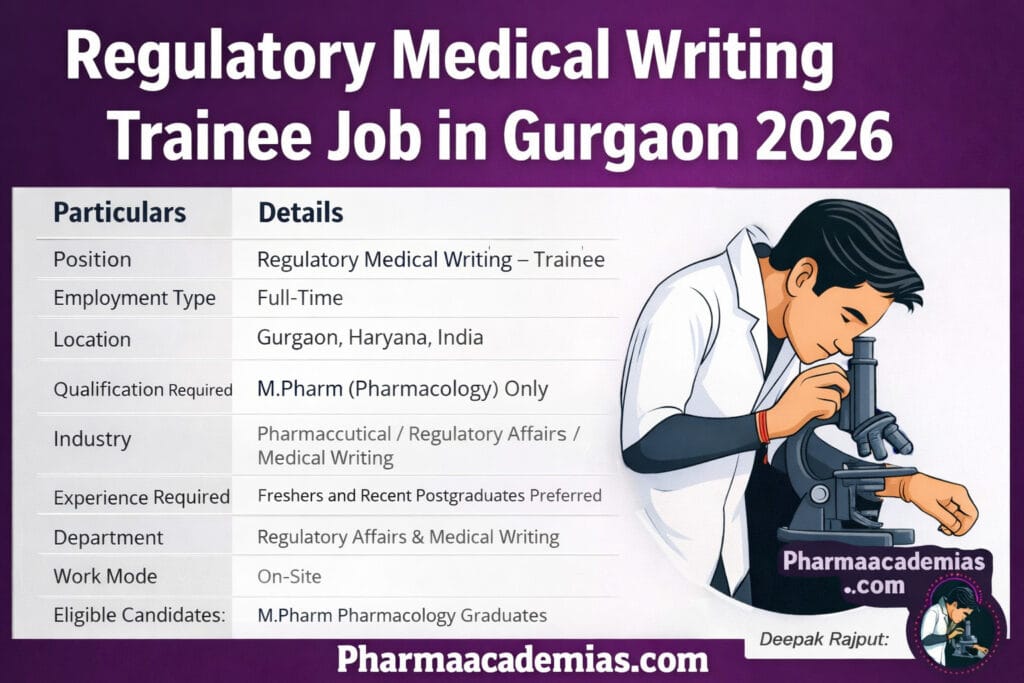
| Particulars | Details |
| Position | Regulatory Medical Writing – Trainee |
| Employment Type | Full-Time |
| Location | Gurgaon, Haryana, India |
| Qualification Required | M.Pharm (Pharmacology) Only |
| Industry | Pharmaceutical / Regulatory Affairs / Medical Writing |
| Experience Required | Freshers and Recent Postgraduates Preferred |
| Department | Regulatory Affairs & Medical Writing |
| Work Mode | On-Site |
| Eligible Candidates | M.Pharm Pharmacology Graduates |
Key Responsibilities Regulatory Medical Writing Trainee Job
The selected candidate will support various medical writing and regulatory documentation activities under the supervision of senior professionals.
1. Regulatory Document Preparation
One of the primary responsibilities of the trainee will be assisting in the preparation of regulatory and scientific documents required for product submissions.
The trainee will support drafting and updating documents such as:
- Prescribing Information (PI)
- Structured Product Labeling (SPL)
- Technical Information Files (TIF)
- Bioequivalence (BE) Templates
- Clinical Overviews
- Non-Clinical Overviews
- Biowaiver Justification Documents
- Supporting Regulatory Submission Documents
Through these activities, candidates will gain valuable exposure to pharmaceutical regulatory requirements and submission processes.
2. Clinical and Scientific Data Review
Regulatory documentation requires accurate scientific information extracted from multiple sources.
The trainee will assist in:
- Reviewing clinical study reports
- Reviewing non-clinical study reports
- Examining scientific publications
- Understanding pharmacological data
- Summarizing clinical evidence
- Identifying key findings relevant to regulatory submissions
This responsibility helps develop critical analysis skills and scientific interpretation abilities.
3. Literature Search and Scientific Research
Medical writing relies heavily on scientific evidence.
Candidates will participate in:
- Literature searches using scientific databases
- Identifying relevant scientific publications
- Reviewing journal articles
- Collecting supporting evidence for regulatory documents
- Managing references and citations
This activity strengthens research capabilities and scientific writing expertise.
4. Quality Review and Document Verification
Quality and accuracy are critical components of regulatory documentation.
The trainee will perform preliminary quality checks to ensure:
- Scientific accuracy
- Data consistency
- Proper formatting
- Compliance with templates
- Alignment with regulatory guidelines
- Error-free documentation
Learning document quality control is an important skill for future regulatory and medical writing professionals.
5. Gap Analysis Activities
The pharmaceutical industry frequently performs gap assessments before regulatory submissions.
The trainee will support:
- Gap analysis for small molecule products
- Gap analysis for biosimilar products
- Identification of missing information
- Review of incomplete datasets
- Documentation of data deficiencies
This process helps ensure regulatory submissions are complete and compliant.
6. Regulatory Query Response Support
Health authorities and clients often request clarifications regarding submitted documents.
The trainee may assist in:
- Drafting preliminary responses
- Updating documents based on review comments
- Incorporating feedback from senior reviewers
- Revising regulatory documents
- Supporting query resolution activities
These experiences provide valuable insights into regulatory communication processes.
7. Project Documentation and Tracking
Effective project management is essential in regulatory operations.
The selected candidate will support:
- Version control management
- Work tracker maintenance
- Documentation organization
- Project status updates
- Submission timelines monitoring
These activities help develop organizational and project coordination skills.
Educational Qualification
To be eligible for this opportunity, candidates must possess:
Mandatory Qualification
Master of Pharmacy (M.Pharm) in Pharmacology
Only candidates with this specialization are eligible to apply.
Candidates with strong academic backgrounds in pharmacology, drug development, clinical research, and therapeutics will have an advantage.
Required Skills
Technical Skills
Candidates should possess:
- Proficiency in Microsoft Word
- Working knowledge of Microsoft Excel
- Knowledge of Microsoft PowerPoint
- Basic understanding of scientific writing
- Familiarity with literature search techniques
- Understanding of clinical and non-clinical data
Communication Skills
Since medical writing involves extensive documentation, candidates must demonstrate:
- Excellent written English
- Strong verbal communication
- Scientific writing capability
- Attention to grammar and formatting
- Ability to communicate complex information clearly
Professional Skills
Successful candidates should exhibit:
- Strong attention to detail
- Analytical thinking
- Learning agility
- Time management
- Deadline-oriented mindset
- Team collaboration skills
- Adaptability to changing regulatory requirements
Why Choose a Career in Medical Writing?
Medical Writing has emerged as one of the fastest-growing career paths for pharmacy postgraduates.
Some major advantages include:
High Demand Globally
Medical writers are required by:
- Pharmaceutical companies
- Biotechnology firms
- CROs (Contract Research Organizations)
- Regulatory consulting organizations
- Medical communication agencies
Strong Career Growth
Professionals can progress from:
- Medical Writing Trainee
- Junior Medical Writer
- Medical Writer
- Senior Medical Writer
- Lead Medical Writer
- Regulatory Writing Manager
International Exposure
Medical writers frequently work on projects involving:
- US FDA submissions
- European Medicines Agency (EMA) submissions
- Global product registrations
- International clinical studies
Attractive Compensation
Medical writing professionals often enjoy competitive salary growth due to the specialized nature of the role.
Career Opportunities After This Role
After gaining experience, candidates can pursue careers as:
- Medical Writer
- Regulatory Affairs Associate
- Scientific Writer
- Clinical Documentation Specialist
- Regulatory Submission Associate
- Drug Safety Writer
- Pharmacovigilance Writer
- Regulatory Affairs Executive
- Scientific Communication Specialist
The skills acquired in this trainee position are highly transferable across multiple pharmaceutical domains.
Work Environment and Additional Requirements
Candidates should note that project requirements may occasionally involve working schedules aligned with different international time zones.
This provides valuable exposure to global pharmaceutical operations and international project teams.
Why M.Pharm Pharmacology Graduates Should Apply
M.Pharm Pharmacology graduates possess strong knowledge of:
- Pharmacology
- Drug Mechanisms
- Clinical Research
- Therapeutics
- Toxicology
- Scientific Literature Analysis
These skills align perfectly with the requirements of medical writing and regulatory affairs, making this role an excellent career fit.
Apply now
Click here to apply via company official website: Click Here
Final Thoughts
The Regulatory Medical Writing – Trainee position in Gurgaon offers a unique opportunity for M.Pharm (Pharmacology) graduates to enter the highly rewarding fields of Medical Writing and Regulatory Affairs. The role provides hands-on training, exposure to global regulatory standards, scientific documentation experience, and the opportunity to work with experienced industry professionals.
For candidates seeking a long-term career in pharmaceutical regulations, scientific communication, clinical documentation, and global drug development, this trainee position can be the ideal stepping stone toward professional success.
If you are passionate about science, writing, research, and regulatory compliance, don’t miss this opportunity to begin your journey in one of the pharmaceutical industry’s most promising career domains.
Frequently Asked Questions (FAQs)
1. What is a Regulatory Medical Writing Trainee?
A Regulatory Medical Writing Trainee assists in preparing scientific and regulatory documents required for pharmaceutical product submissions. The role involves literature review, clinical data analysis, document preparation, and compliance with global regulatory guidelines.
2. Who can apply for the Regulatory Medical Writing Trainee position?
Candidates with an M.Pharm degree in Pharmacology are eligible to apply for this position. Fresh graduates interested in regulatory affairs and medical writing are encouraged to apply.
3. Is this Regulatory Medical Writing job suitable for freshers?
Yes. This trainee position is designed for fresh M.Pharm (Pharmacology) graduates who want to start their careers in medical writing and regulatory affairs.
4. What skills are required for a Medical Writing Trainee role?
Candidates should have strong scientific knowledge, excellent written and spoken English, attention to detail, literature review skills, and proficiency in Microsoft Word, Excel, and PowerPoint.
5. What is the career scope of Regulatory Medical Writing?
Regulatory Medical Writing offers excellent career growth opportunities in pharmaceutical companies, CROs, biotechnology firms, and regulatory consulting organizations. Professionals can progress to roles such as Medical Writer, Senior Medical Writer, and Regulatory Affairs Specialist.
6. What does a Medical Writer do in the pharmaceutical industry?
A Medical Writer prepares scientific and regulatory documents such as clinical study reports, prescribing information, regulatory submissions, and scientific publications to support drug development and approval processes.
7. What is the salary of a Regulatory Medical Writing Trainee in India?
The salary varies depending on the organization, location, and candidate profile. Entry-level medical writing professionals generally receive competitive packages with significant growth potential.
8. Is Medical Writing a good career option for M.Pharm graduates?
Yes. Medical Writing is one of the fastest-growing career paths for M.Pharm graduates, offering opportunities in scientific communication, regulatory affairs, clinical research, and pharmaceutical documentation.
9. What is the difference between Medical Writing and Regulatory Affairs?
Medical Writing focuses on creating scientific and regulatory documents, while Regulatory Affairs manages product registration, compliance, and communication with health authorities. Both functions often work closely together.
10. What are the future opportunities after gaining experience in Medical Writing?
Experienced professionals can advance to positions such as Medical Writer, Senior Medical Writer, Lead Medical Writer, Regulatory Affairs Associate, Scientific Writer, or Medical Communications Specialist.
11. Are Medical Writing jobs in demand in India?
Yes. The demand for Medical Writing professionals is growing rapidly due to increasing pharmaceutical research, clinical trials, biosimilar development, and global regulatory submission requirements.
12. Why should M.Pharm Pharmacology graduates consider a career in Medical Writing?
M.Pharm Pharmacology graduates possess strong knowledge of drug mechanisms, therapeutics, clinical research, and scientific literature, making them ideal candidates for Medical Writing and Regulatory Affairs roles.