Skip to content
Pharmaacademias
  • Home
  • CoursesExpand
    • B.Pharm Old Syllabus Notes (Archive)Expand
      • SEM-I oldExpand
        • Human Anatomy and Physiology-IExpand
          • Unit 1
          • Unit 2
          • Unit 3
          • Unit 4
          • Unit 5
        • Pharmaceutical AnalysisExpand
          • Unit 1
          • Unit 2
          • Unit 3
          • Unit 4
          • Unit 5
        • Pharmaceutics – 1Expand
          • Unit 1
          • Unit 2
          • Unit 3
          • Unit 4
          • Unit 5
        • Pharmaceutical Inorganic ChemistryExpand
          • Unit 1
          • Unit 2
          • Unit 3
          • Unit 4
          • Unit 5
        • Remedial BiologyExpand
          • Unit 1
          • rb Unit 2
      • SEM-IIExpand
        • Human Anatomy and Physiology – IIExpand
          • Unit 1
          • Unit 2
          • Unit 3
          • Unit 4
          • Unit 5
        • BiochemistryExpand
          • Unit 1
          • Unit 2
          • Unit 3
          • Unit 4
          • Unit 5
        • PathophysiologyExpand
          • Unit 1
          • Unit 2
          • Unit 3
          • Unit 4
          • Unit 5
        • Pharmaceutical Organic Chemistry IExpand
          • poc1 Unit 1
      • SEM-IIIExpand
        • Pharmaceutical Organic Chemistr IIExpand
          • Unit 1
          • Unit 2
          • Unit 3
          • Unit 4
          • Unit 5
        • Physical Pharmaceutics IExpand
          • Unit 1
          • Unit 2
          • Unit 3
          • Unit 4
          • Unit 5
        • Pharmaceutical MicrobiologyExpand
          • Unit 1
          • Unit 2
          • Unit 3
          • Unit 4
          • Unit 5
        • Pharmaceutical EngineeringExpand
          • Unit 1
          • Unit 2
          • Unit 3
          • Unit 4
          • Unit 5
        • Universal human values and professional ethicsExpand
          • value Unit 1
      • SEM-IVExpand
        • Pharmaceutical Organic Chemistry IIIExpand
          • POC 3 Unit 1
          • POC 3 Unit 2
        • Medicinal Chemistry – IExpand
          • Unit 1
        • Physical Pharmaceutics – IIExpand
          • Unit 1
          • pp2 Unit 2
        • Pharmacology-1Expand
          • Unit 1
          • Unit 2
          • Unit 3
          • Unit 4
          • Unit 5
        • Pharmacognosy and Phytochemistry – IExpand
          • Unit 1
          • Unit 2
          • Unit 3
          • Unit 4
          • Unit 5
      • SEM-VExpand
        • Medicinal Chemistry IIExpand
          • mc2 Unit 1
        • Industrial Pharmacy IExpand
          • Unit 1
          • Unit 2
          • BIP Unit 3
          • BIP Unit 4
        • Pharmacology-IIExpand
          • Unit 1
          • Unit 2
          • colo2 Unit 3
        • Pharmacognosy & Phytochemistry IIExpand
          • Unit 1
          • Unit 2
          • cog Unit 3
        • Pharmaceutical JurisprudenceExpand
          • Unit 1
          • Unit 2
          • Unit 3
          • juris Unit 4
      • SEM-VIExpand
        • Medicinal Chemistry IIIExpand
          • MC III Unit 1
        • Herbal Drug TechnologyExpand
          • Unit 1
          • HDT Unit 2
        • Biopharmaceutics & PharmacokineticsExpand
          • kinet Unit 1
          • Kinet Unit 2
        • Pharmaceutical BiotechnologyExpand
          • Unit 1
          • Unit 2
          • biotech Unit 3
        • Pharmaceutical Quality AssuranceExpand
          • Unit 1
      • SEM- VIIExpand
        • Instrumental Method of AnalysisExpand
          • lysis Unit 1
          • Unit 3
          • Unit 4
          • Unit 5
        • Industrial Pharmacy-IIExpand
          • IP 2 Unit 1
        • Pharmacy PracticeExpand
          • Unit 1
          • pp Unit 2
        • Novel Drug Delivery SystemExpand
          • Unit 1
          • ndds Unit 2
      • SEM-VIIIExpand
        • Biostatistics and Research MethodologyExpand
          • Unit 1
        • PharmacovigilanceExpand
          • Unit-1
          • Unit 2
          • Unit 3
          • vigi Unit 4
        • Social and Preventive PharmacyExpand
          • Social Unit 1
    • B.Pharm New PCI Syllabus 2026Expand
      • SEM-1 newExpand
        • Basics of Python Programming for Pharmaceutical SciencesExpand
          • Unit 1
          • Python Unit 2
        • General PharmacyExpand
          • Unit 1
          • Unit 2
          • Unit 3
        • Healthcare Psychology and Communication SkillsExpand
          • Unit 1
          • Unit 2
          • Unit 3
        • Human Anatomy, Physiology and Pathophysiology IExpand
          • Unit 1
          • Unit 2
          • Unit 3
          • Unit 4
          • new HAP Unit 5
        • Introduction to PharmacognosyExpand
          • Unit 1
          • Unit 2
          • Unit 3
          • ITP Unit 4
        • Pharmaceutical Inorganic and Analytical ChemistryExpand
          • Unit 1
          • Unit 2
          • new ana Unit 3
    • D.PharmaExpand
      • PharmaceuticsExpand
        • Chapter 1
        • Chapter 2
        • Chpater 3
        • Chpater 4
        • dceu Chapter 5
      • Pharmaceutical ChemistryExpand
        • Chapter 1
        • Chapter 2
        • Chapter 3
        • Chapter 4
        • Chapter 5
        • dchem Chapter 6
      • PharmacognosyExpand
        • Chapter 3
        • Chapter 1
        • Chapter 2
        • Chapter 4
        • cogno Chapter 5
      • Human Anatomy and PhysiologyExpand
        • Chapter 1
        • Chapter 2
        • Chapter 3
        • Chapter 4
        • Chapter 5
        • Chapter 6
        • Chapter 7
        • Chapter 8
        • Chapter 9
        • Chapter 10
        • Chapter 11
        • Chapter 12
        • Chapter 13
        • Chapter 14
        • Chapter 15
      • Social PharmacyExpand
        • Chapter 1
        • Chapter 2
        • Chapter 3
        • sp Chapter 4
      • PharmacologyExpand
        • Chapter 1
        • Chapter 2
        • Chapter 3
        • Chapter 4
        • Chapter 5
        • Chapter 6
        • Chapter 7
        • Chapter 8
        • Chapter 9
        • Chapter 10
        • Chapter 11
        • Chapter 12
        • Chapter 13
      • Community pharmacy and managementExpand
        • Chapter 1
        • Chapter 2
        • Chapter 3
        • Chapter 5
        • Chapter 6
        • Chapter 7
        • cpm Chapter 8
      • Biochemistry & Clinical PathologyExpand
        • Chapter 1
        • Chapter 2
        • Chapter 3
        • Chapter 4
        • Chapter 5
        • Chapter 6
        • Chapter 7
      • PharmacotherapeuticsExpand
        • Chapter 1
        • the Chapter 2
      • Hospital and Clinical PharmacyExpand
        • Chapter 1
        • Chapter 2
        • hcp Chapter 3
      • Pharmacy law and EthicsExpand
        • Chapter 1
        • Chapter 2
    • M.PharmExpand
      • Pharmacology Branch
    • Pharm DExpand
      • Human Anatomy & Physiology (D)Expand
        • Unit 1
        • Unit 2
        • Unit 3
        • hap Unit 4 (D)
        • Unit 5
        • Unit 6
        • Unit 7
        • Unit 8
        • Unit 9
        • Unit 10
        • Unit 11
        • Unit 12
        • hap Unit 13
    • DMLTExpand
      • dmlt 1 yearExpand
        • Anatomy and Physiology
  • Study MaterialExpand
    • Practicals
    • Notes pdf
    • Previous year papers
    • Books
  • Blog
  • Jobs
  • Syllabus
Pharmaacademias
  • Definition and Scope of Anatomy Physiology
    Home | Unit 1

    Definition and Scope of Anatomy Physiology and Pathophysiology

    ByDeepak Rajput May 11, 2026August 27, 2026

    Definition and Scope of Anatomy Physiology: The study of the human body is one of the most important branches of biological and medical sciences. Understanding the structure of the body, the functions performed by different organs, and the changes that occur during disease conditions forms the basis of healthcare education. Three major disciplines that provide…
    Read More Definition and Scope of Anatomy Physiology and PathophysiologyContinue

  • Cellular and Tissue Level of Organization
    Home | Unit 1

    Cellular and Tissue Level of Organization

    ByDeepak Rajput May 11, 2026August 27, 2026

    Cellular and Tissue Level of Organization: The human body is an extraordinarily complex and highly organized biological system composed of trillions of microscopic units working together to sustain life. Every movement, thought, heartbeat, and breath depends upon a remarkable level of structural and functional coordination. To understand the human body properly, it is essential to…

    Read More Cellular and Tissue Level of OrganizationContinue

  • Emotion and Motivation
    Home | Unit 1

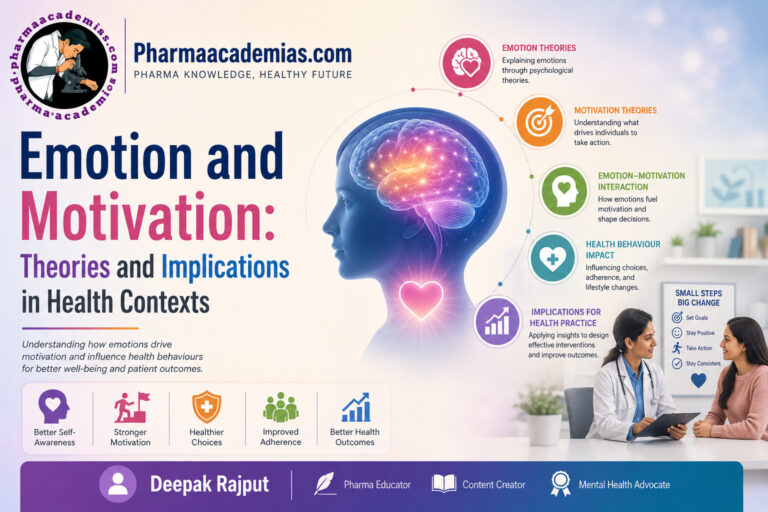
    Emotion and Motivation: Theories and Implications

    ByDeepak Rajput May 8, 2026August 27, 2026

    Emotion and motivation are important psychological processes that strongly influence human behavior, decision-making, health practices, and overall well-being. In healthcare, emotions affect how patients respond to illness, treatment, pain, and recovery, while motivation determines whether individuals adopt healthy behaviors and follow medical advice. Patients suffering from illness often experience emotions such as fear, anxiety, sadness,…

    Read More Emotion and Motivation: Theories and ImplicationsContinue

  • Learning and Memory
    Home | Unit 1

    Learning and Memory: Reinforcement in Health Behaviour Change

    ByDeepak Rajput May 8, 2026August 27, 2026

    Learning and memory are important psychological processes that influence human behavior, habits, and decision-making. In healthcare, these processes play a major role in developing healthy behaviors, improving treatment adherence, preventing diseases, and promoting overall well-being. Many health-related behaviors such as taking medicines regularly, following a healthy diet, exercising, avoiding smoking, and maintaining hygiene are learned…

    Read More Learning and Memory: Reinforcement in Health Behaviour ChangeContinue

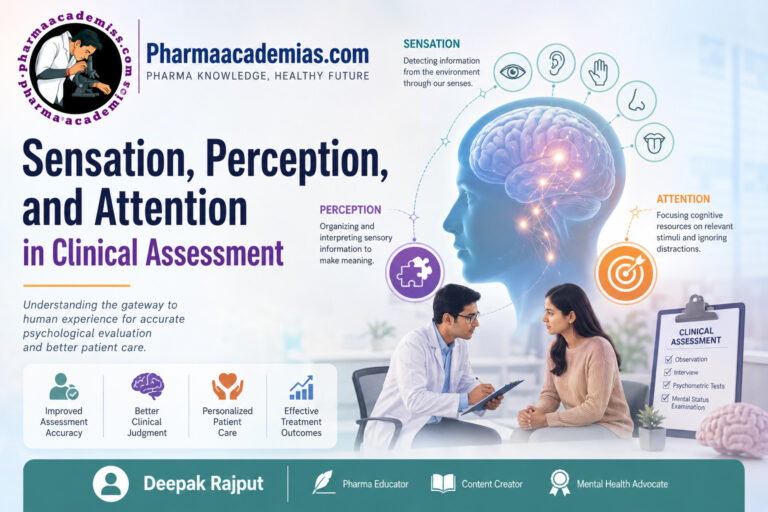
  • Sensation Perception and Attention
    Home | Unit 1

    Sensation Perception and Attention in Clinical Assessment

    ByDeepak Rajput May 8, 2026August 27, 2026

    Sensation perception and attention are important psychological processes that help individuals receive, interpret, and respond to information from the environment. These processes are essential for normal functioning of the human body and mind. In healthcare and clinical practice, understanding sensation, perception, and attention helps healthcare professionals assess a patient’s mental status, neurological condition, emotional state,…

    Read More Sensation Perception and Attention in Clinical AssessmentContinue

  • Branches of Psychology
    Home | Unit 1

    Branches of Psychology with Healthcare Relevance

    ByDeepak Rajput May 8, 2026August 27, 2026

    Branches of Psychology: Psychology has several branches that contribute significantly to healthcare and medical sciences. These branches help healthcare professionals understand human behavior, emotions, mental health, learning patterns, and responses to illness and treatment. In healthcare settings, psychological knowledge improves patient care, communication, rehabilitation, and treatment outcomes. Among the various branches of psychology, clinical psychology,…

    Read More Branches of Psychology with Healthcare RelevanceContinue

  • Psychology in Healthcare
    Home | Unit 1

    Introduction to Psychology in Healthcare

    ByDeepak Rajput May 8, 2026August 27, 2026

    Psychology in Healthcare: Psychology is an important subject in healthcare and health sciences because it helps in understanding human behavior, emotions, thoughts, and mental processes. In the healthcare field, patients not only suffer physically but also experience emotional and psychological problems such as fear, anxiety, stress, depression, and frustration. Therefore, healthcare professionals must understand the…

    Read More Introduction to Psychology in HealthcareContinue

  • Excipients
    Unit 3

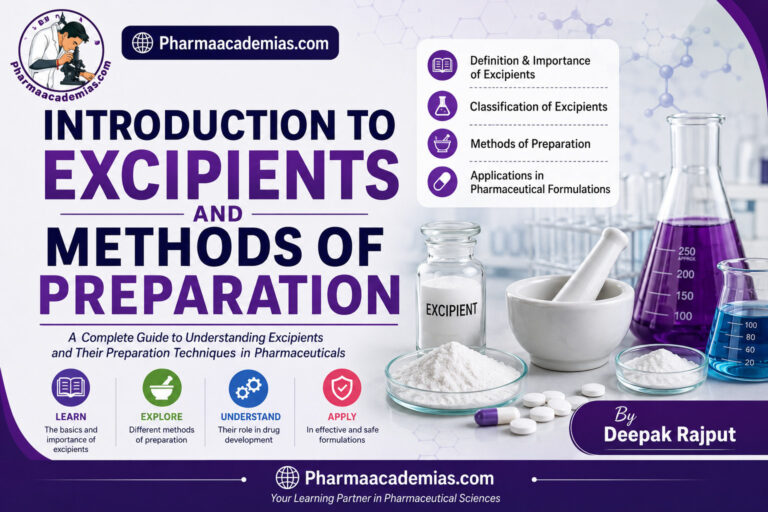
    What are Excipients: Definition and Methods of Preparation

    ByDeepak Rajput May 7, 2026August 27, 2026

    What are Excipients: Excipients are pharmacologically inactive substances that are formulated along with the active pharmaceutical ingredient (API) in a dosage form. Although excipients do not produce therapeutic effects directly, they play a vital role in the formulation, manufacturing, stability, appearance, bioavailability, and patient acceptability of pharmaceutical products. In modern pharmaceutics, excipients are considered essential…

    Read More What are Excipients: Definition and Methods of PreparationContinue

  • Eutectic Mixtures
    Unit 3

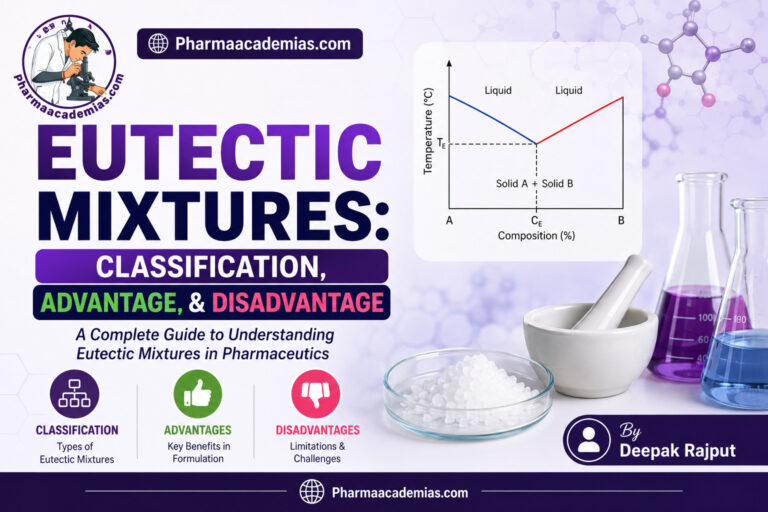
    Eutectic Mixtures: Classification, Advantage, & Disadvantage

    ByDeepak Rajput May 7, 2026August 27, 2026

    A eutectic mixtures is a combination of two or more solid substances that, when mixed together in a particular proportion, liquefy or melt at a temperature lower than the melting point of either individual component. In pharmaceutical compounding, eutectic formation is an important phenomenon because it may affect the stability, appearance, and handling properties of…

    Read More Eutectic Mixtures: Classification, Advantage, & DisadvantageContinue

  • Hygroscopic Powders
    Home | Unit 3

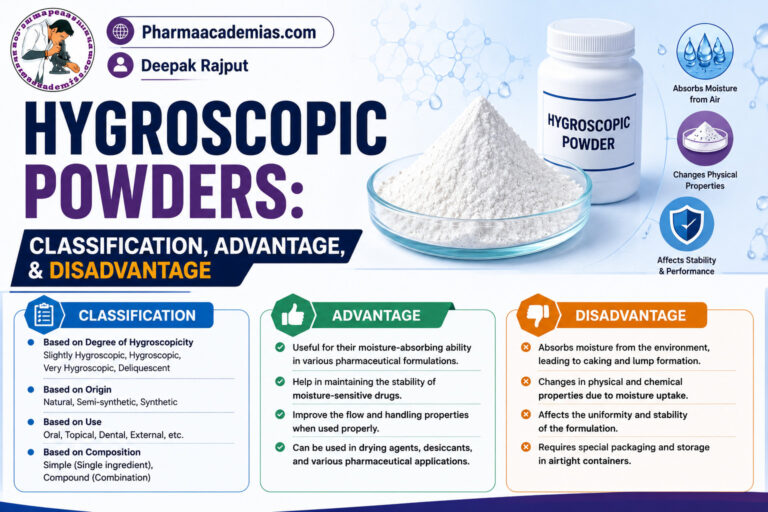
    Hygroscopic Powders: Classification, Advantage, & Disadvantage

    ByDeepak Rajput May 7, 2026August 27, 2026

    Hygroscopic powders are pharmaceutical substances that have the ability to absorb moisture from the atmosphere when exposed to air. This property is known as hygroscopicity. In pharmaceutics, hygroscopic substances are very important because their moisture-absorbing nature can significantly affect the stability, flow properties, appearance, handling, and therapeutic effectiveness of powder formulations. Many pharmaceutical drugs and…

    Read More Hygroscopic Powders: Classification, Advantage, & DisadvantageContinue

Page navigation

Previous PagePrevious 1 … 15 16 17 18 19 … 218 Next PageNext
  • About Pharmaacademias
  • Contact Us
  • Disclaimer
  • Privacy Policy
  • Terms and Conditions

© 2026 Pharmaacademias - WordPress Theme by Kadence WP

  • Home
  • Courses
    • B.Pharm Old Syllabus Notes (Archive)
      • SEM-I old
        • Human Anatomy and Physiology-I
          • Unit 1
          • Unit 2
          • Unit 3
          • Unit 4
          • Unit 5
        • Pharmaceutical Analysis
          • Unit 1
          • Unit 2
          • Unit 3
          • Unit 4
          • Unit 5
        • Pharmaceutics – 1
          • Unit 1
          • Unit 2
          • Unit 3
          • Unit 4
          • Unit 5
        • Pharmaceutical Inorganic Chemistry
          • Unit 1
          • Unit 2
          • Unit 3
          • Unit 4
          • Unit 5
        • Remedial Biology
          • Unit 1
          • rb Unit 2
      • SEM-II
        • Human Anatomy and Physiology – II
          • Unit 1
          • Unit 2
          • Unit 3
          • Unit 4
          • Unit 5
        • Biochemistry
          • Unit 1
          • Unit 2
          • Unit 3
          • Unit 4
          • Unit 5
        • Pathophysiology
          • Unit 1
          • Unit 2
          • Unit 3
          • Unit 4
          • Unit 5
        • Pharmaceutical Organic Chemistry I
          • poc1 Unit 1
      • SEM-III
        • Pharmaceutical Organic Chemistr II
          • Unit 1
          • Unit 2
          • Unit 3
          • Unit 4
          • Unit 5
        • Physical Pharmaceutics I
          • Unit 1
          • Unit 2
          • Unit 3
          • Unit 4
          • Unit 5
        • Pharmaceutical Microbiology
          • Unit 1
          • Unit 2
          • Unit 3
          • Unit 4
          • Unit 5
        • Pharmaceutical Engineering
          • Unit 1
          • Unit 2
          • Unit 3
          • Unit 4
          • Unit 5
        • Universal human values and professional ethics
          • value Unit 1
      • SEM-IV
        • Pharmaceutical Organic Chemistry III
          • POC 3 Unit 1
          • POC 3 Unit 2
        • Medicinal Chemistry – I
          • Unit 1
        • Physical Pharmaceutics – II
          • Unit 1
          • pp2 Unit 2
        • Pharmacology-1
          • Unit 1
          • Unit 2
          • Unit 3
          • Unit 4
          • Unit 5
        • Pharmacognosy and Phytochemistry – I
          • Unit 1
          • Unit 2
          • Unit 3
          • Unit 4
          • Unit 5
      • SEM-V
        • Medicinal Chemistry II
          • mc2 Unit 1
        • Industrial Pharmacy I
          • Unit 1
          • Unit 2
          • BIP Unit 3
          • BIP Unit 4
        • Pharmacology-II
          • Unit 1
          • Unit 2
          • colo2 Unit 3
        • Pharmacognosy & Phytochemistry II
          • Unit 1
          • Unit 2
          • cog Unit 3
        • Pharmaceutical Jurisprudence
          • Unit 1
          • Unit 2
          • Unit 3
          • juris Unit 4
      • SEM-VI
        • Medicinal Chemistry III
          • MC III Unit 1
        • Herbal Drug Technology
          • Unit 1
          • HDT Unit 2
        • Biopharmaceutics & Pharmacokinetics
          • kinet Unit 1
          • Kinet Unit 2
        • Pharmaceutical Biotechnology
          • Unit 1
          • Unit 2
          • biotech Unit 3
        • Pharmaceutical Quality Assurance
          • Unit 1
      • SEM- VII
        • Instrumental Method of Analysis
          • lysis Unit 1
          • Unit 3
          • Unit 4
          • Unit 5
        • Industrial Pharmacy-II
          • IP 2 Unit 1
        • Pharmacy Practice
          • Unit 1
          • pp Unit 2
        • Novel Drug Delivery System
          • Unit 1
          • ndds Unit 2
      • SEM-VIII
        • Biostatistics and Research Methodology
          • Unit 1
        • Pharmacovigilance
          • Unit-1
          • Unit 2
          • Unit 3
          • vigi Unit 4
        • Social and Preventive Pharmacy
          • Social Unit 1
    • B.Pharm New PCI Syllabus 2026
      • SEM-1 new
        • Basics of Python Programming for Pharmaceutical Sciences
          • Unit 1
          • Python Unit 2
        • General Pharmacy
          • Unit 1
          • Unit 2
          • Unit 3
        • Healthcare Psychology and Communication Skills
          • Unit 1
          • Unit 2
          • Unit 3
        • Human Anatomy, Physiology and Pathophysiology I
          • Unit 1
          • Unit 2
          • Unit 3
          • Unit 4
          • new HAP Unit 5
        • Introduction to Pharmacognosy
          • Unit 1
          • Unit 2
          • Unit 3
          • ITP Unit 4
        • Pharmaceutical Inorganic and Analytical Chemistry
          • Unit 1
          • Unit 2
          • new ana Unit 3
    • D.Pharma
      • Pharmaceutics
        • Chapter 1
        • Chapter 2
        • Chpater 3
        • Chpater 4
        • dceu Chapter 5
      • Pharmaceutical Chemistry
        • Chapter 1
        • Chapter 2
        • Chapter 3
        • Chapter 4
        • Chapter 5
        • dchem Chapter 6
      • Pharmacognosy
        • Chapter 3
        • Chapter 1
        • Chapter 2
        • Chapter 4
        • cogno Chapter 5
      • Human Anatomy and Physiology
        • Chapter 1
        • Chapter 2
        • Chapter 3
        • Chapter 4
        • Chapter 5
        • Chapter 6
        • Chapter 7
        • Chapter 8
        • Chapter 9
        • Chapter 10
        • Chapter 11
        • Chapter 12
        • Chapter 13
        • Chapter 14
        • Chapter 15
      • Social Pharmacy
        • Chapter 1
        • Chapter 2
        • Chapter 3
        • sp Chapter 4
      • Pharmacology
        • Chapter 1
        • Chapter 2
        • Chapter 3
        • Chapter 4
        • Chapter 5
        • Chapter 6
        • Chapter 7
        • Chapter 8
        • Chapter 9
        • Chapter 10
        • Chapter 11
        • Chapter 12
        • Chapter 13
      • Community pharmacy and management
        • Chapter 1
        • Chapter 2
        • Chapter 3
        • Chapter 5
        • Chapter 6
        • Chapter 7
        • cpm Chapter 8
      • Biochemistry & Clinical Pathology
        • Chapter 1
        • Chapter 2
        • Chapter 3
        • Chapter 4
        • Chapter 5
        • Chapter 6
        • Chapter 7
      • Pharmacotherapeutics
        • Chapter 1
        • the Chapter 2
      • Hospital and Clinical Pharmacy
        • Chapter 1
        • Chapter 2
        • hcp Chapter 3
      • Pharmacy law and Ethics
        • Chapter 1
        • Chapter 2
    • M.Pharm
      • Pharmacology Branch
    • Pharm D
      • Human Anatomy & Physiology (D)
        • Unit 1
        • Unit 2
        • Unit 3
        • hap Unit 4 (D)
        • Unit 5
        • Unit 6
        • Unit 7
        • Unit 8
        • Unit 9
        • Unit 10
        • Unit 11
        • Unit 12
        • hap Unit 13
    • DMLT
      • dmlt 1 year
        • Anatomy and Physiology
  • Study Material
    • Practicals
    • Notes pdf
    • Previous year papers
    • Books
  • Blog
  • Jobs
  • Syllabus
Search