Cellular and Tissue Level of Organization: The human body is an extraordinarily complex and highly organized biological system composed of trillions of microscopic units working together to sustain life. Every movement, thought, heartbeat, and breath depends upon a remarkable level of structural and functional coordination. To understand the human body properly, it is essential to study its organization from the smallest living units to larger integrated systems. Among the most fundamental concepts in human anatomy and physiology are the cellular level and the tissue level of organization. These two levels form the foundation upon which organs, organ systems, and the entire body are built.
The study of the human body begins with the understanding that the body is organized in hierarchical levels. Each level depends on the proper functioning of the level below it. The major levels of organization include:
- Chemical level
- Cellular level
- Tissue level
- Organ level
- Organ system level
- Organism level
Among these, the cellular and tissue levels are especially important because they explain how living structures are formed and how body functions originate.
Cellular Level of Organization
Introduction to Cells
The cell is the basic structural, functional, and biological unit of life. Every living organism is composed of cells, and the human body contains trillions of them. Cells are so small that most can only be seen under a microscope, yet they perform incredibly complex activities essential for survival.
The cell is often referred to as the “building block of life” because:
- It is the smallest unit capable of independent life.
- It carries out metabolic activities.
- It reproduces and transmits genetic information.
- It responds to environmental changes.
- It maintains internal balance or homeostasis.
Different types of cells exist in the human body, each specialized for a particular function. For example:
- Nerve cells transmit impulses.
- Muscle cells contract and produce movement.
- Blood cells transport oxygen and defend against infection.
- Epithelial cells protect body surfaces.
Although cells differ in shape, size, and function, they share certain common structural features.
Structure of a Typical Human Cell
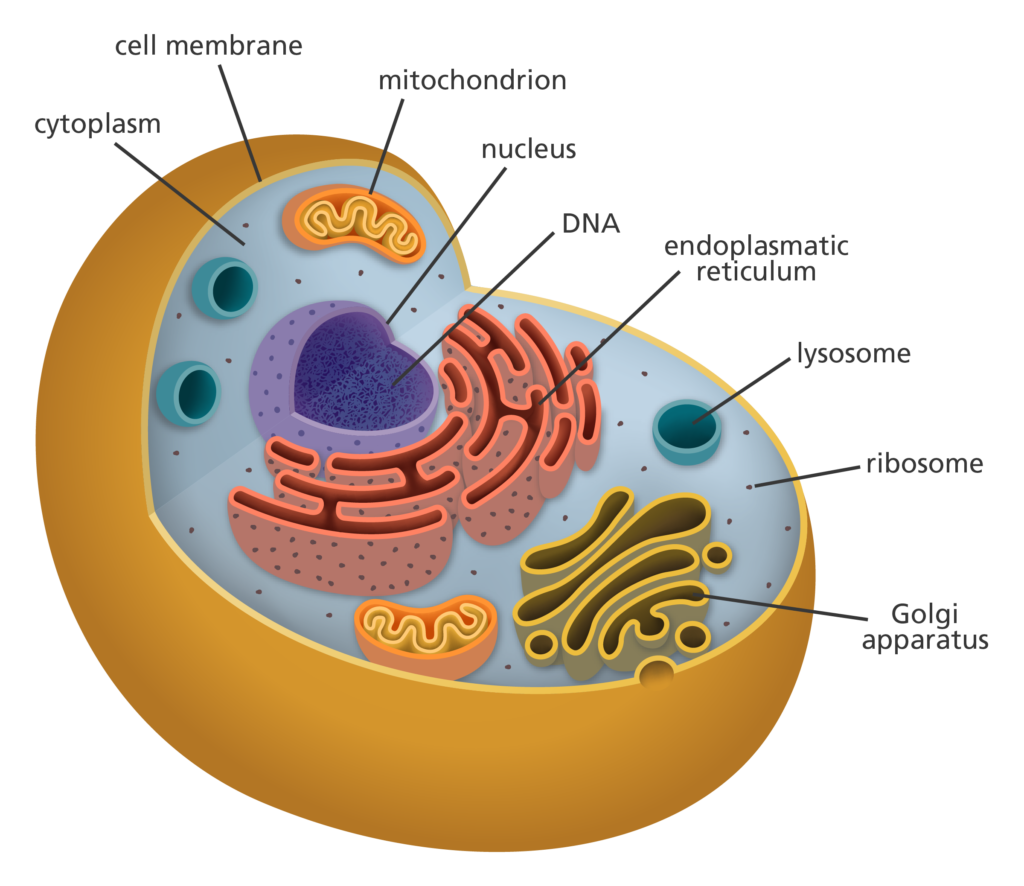
A typical human cell consists of three major parts:
- Cell membrane (plasma membrane)
- Cytoplasm
- Nucleus
1. Cell Membrane (Plasma Membrane)
The cell membrane is the outer covering of the cell that separates the internal contents from the external environment. It is thin, flexible, and selectively permeable.
Composition of Cell Membrane
The membrane mainly consists of:
- Phospholipids
- Proteins
- Cholesterol
- Carbohydrates
These components form a fluid mosaic structure.
Functions of Cell Membrane
- Protects the cell from external damage
- Regulates movement of substances into and out of the cell
- Maintains cellular integrity
- Facilitates communication between cells
- Helps in cell recognition and signaling
The selectively permeable nature of the membrane allows nutrients to enter while waste products leave the cell.
2. Cytoplasm
The cytoplasm is the semifluid material present between the cell membrane and nucleus. It contains water, salts, proteins, nutrients, and various organelles.
Functions of Cytoplasm
- Site of metabolic reactions
- Supports and suspends organelles
- Stores nutrients and chemicals
- Assists intracellular transport
The cytoplasm is highly active and plays a vital role in maintaining cellular activities.
Cell Organelles and Their Functions
Organelles are specialized structures within the cytoplasm that perform specific functions.
Mitochondria
Mitochondria are known as the “powerhouses of the cell.”
Functions
- Produce energy in the form of ATP
- Carry out cellular respiration
- Support metabolic activities
Cells requiring more energy, such as muscle cells, contain numerous mitochondria.
Ribosomes
Ribosomes are tiny structures responsible for protein synthesis.
Functions
- Manufacture proteins
- Assist growth and repair
- Produce enzymes and hormones
They may be free in the cytoplasm or attached to the rough endoplasmic reticulum.
Endoplasmic Reticulum (ER)
The endoplasmic reticulum is a network of membranes.
Types
a) Rough Endoplasmic Reticulum (RER)
Contains ribosomes.
Functions
- Protein synthesis
- Protein transport
b) Smooth Endoplasmic Reticulum (SER)
Lacks ribosomes.
Functions
- Lipid synthesis
- Detoxification
- Calcium storage
Golgi Apparatus
The Golgi apparatus modifies, packages, and transports proteins.
Functions
- Processing of proteins
- Formation of secretory vesicles
- Packaging cellular products
It is highly developed in secretory cells.
Lysosomes
Lysosomes contain digestive enzymes.
Functions
- Breakdown of waste materials
- Digestion of damaged organelles
- Defense against foreign particles
They are often called the “suicidal bags” of the cell because they can digest cellular components.
Centrosome and Centrioles
These structures help in cell division.
Functions
- Organize spindle fibers
- Assist chromosome movement during mitosis
Vacuoles
Vacuoles are storage sacs.
Functions
- Store nutrients and waste
- Maintain water balance
Human cells usually contain small vacuoles.
Nucleus
The nucleus is the control center of the cell.
Structure
The nucleus contains:
- Nuclear membrane
- Nucleoplasm
- Nucleolus
- Chromatin material
Functions of Nucleus
- Controls cellular activities
- Stores genetic information (DNA)
- Regulates protein synthesis
- Controls cell division
The DNA within the nucleus determines hereditary characteristics and directs cellular functions.
Types of Human Cells
The human body contains many specialized cells adapted for specific functions.
Epithelial Cells
- Form body coverings and linings
- Provide protection
- Aid absorption and secretion
Muscle Cells
- Specialized for contraction
- Produce movement
- Generate heat
Three types exist:
- Skeletal muscle cells
- Cardiac muscle cells
- Smooth muscle cells
Nerve Cells (Neurons)
- Conduct electrical impulses
- Coordinate body functions
- Enable communication
Neurons possess long processes called axons and dendrites.
Blood Cells
Red Blood Cells (RBCs): Carry oxygen using hemoglobin
White Blood Cells (WBCs): Defend against infection
Platelets: Help blood clotting
Cell Division
Cell division allows growth, repair, and reproduction.
Mitosis
Mitosis produces two identical daughter cells.
Importance
- Growth
- Tissue repair
- Replacement of damaged cells
Meiosis
Occurs in reproductive organs and produces gametes.
Importance
- Maintains chromosome number
- Introduces genetic variation
Cellular Functions Essential for Life
Cells perform several essential life processes:
1. Metabolism
Chemical reactions occurring within cells.
Includes:
- Catabolism (breakdown reactions)
- Anabolism (building reactions)
2. Respiration: Cells use oxygen to produce energy.
3. Excretion: Removal of metabolic waste products.
4. Growth: Increase in size and number of cells.
5. Movement: Includes movement of cells and intracellular substances.
6. Irritability: Ability to respond to stimuli.
7. Reproduction: Formation of new cells.
Tissue Level of Organization
A tissue is a group of similar cells working together to perform a common function. Cells with similar structure and function combine to form tissues.
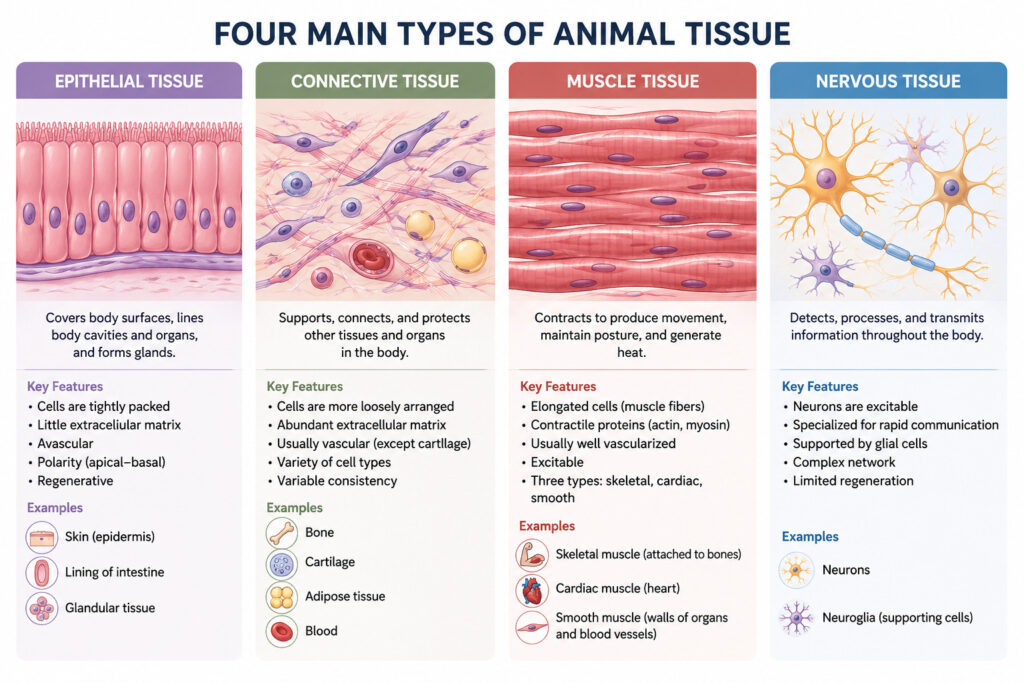
The tissue level represents a higher level of organization than the cellular level. Human tissues are organized into four primary categories:
- Epithelial tissue
- Connective tissue
- Muscle tissue
- Nervous tissue
Each tissue has unique characteristics and specialized functions.
1. Epithelial Tissue
Epithelial tissue covers body surfaces, lines internal organs, and forms glands. It acts as a protective barrier between the body and the external environment.
Characteristics
- Cells closely packed
- Minimal intercellular material
- Avascular (lack blood vessels)
- Rapid regeneration
Functions of Epithelial Tissue
- Protection
- Absorption
- Secretion
- Excretion
- Filtration
- Sensory reception
Types of Epithelial Tissue
a) Simple Epithelium: Single layer of cells.
Functions
- Absorption
- Diffusion
- Filtration
Types
- Simple squamous epithelium
- Simple cuboidal epithelium
- Simple columnar epithelium
b) Stratified Epithelium: Multiple layers of cells.
Functions
- Protection against wear and tear
Found in skin and mouth lining.
c) Glandular Epithelium: Specialized for secretion.
Forms:
- Sweat glands
- Salivary glands
- Endocrine glands
2. Connective Tissue
Connective tissue supports, binds, and protects body structures. It is the most abundant and widely distributed tissue in the body.
Characteristics
- Cells widely spaced
- Abundant extracellular matrix
- Usually well vascularized
Functions of Connective Tissue
- Support
- Protection
- Transport
- Energy storage
- Defense
Types of Connective Tissue
a) Loose Connective Tissue: Provides support and elasticity.
Examples:
- Areolar tissue
- Adipose tissue
b) Dense Connective Tissue: Contains densely packed collagen fibers.
Examples:
- Tendons
- Ligaments
c) Cartilage: Flexible supporting tissue.
Functions:
- Reduces friction
- Provides flexibility
d) Bone: Hard connective tissue forming the skeleton.
Functions:
- Support
- Protection
- Blood cell formation
- Mineral storage
e) Blood: Fluid connective tissue.
Functions:
- Transport gases and nutrients
- Immunity
- Clotting
3. Muscle Tissue
Muscle tissue is specialized for contraction and movement.
Types of Muscle Tissue
a) Skeletal Muscle
- Voluntary
- Attached to bones
- Produces body movement
Characteristics:
- Striated
- Multinucleated
b) Cardiac Muscle
- Found only in heart
- Involuntary
- Rhythmic contractions
Characteristics:
- Branched fibers
- Intercalated discs
c) Smooth Muscle
- Found in internal organs
- Involuntary
- Non-striated
Functions:
- Controls movement of substances in organs
4. Nervous Tissue
Nervous tissue forms the nervous system and conducts electrical impulses.
Components
- Neurons
- Neuroglial cells
Functions of Nervous Tissue
- Sensory perception
- Transmission of impulses
- Coordination of body activities
- Response to stimuli
Neurons
Neurons are specialized cells capable of generating and conducting nerve impulses.
Structure
- Cell body
- Dendrites
- Axon
Neuroglial Cells
Supportive cells that protect and nourish neurons.
Importance of Cellular and Tissue Organization
The cellular and tissue levels are fundamental for maintaining body structure and function. Proper organization ensures:
- Efficient communication
- Energy production
- Growth and repair
- Protection against disease
- Coordination among organs
When cells or tissues become damaged, diseases may develop. For example:
- Cancer results from uncontrolled cell division.
- Muscular disorders affect muscle tissue.
- Nervous tissue damage may impair coordination.
Thus, understanding cells and tissues is essential in medicine, pharmacy, nursing, and healthcare sciences.
Conclusion
The human body is an intricately organized system beginning at the cellular level and progressing to tissues, organs, and organ systems. Cells are the smallest living units capable of performing vital life functions, while tissues are organized groups of similar cells working together for specialized purposes. The four primary tissues—epithelial, connective, muscle, and nervous tissue—form the structural and functional basis of the entire body.
A clear understanding of cellular and tissue organization provides the foundation for studying anatomy, physiology, pathology, pharmacology, and other medical sciences. Knowledge of how cells function and how tissues interact is crucial for understanding health, disease, diagnosis, treatment, and the maintenance of life itself.
Editorial Note
This article has been carefully researched and written by Deepak Rajput with a focus on accuracy, clarity, and evidence-based healthcare information. Pharmaacademias.com