
Hospital Formulary and Drug List: A hospital formulary is a comprehensive, continuously revised document that contains the list of approved medicines along with detailed policies, prescribing guidelines, safety information, therapeutic recommendations, dosage standards, and medication-use procedures for a specific hospital. It is developed and maintained by the Pharmacy and Therapeutics (P&T) Committee, which evaluates medicines on the basis of efficacy, safety, quality, and cost-effectiveness.
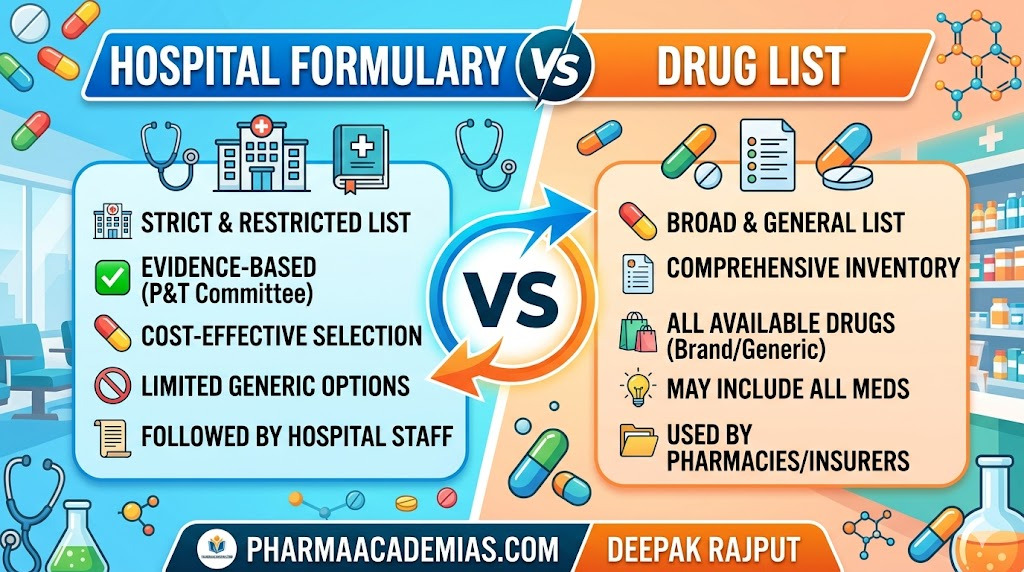
A drug list, in contrast, is simply a basic inventory or enumeration of medicines available in stock, pharmacy shelves, ward supplies, or procurement records. It usually contains only the names of drugs, dosage forms, and strengths, without detailed clinical policies or prescribing guidance.
Differentiation Between Hospital Formulary and Drug List
The difference between a hospital formulary and a drug list is important in hospital pharmacy and pharmacy practice.
The hospital formulary is a scientific, policy-based, therapeutic reference document, whereas the drug list is only a stock or supply list.
The formulary includes:
- approved medicines
- therapeutic classification
- indications
- doses
- contraindications
- restrictions
- monitoring parameters
- ADR precautions
- substitution policy
- committee recommendations
By comparison, the drug list generally includes only:
- drug name
- strength
- dosage form
- quantity available
- storage location
The main purpose of a hospital formulary is to promote rational prescribing, therapeutic standardization, medication safety, and cost control.
The main purpose of a drug list is to help in inventory management, procurement, and stock verification.
Another major difference is that the formulary is approved by the P&T committee and revised periodically, while the drug list may simply be updated by the pharmacy store or inventory department whenever stock changes.
Thus, every formulary contains a drug list, but every drug list is not a formulary.
Preparation of Hospital Formulary
The preparation of a hospital formulary is a systematic and multidisciplinary process.
It begins with the formation of the Pharmacy and Therapeutics Committee, which includes physicians, pharmacists, nurses, administrators, and other specialists. The committee studies the disease pattern of the hospital, prescribing trends, patient population, and availability of medicines.
The preparation process usually involves:
First, the committee collects data on commonly used medicines from different departments such as medicine, surgery, pediatrics, ICU, and emergency.
Second, each drug is evaluated for:
- therapeutic efficacy
- safety profile
- cost
- dosage convenience
- availability
- quality assurance
- legal approval
- storage conditions
Third, duplicate drugs with similar action are minimized to avoid unnecessary therapeutic redundancy. Preference is given to medicines with proven clinical value and cost benefit.
After final selection, the drugs are arranged in a structured format, usually:
- alphabetically
- pharmacologically
- therapeutically
- department-wise
The formulary document is then prepared with sections such as:
- preface
- objectives
- committee details
- drug monographs
- hospital policies
- emergency drugs
- appendices
- dose charts
Finally, it is approved by the medical administration and distributed to prescribers, wards, pharmacy, and nursing stations.
Revision of Hospital Formulary
The revision of hospital formulary is a continuous and essential activity.
A formulary is never considered permanent because new medicines are introduced, old medicines become obsolete, resistance patterns change, safety warnings are updated, and hospital treatment policies evolve.
Therefore, the P&T committee performs periodic review, usually annually or whenever clinically required.
Revision includes reviewing:
- newly approved drugs
- banned or withdrawn drugs
- antimicrobial resistance trends
- adverse drug reaction reports
- cost changes
- changes in hospital protocols
- medication error reports
- changes in manufacturer quality
The revised information may be issued as:
- new edition
- supplementary pages
- electronic update
- amendment sheets
Regular revision keeps the formulary clinically relevant, legally compliant, and economically useful.
Addition of Drugs to Hospital Formulary
The addition of a drug to the hospital formulary is a carefully controlled process.
A request for addition may come from:
- consultant physicians
- department heads
- pharmacists
- infection control committee
- critical care specialists
- hospital administration
The proposed drug is then critically evaluated by the P&T committee.
The major criteria for addition include:
- proven therapeutic efficacy
- better safety than existing alternatives
- unique clinical advantage
- cost-effectiveness
- availability of quality manufacturer
- essential need in hospital disease pattern
- reduced dosing frequency
- improved patient compliance
- lower ADR incidence
The committee also compares the new drug with already existing formulary alternatives. If the new drug offers no significant therapeutic benefit, it may not be included.
After approval, the drug is assigned:
- therapeutic category
- prescribing restrictions
- dosage guidelines
- monitoring requirements
- storage standards
This ensures safe integration into hospital practice.
Deletion of Drugs from Hospital Formulary
The deletion of a drug from hospital formulary is equally important for maintaining quality.
A drug may be deleted when:
- it is therapeutically obsolete
- safer alternatives are available
- it is rarely used
- severe ADRs are reported
- the manufacturer quality is doubtful
- it is banned or withdrawn
- antimicrobial resistance has increased
- it causes unnecessary duplication
- cost is unjustifiably high
- hospital treatment guidelines no longer support it
Before deletion, the P&T committee reviews clinical necessity and obtains feedback from concerned departments.
Once approved for deletion, the drug is removed from:
- prescribing software
- ward stock
- pharmacy shelves
- emergency carts
- procurement schedules
- policy manuals
This prevents irrational and outdated therapy.
Conclusion
The hospital formulary is much broader than a simple drug list, as it includes medication policies, therapeutic guidelines, safety information, and hospital-approved standards of medicine use.
Its preparation, revision, addition, and deletion processes are scientifically managed by the P&T committee to ensure that only the most safe, effective, and cost-efficient medicines remain available for patient care.
A strong formulary system improves rational drug use, patient safety, inventory control, and hospital pharmacy efficiency.
Editorial Note
This article has been carefully researched and written by Deepak Rajput with a focus on accuracy, clarity, and evidence-based healthcare information. Pharmaacademias.com