
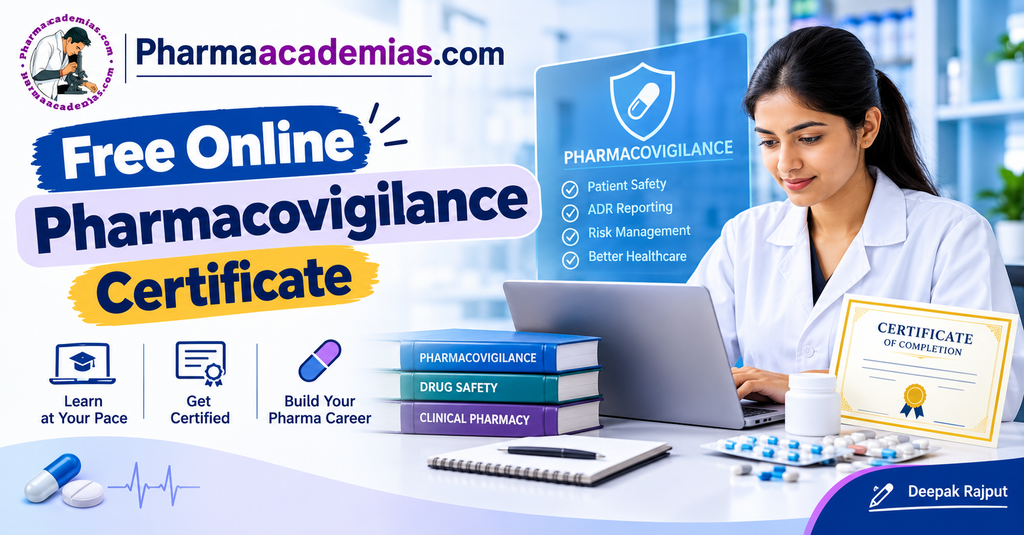
Free online Pharmacovigilance certificate
Free online Pharmacovigilance certificate: Are you a B.Pharm, M.Pharm, Pharm.D or other life sciences student interested in building a career in the pharmaceutical industry? Have you heard about Pharmacovigilance but are unsure what it is, how it works, or how to enter this field?
Pharmacovigilance (PV) is an important area of healthcare that focuses on monitoring the safety of medicines, identifying possible adverse effects and helping protect patients. It can be a career option for eligible pharmacy and life sciences graduates interested in drug safety, medical information and pharmaceutical research.
In this guide by Pharmaacademias.com, you will learn what Pharmacovigilance means, why it is needed, how the process works, which skills are useful, how to prepare for PV jobs and how you can start learning through a free online certification course.
1. What Is Pharmacovigilance?
According to the World Health Organization (WHO), Pharmacovigilance is the science and activities related to the detection, assessment, understanding and prevention of adverse effects or other medicine-related problems.
In simple words, Pharmacovigilance means monitoring medicines to understand their safety and identify possible risks to patients.
Before a medicine is approved, it is studied in clinical trials. However, clinical trials involve a limited number of participants and take place under specific conditions. Some adverse effects may become apparent only after a medicine is used by a much larger and more diverse population.
2. Why Is Pharmacovigilance Needed?
Every medicine has potential benefits and risks. Monitoring medicine safety helps healthcare professionals, pharmaceutical companies and regulatory authorities understand those risks and take appropriate action when necessary.
Patient Safety
Helps identify and evaluate suspected adverse reactions that may affect patients using medicines.
Detection of New Risks
Helps investigate unexpected or previously unrecognized safety concerns as additional information becomes available.
Benefit-Risk Assessment
Supports ongoing evaluation of whether the benefits of a medicine continue to outweigh its known and potential risks.
Regulatory Decisions
Safety findings may contribute to updated warnings, changes in product information, additional monitoring or other regulatory measures.
3. How Does Pharmacovigilance Work?
Pharmacovigilance is a systematic process. The exact workflow varies between organizations, products and regulatory requirements, but common activities include the following.
Step 1: Adverse Event Reporting
Information about a suspected adverse event may come from healthcare professionals, patients, clinical studies, medical literature or other approved reporting channels.
Step 2: Case Intake and Data Collection
The drug safety team receives the report and collects relevant details, such as the suspected medicine, reaction, patient information and reporter details, according to applicable procedures.
Step 3: Case Processing
Relevant information is entered into the appropriate safety database. The case may be coded using standardized medical terminology and checked for completeness and duplicate reports.
Step 4: Medical Review and Assessment
Qualified personnel assess the available evidence, seriousness, expectedness and possible relationship between the medicine and the reported event, as required by the applicable process.
Step 5: Reporting and Follow-Up
Where required, safety reports are submitted within applicable timelines. Missing information may be requested from the reporter or healthcare provider.
Step 6: Signal Detection and Safety Monitoring
Safety information from multiple cases and other sources may be reviewed to identify patterns or possible new risks. Further evaluation can lead to appropriate safety actions.
4. Important Terms Every PV Beginner Should Know
Adverse Event (AE)
An untoward medical occurrence in a patient who has received a pharmaceutical product. It does not necessarily mean that the medicine caused the event.
Adverse Drug Reaction (ADR)
A harmful and unintended response to a medicine for which there is a reasonable possibility of a causal relationship under the applicable definition.
Serious Adverse Event (SAE)
An event meeting one or more seriousness criteria, such as death, a life-threatening event, hospitalization or its prolongation, significant disability, or a congenital anomaly. Seriousness is not the same as intensity.
Individual Case Safety Report (ICSR)
A structured report containing information about an individual case of a suspected adverse reaction or other reportable safety event.
Signal Detection
The process of identifying information suggesting a new or changed possible association between a medicine and an adverse event that requires further evaluation.
5. What Does a Pharmacovigilance Professional Do?
Job responsibilities depend on the position, company and experience level. Common entry-level and related responsibilities may include:
- Collecting and reviewing adverse event information.
- Checking case details for completeness and consistency.
- Processing safety cases according to standard procedures.
- Using standardized medical terminology for event coding.
- Supporting follow-up activities for missing information.
- Maintaining accurate documentation and quality records.
- Following applicable SOPs, privacy rules and regulatory timelines.
- Supporting quality checks and other drug safety activities.
6. Pharmacovigilance Career Opportunities
Pharmacovigilance includes several types of roles. Job titles, eligibility and responsibilities vary by employer.
Drug Safety Associate
May support adverse event case processing, data entry, documentation and case follow-up.
Pharmacovigilance Associate
May work on safety case management, quality checks, reporting support and related drug safety activities.
Medical Reviewer
Reviews clinical and safety information. Medical qualification and relevant experience requirements depend on the specific position.
Signal Detection and Risk Management
More specialized activities involve reviewing safety data, investigating potential signals and supporting medicine risk-management activities.
7. Who Can Start a Career in Pharmacovigilance?
Candidates with qualifications in pharmacy, medicine, nursing, life sciences and other relevant healthcare disciplines may find opportunities in Pharmacovigilance. However, eligibility depends on the employer and the specific job description.
Students and graduates can begin by focusing on:
- B.Pharm and M.Pharm fundamentals.
- Basic pharmacology and adverse drug reactions.
- Medical terminology and clinical documentation.
- Pharmacovigilance concepts and case-processing basics.
- Professional communication and written English.
- Attention to detail, data accuracy and documentation.
8. How to Join Pharmacovigilance After B.Pharm
If you are a B.Pharm graduate or a final-year student planning to enter the drug safety field, follow this practical roadmap.
Step 1: Learn the Basics
Start with adverse events, adverse drug reactions, seriousness criteria, case processing and the purpose of Pharmacovigilance.
Step 2: Complete Relevant Training
Take a suitable introductory Pharmacovigilance course. Learn the terminology, workflow and documentation requirements covered by the course.
Step 3: Understand Case Processing
Learn the basic stages of an Individual Case Safety Report (ICSR), including intake, data review, coding, quality checks and follow-up.
Step 4: Prepare Your Resume
Highlight relevant pharmacy subjects, training, communication skills, attention to detail and any legitimate project or internship experience. Do not claim skills or work experience you do not have.
Step 5: Search for Relevant Job Titles
Search for roles such as Drug Safety Associate, Pharmacovigilance Associate and Drug Safety Trainee. Check each vacancy for qualification, experience and location requirements.
Step 6: Prepare for Interviews
Practise explaining AE versus ADR, serious adverse events, ICSR processing, case quality, confidentiality and why medicine safety monitoring is important.
9. Free Online Pharmacovigilance Certification Course
Start Learning Pharmacovigilance Online
Want to understand Pharmacovigilance before applying for drug safety jobs? You can start with this free online Pharmacovigilance certification course.
It can be a useful first step for pharmacy students, fresh graduates and other eligible learners who want to explore medicine safety and understand the basics of this career field.
Review the course details, eligibility, learning requirements and certificate conditions on the official course page before enrolling.
Explore Free Certification Course →Note: Course access, certificate eligibility and completion requirements are determined by the course provider. Completing a course does not guarantee employment.
10. Frequently Asked Questions About Pharmacovigilance
What is Pharmacovigilance in simple words?
Pharmacovigilance is the monitoring and evaluation of medicine safety to identify, assess and help prevent adverse effects and other medicine-related problems.
Why is Pharmacovigilance important?
It helps identify potential medicine-related risks, supports benefit-risk assessment and contributes to safer use of medicines and vaccines.
Can B.Pharm freshers apply for Pharmacovigilance jobs?
Some entry-level positions may accept eligible pharmacy graduates, but requirements vary by employer. Check the job description for the accepted degree, experience and skills.
Is a Pharmacovigilance certificate enough to get a job?
No certificate can guarantee a job. Training may demonstrate your interest and provide foundational knowledge, but recruitment also depends on eligibility, skills, assessments and the employer’s requirements.
What is the difference between AE and ADR?
An adverse event is an untoward medical occurrence that does not necessarily have a causal relationship with a medicine. An adverse drug reaction involves a suspected harmful response to a medicine under the applicable definition.
Where can I learn Pharmacovigilance for free?
You can explore the free course linked in this article once the official course URL is added. You can also consult educational resources from the World Health Organization and the Pharmacovigilance Programme of India.
Conclusion
Pharmacovigilance is an important part of medicine safety. It helps healthcare professionals, pharmaceutical companies and regulatory authorities monitor adverse effects and evaluate possible risks throughout a medicine’s lifecycle.
For B.Pharm and other eligible graduates, learning the basics of Pharmacovigilance can be a useful starting point when exploring drug safety careers. Build your knowledge, practise the relevant concepts, prepare a clear resume and apply only for positions that match your qualifications.
Explore more pharmacy career guidance, educational resources and job updates at Pharmaacademias.com.
References and Further Reading
Editorial Note
This article has been carefully researched and written by Deepak Rajput with a focus on accuracy, clarity, and evidence-based healthcare information. Pharmaacademias.com

V.P.House
Mancode P.O
Chithara
Kollam(dist)
Kerala