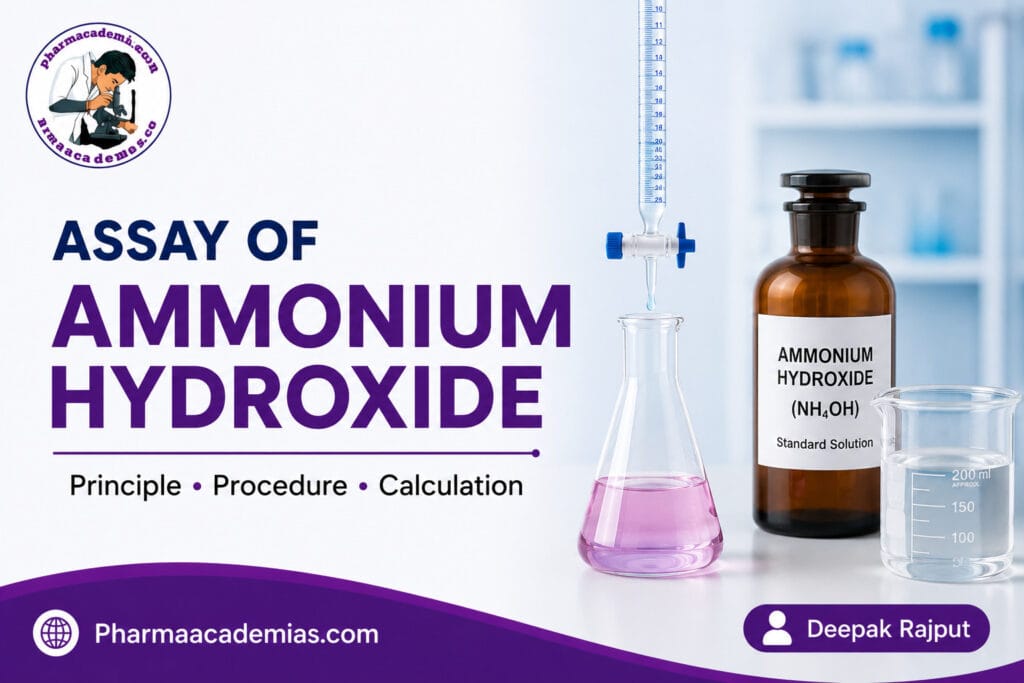
Assay of Ammonium Hydroxide: Assay of Ammonium Hydroxide is an important analytical procedure used to determine the strength or percentage purity of ammonium hydroxide (NH₄OH) present in a pharmaceutical sample. Ammonium hydroxide is a weak alkaline solution formed when ammonia gas (NH₃) dissolves in water. It is widely used in pharmaceutical industries, analytical laboratories, chemical manufacturing, textile processing, and cleaning formulations. Pharmaacademias.com
Since ammonium hydroxide is volatile and its concentration decreases on prolonged storage due to the escape of ammonia gas, it is necessary to determine its exact strength before use. The assay is performed by acid–base titration, where ammonium hydroxide is neutralized with a standard solution of hydrochloric acid (HCl). The amount of hydrochloric acid required for complete neutralization is used to calculate the concentration of ammonium hydroxide in the sample.
The assay is described in official pharmacopoeias such as the Indian Pharmacopoeia (IP), British Pharmacopoeia (BP), and United States Pharmacopeia (USP) to ensure that pharmaceutical-grade ammonium hydroxide meets the required quality standards.
Definition
An assay is a quantitative analytical method used to determine the amount or purity of an active chemical substance in a sample.
The assay of ammonium hydroxide determines the exact amount of NH₄OH present in the solution by titrating it with a standard acid.
Chemical Formula
Ammonium Hydroxide: NH₄OH
Molecular Weight: 35.05 g/mol
Nature:
- Weak base
- Colourless liquid
- Strong ammonia odour
- Completely miscible with water
- Volatile in nature
Principle
The assay is based on the neutralization reaction between a weak base (ammonium hydroxide) and a strong acid (hydrochloric acid).
When hydrochloric acid is added slowly to ammonium hydroxide, hydrogen ions (H⁺) from hydrochloric acid react with hydroxide ions (OH⁻) from ammonium hydroxide to form water, while ammonium chloride is produced as the salt.
The reaction continues until all the ammonium hydroxide has been completely neutralized. The end point is detected by using a suitable indicator, usually methyl red or methyl orange, which changes colour in the acidic pH range.
Chemical Reaction
NH₄OH + HCl → NH₄Cl + H₂O
This reaction shows that one mole of hydrochloric acid reacts with one mole of ammonium hydroxide.
Therefore,
1 Equivalent of HCl = 1 Equivalent of NH₄OH
Reaction Mechanism
During titration:
NH₄OH ⇌ NH₄⁺ + OH⁻
HCl → H⁺ + Cl⁻
H⁺ + OH⁻ → H₂O
NH₄⁺ + Cl⁻ → NH₄Cl
Overall Reaction:
NH₄OH + HCl → NH₄Cl + H₂O
Principle of Neutralization
The titration depends on the neutralization of hydrogen ions by hydroxide ions.
At the equivalence point,
Number of H⁺ ions = Number of OH⁻ ions
Complete neutralization occurs, and the amount of hydrochloric acid used is directly proportional to the amount of ammonium hydroxide present.
Type of Titration
The assay of ammonium hydroxide is classified as a:
Strong Acid – Weak Base Titration
Because:
- Hydrochloric acid is a strong acid.
- Ammonium hydroxide is a weak base.
The equivalence point occurs below pH 7 due to the formation of ammonium chloride, which undergoes slight hydrolysis and makes the solution acidic.
Indicator Used
Methyl Red (commonly recommended)
or
Methyl Orange
Why Methyl Red?
The equivalence point of a strong acid–weak base titration lies in the acidic pH range (approximately pH 5–6). Methyl red changes colour within this range, making it suitable for detecting the end point accurately.
Colour Change
Methyl Red
- Alkaline solution → Yellow
- End point → Orange
- Acidic solution → Red
Methyl Orange
- Alkaline solution → Yellow
- End point → Orange
- Acidic solution → Red
Reagents Required
- Ammonium hydroxide sample
- Standard 0.1 N Hydrochloric acid
- Methyl Red or Methyl Orange indicator
- Distilled water
Apparatus Required
- Burette
- Pipette
- Conical flask
- Volumetric flask
- Funnel
- White tile
- Wash bottle
- Glass rod
Procedure
Step 1: Rinse the burette with standard hydrochloric acid.Fill the burette with 0.1 N HCl.
Step 2: Pipette 10 mL (or the prescribed volume according to the pharmacopoeial method) of ammonium hydroxide solution into a clean conical flask.
Step 3: Dilute the sample with about 50 mL of distilled water.
Step 4: Add 2–3 drops of methyl red indicator. The solution appears yellow.
Step 5: Titrate slowly with 0.1 N hydrochloric acid while continuously swirling the flask.
Step 6: Continue adding acid until the colour changes from:
Yellow → Orange → Permanent Red
The first permanent red colour indicates the end point.
Step 7: Record the burette reading.Repeat the titration until three concordant readings are obtained.Calculate the average titre value.
Calculation
Normality Equation
N1V1 = N2V2
Where:
- (N1) = Normality of HCl
- (V1) = Volume of HCl used
- (N2) = Normality of NH₄OH
- (V2) = Volume of NH₄OH taken
Percentage Assay

Pharmacopoeial Factor
Since:
Equivalent weight of NH₄OH = 35.05
Therefore,
1 mL of 0.1 N HCl ≡ 0.003505 g of NH₄OH
This factor is commonly used to calculate the amount of ammonium hydroxide present in the sample.
Observation Table (Sample)
| Trial | Initial Burette Reading (mL) | Final Burette Reading (mL) | Volume of HCl Used (mL) |
| 1 | 0.00 | 9.80 | 9.80 |
| 2 | 0.00 | 9.75 | 9.75 |
| 3 | 0.00 | 9.78 | 9.78 |
Average Titre Value = 9.78 mL
Result
The concentration or percentage purity of ammonium hydroxide is calculated using the average titre value and the normality equation. The sample complies with pharmacopoeial specifications if the calculated assay falls within the prescribed limits.
Precautions
- Use freshly standardized hydrochloric acid.
- Keep the ammonium hydroxide bottle tightly closed because ammonia is volatile.
- Avoid prolonged exposure of the sample to air to minimize loss of ammonia.
- Read the burette at eye level to avoid parallax error.
- Add the acid slowly near the end point.
- Use only 2–3 drops of indicator, as excess indicator may affect the end point.
- Perform at least three concordant titrations and use the average titre value.
- Ensure all glassware is clean and free from contamination.
Applications
The assay of ammonium hydroxide is widely used in:
- Pharmaceutical quality control laboratories.
- Analysis of raw materials.
- Preparation and standardization of laboratory reagents.
- Chemical manufacturing industries.
- Research laboratories.
- Educational laboratory experiments.
- Validation of pharmacopoeial formulations.
Advantages
- Simple and easy to perform.
- Accurate and reliable when properly standardized.
- Economical and rapid.
- Requires only basic laboratory equipment.
- Suitable for routine quality control.
Limitations
- Ammonium hydroxide is volatile, so its concentration may decrease if not stored properly.
- Careful end-point detection is required because it is a strong acid–weak base titration.
- Exposure to atmospheric carbon dioxide or loss of ammonia may introduce errors if the sample is left open for a long time.
Conclusion
The assay of ammonium hydroxide is an important acid–base titration used to determine the exact strength or purity of ammonium hydroxide solutions. The method is based on the neutralization of ammonium hydroxide, a weak base, with standard hydrochloric acid, a strong acid, using methyl red (or methyl orange) as the indicator. Because ammonium hydroxide is volatile, careful handling, proper storage, and prompt analysis are essential for obtaining accurate results. This assay plays a significant role in pharmaceutical quality control, laboratory standardization, and routine analytical testing, ensuring that ammonium hydroxide used in pharmaceutical and industrial applications meets the required pharmacopoeial standards.
Editorial Note
This article has been carefully researched and written by Deepak Rajput with a focus on accuracy, clarity, and evidence-based healthcare information.