
pH Scale and Its Significance: The pH scale is a numerical scale used to measure the acidity or alkalinity (basicity) of a solution. It indicates the concentration of hydrogen ions (H⁺) present in a solution and is one of the most important concepts in chemistry, biology, medicine, and pharmaceutical sciences. The term pH was introduced by the Danish biochemist Søren Peder Lauritz Sørensen in 1909. Understanding pH is essential in pharmacy because it influences drug stability, solubility, absorption, formulation, and therapeutic effectiveness.
Many pharmaceutical products, such as injections, eye drops, syrups, and tablets, are formulated within a specific pH range to ensure their safety, stability, and efficacy. Even small changes in pH can significantly alter the behavior of drugs and biological systems.
Definition of pH
The term pH refers to the negative logarithm of the hydrogen ion concentration in a solution.
Mathematically:
pH = −log[H+]
where:
- pH = potential (or power) of hydrogen
- [H⁺] = concentration of hydrogen ions in moles per liter
This equation shows that pH is inversely related to hydrogen ion concentration. A high concentration of hydrogen ions results in a low pH (acidic solution), whereas a low concentration of hydrogen ions results in a high pH (basic solution).
For example:
- If [H⁺] = 10⁻¹ mol/L, pH = 1
- If [H⁺] = 10⁻⁷ mol/L, pH = 7
- If [H⁺] = 10⁻¹³ mol/L, pH = 13
Because pH is a logarithmic scale, a one-unit change in pH represents a tenfold change in hydrogen ion concentration.
pH Scale and Its Significance
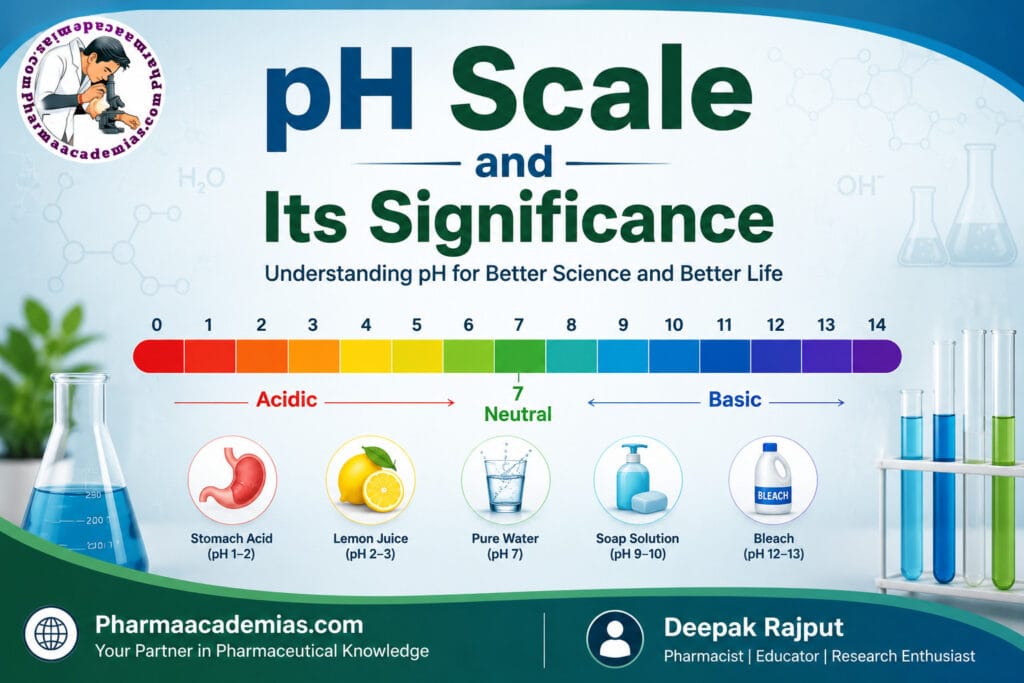
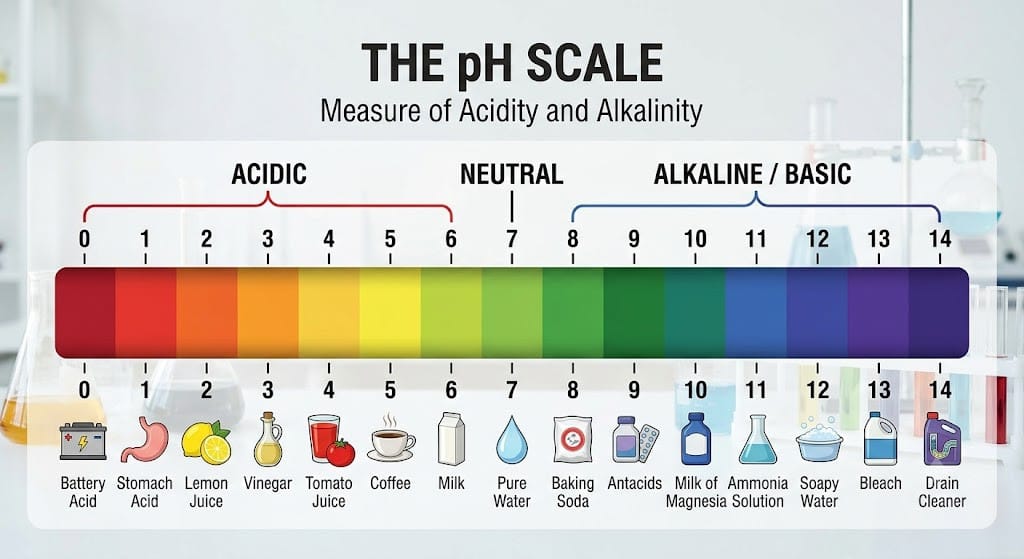
The pH scale generally ranges from 0 to 14.
- pH less than 7 = Acidic solution
- pH equal to 7 = Neutral solution
- pH greater than 7 = Basic (alkaline) solution
A lower pH indicates stronger acidity, while a higher pH indicates stronger alkalinity.
Classification of Solutions Based on pH
| pH Range | Nature of Solution |
| 0–3 | Strongly acidic |
| 4–6 | Weakly acidic |
| 7 | Neutral |
| 8–10 | Weakly alkaline |
| 11–14 | Strongly alkaline |
Common Examples of pH Values
The pH values of common substances help us understand the practical significance of the pH scale.
| Substance | Approximate pH |
| Battery acid | 0–1 |
| Gastric juice | 1–3 |
| Lemon juice | 2 |
| Vinegar | 3 |
| Orange juice | 3–4 |
| Coffee | 5 |
| Milk | 6.5 |
| Pure water | 7 |
| Human blood | 7.35–7.45 |
| Tears | 7.4 |
| Seawater | 8 |
| Baking soda solution | 8–9 |
| Soap solution | 9–10 |
| Ammonia solution | 11 |
| Sodium hydroxide solution | 13–14 |
These examples demonstrate how substances encountered in daily life vary greatly in acidity and alkalinity.
Measurement of pH
Several methods are used to determine pH.
pH Indicators: Indicators are substances that change color according to the pH of the solution.
Examples include:
- Litmus
- Phenolphthalein
- Methyl orange
- Bromothymol blue
For instance, blue litmus turns red in acidic solutions, while red litmus turns blue in alkaline solutions.
pH Paper: pH paper contains mixtures of indicators and provides an approximate pH value by comparing the color obtained with a standard color chart.
pH Meter: A pH meter is the most accurate method for measuring pH. It consists of a glass electrode connected to an electronic meter that directly displays the pH value.
In pharmaceutical industries and research laboratories, pH meters are routinely used because of their high precision and reliability.
Significance of pH in Pharmacy
The pH of a pharmaceutical formulation is one of the most critical factors affecting the quality and performance of medicines.
Effect on Drug Stability
Many drugs undergo degradation when exposed to unsuitable pH conditions. Chemical reactions such as hydrolysis and oxidation often occur more rapidly at specific pH values.
For example:
- Penicillin preparations are unstable in strongly acidic environments.
- Certain vitamins degrade rapidly under alkaline conditions.
Therefore, pharmaceutical formulations are often buffered to maintain the pH at which the drug is most stable.
Effect on Drug Solubility
The solubility of many drugs depends on pH.
Weak acidic and weak basic drugs may become more soluble when ionized.
For example:
- Aspirin is more soluble in alkaline conditions.
- Weakly basic drugs often become more soluble in acidic media.
Proper control of pH can therefore improve drug dissolution and bioavailability.
Effect on Drug Absorption
Most drugs are absorbed through biological membranes in their unionized form.
The degree of ionization depends on the pH of the environment and the drug’s pKa value.
Example: Weak Acid (Aspirin)
In the acidic stomach:
- Predominantly unionized
- Better membrane permeability
- Greater absorption
Example: Weak Base (Morphine)
In the acidic stomach:
- Predominantly ionized
- Reduced absorption
In the more alkaline intestine:
- More unionized
- Improved absorption
Thus, pH significantly influences the absorption and therapeutic effect of drugs.
Effect on Drug Distribution
The pH of body fluids affects the distribution of drugs between tissues and blood.
Drugs may become trapped in body compartments where they are highly ionized, a phenomenon known as ion trapping.
For example, weakly basic drugs may accumulate in acidic environments because they become ionized and cannot easily cross membranes.
Effect on Drug Excretion
The pH of urine influences renal drug excretion.
Alkalinization of urine enhances the elimination of weak acidic drugs such as salicylates.
Acidification of urine promotes the excretion of weakly basic drugs.
This principle is sometimes used in the treatment of drug poisoning and overdose.
Significance of pH in Pharmaceutical Formulations
Ophthalmic Preparations
Eye drops should have a pH close to that of tears (approximately 7.4) to minimize irritation and discomfort.
Examples include:
- Artificial tears
- Antibiotic eye drops
- Antiglaucoma preparations
Parenteral Preparations
Injectable products require careful pH adjustment because extreme pH values can cause pain, tissue damage, and precipitation of drugs.
For example:
- Intravenous solutions are generally maintained near physiological pH.
Oral Liquid Formulations
Syrups and suspensions are often buffered to maintain flavor, stability, and preservative effectiveness.
Examples:
- Antacid suspensions
- Cough syrups
- Pediatric formulations
Topical Preparations
Creams, gels, and lotions are formulated to match the natural pH of the skin (approximately 4.5–6.0) to avoid irritation and maintain skin integrity.
Physiological Significance of pH
The human body carefully regulates pH because even small changes can affect enzyme activity, metabolism, and cellular function.
Blood pH: Normal blood pH ranges from 7.35 to 7.45.Maintaining this narrow range is essential for survival.
Acidosis: When blood pH falls below 7.35, the condition is called acidosis.
Possible causes include:
- Diabetes mellitus
- Kidney failure
- Respiratory disorders
Symptoms may include fatigue, confusion, and impaired organ function.
Alkalosis: When blood pH rises above 7.45, the condition is called alkalosis.
Possible causes include:
- Excessive vomiting
- Hyperventilation
- Excessive bicarbonate intake
Symptoms may include muscle cramps, dizziness, and cardiac disturbances.
Enzyme Activity: Most enzymes function optimally within a specific pH range.
For example:
- Pepsin in the stomach functions best at pH 1.5–2.5.
- Trypsin in the intestine functions best at pH 7–8.
Changes in pH can reduce enzyme activity and interfere with normal physiological processes.
Role of Buffer Systems in Maintaining pH
Because pH is so important, the body uses buffer systems to resist sudden pH changes.
Major physiological buffers include:
Bicarbonate Buffer System
The principal extracellular buffer system.
H2CO3 ↔ H+ + HCO3−
Phosphate Buffer System
Important within cells and kidney tubules.
Protein Buffer System
Proteins, including hemoglobin, help maintain blood pH by accepting or donating hydrogen ions.
These buffer systems work continuously to maintain acid–base balance and support normal body functions.
Conclusion
The pH scale is a measure of the acidity or alkalinity of a solution and is based on the concentration of hydrogen ions. It ranges from 0 to 14, with values below 7 indicating acidity, values above 7 indicating alkalinity, and pH 7 representing neutrality. In pharmacy, pH plays a crucial role in drug stability, solubility, absorption, distribution, excretion, and formulation design. It is equally important in physiology, where precise regulation of blood and tissue pH is essential for normal cellular function. Understanding the pH scale and its significance enables pharmacists and pharmaceutical scientists to develop safe, stable, and effective pharmaceutical products while ensuring optimal therapeutic outcomes.