Cell division is a fundamental process in biology by which a single cell divides to produce two or more daughter cells. This process is essential for the growth, development, repair, and reproduction of multicellular organisms. Cell division primarily occurs in two main forms: mitosis and meiosis.
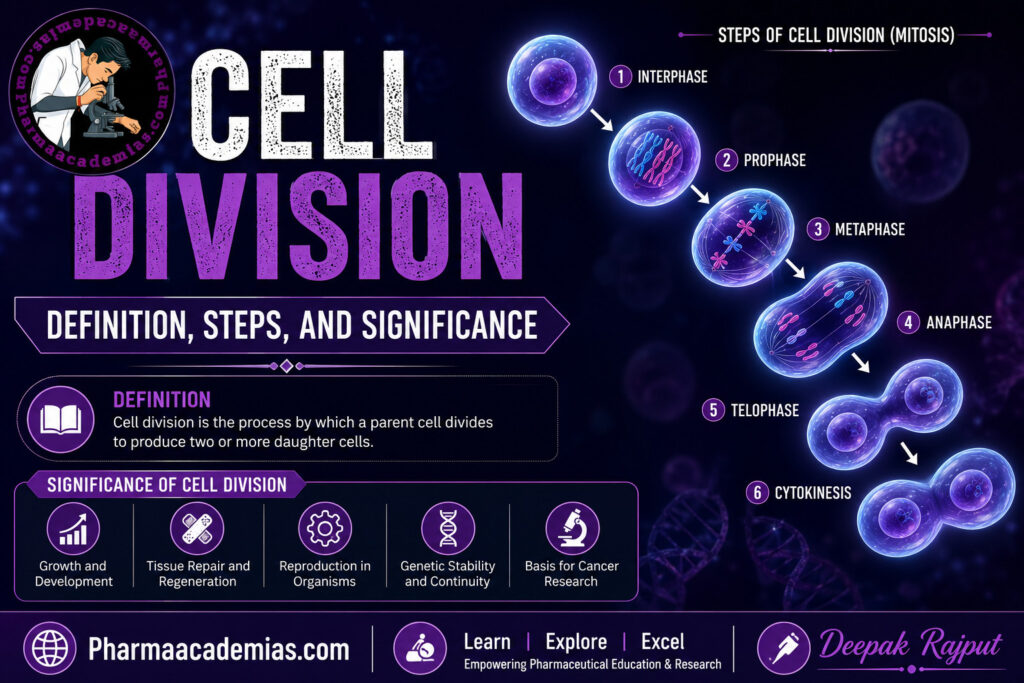
Steps in Cell division
1. Mitosis:
Mitosis is a type of cell division that results in the formation of two genetically identical daughter cells, each with the same number of chromosomes as the parent cell. It is crucial for tissue growth, repair, and maintenance in multicellular organisms. Mitosis consists of several distinct stages:
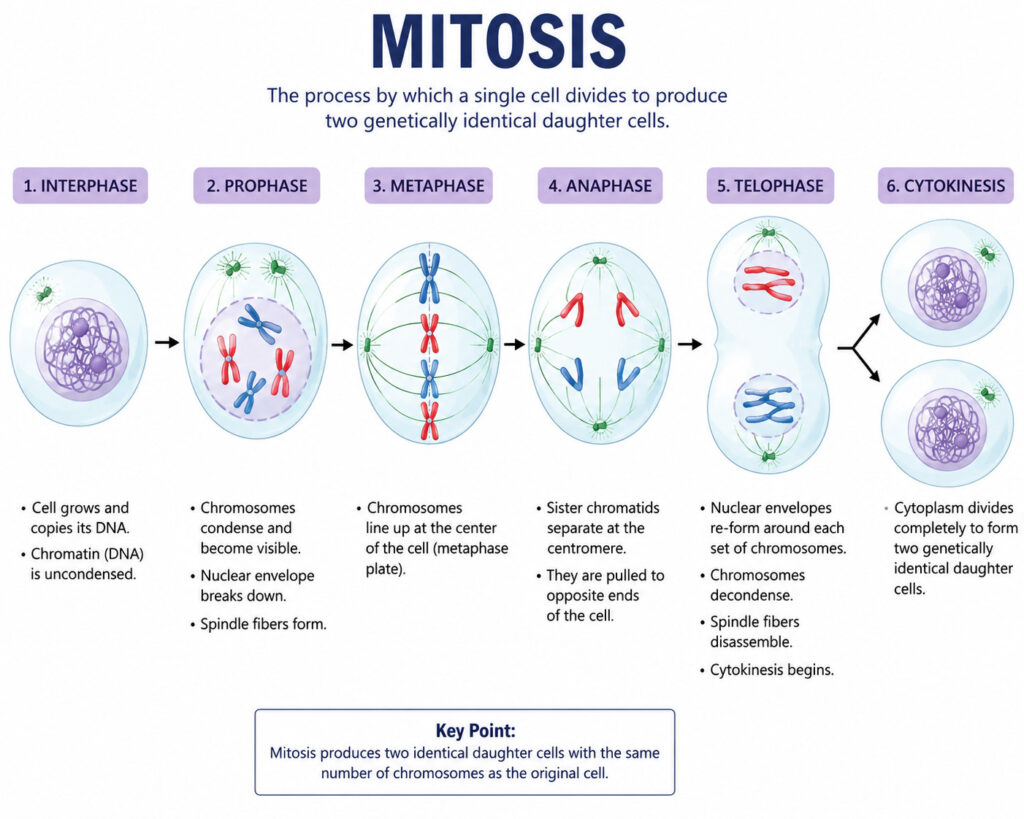
a. Interphase: This is the phase before cell division, during which the cell prepares for mitosis. It consists of three subphases: G1 (cell growth), S (DNA replication), and G2 (further growth and preparation for division).
b. Prophase: Chromatin condenses into visible chromosomes. The nuclear envelope begins to break down, and spindle fibers start forming.
c. Metaphase: Chromosomes align at the cell’s equatorial plane (the metaphase plate), guided by spindle fibers.
d. Anaphase: Sister chromatids are separated and pulled toward opposite poles of the cell. This ensures that each daughter cell receives a full set of chromosomes.
e. Telophase: Chromatids reach opposite poles and decondense into chromatin. The nuclear envelope reforms around each set of chromosomes, resulting in two nuclei.
f. Cytokinesis: This is the final step of cell division, during which the cell’s cytoplasm and organelles are divided between the two daughter cells. In animal cells, a contractile ring of actin filaments pinches the cell membrane, creating two separate cells. In plant cells, a cell plate structure forms to divide the cell.
2. Meiosis:
Meiosis is a specialized form of cell division that occurs in sexually reproducing organisms. It results in the formation of gametes (sperm and egg cells) with half the number of chromosomes as the parent cell, ensuring genetic diversity in offspring. Meiosis involves two rounds of division: meiosis I and meiosis II.
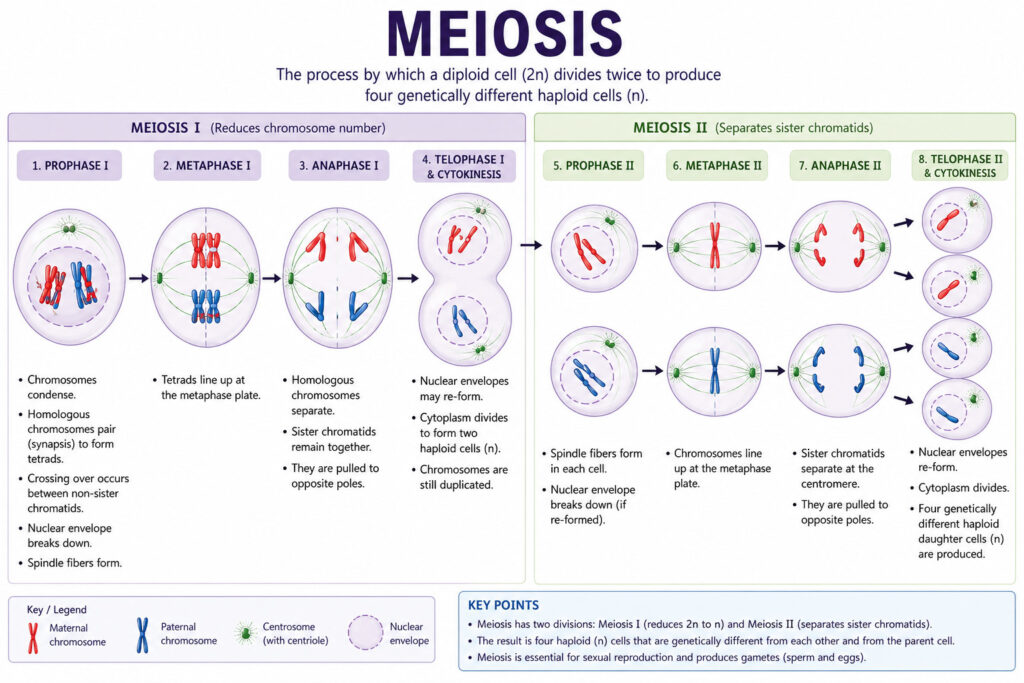
Basics Definitions
Diploid cell: A diploid cell is a type of cell that contains two complete sets of chromosomes, one inherited from each parent. In humans, diploid cells have a total of 46 chromosomes, organized into 23 pairs. These cells are typically somatic cells and are involved in the growth, development, and repair of tissues in multicellular organisms.
Haploid Cell: A haploid cell is a type of cell that contains one complete set of chromosomes, totaling half the number of chromosomes found in diploid cells. In humans, haploid cells have 23 chromosomes. These cells are involved in sexual reproduction and include gametes such as sperm and eggs.
Maternal: Refers to anything related to the mother, such as genes, chromosomes, or traits that are inherited from the mother.
Paternal: Refers to anything related to the father, such as genes, chromosomes, or traits that are inherited from the father.
Chromosomes: Chromosomes are thread-like structures made of DNA and proteins, found in the nucleus of most living cells. They carry genetic information in the form of genes, which are responsible for the inheritance of traits from one generation to the next. Humans have 46 chromosomes arranged in 23 pairs, with one set inherited from the mother (maternal) and one set from the father (paternal). Chromosomes play a crucial role in cell division, growth, and the functioning of an organism.
Genes: Genes are segments of DNA that act as instructions to make molecules, primarily proteins, which are essential for the structure, function, and regulation of the body’s tissues and organs. Each gene carries specific information that determines inherited traits, such as eye color, height, and blood type. Genes are located on chromosomes, and humans have approximately 20,000 to 25,000 genes in their genome. These genes are passed from parents to offspring and are key in determining physical and biochemical characteristics.
a. Meiosis I:
Prophase I: Chromosomes condense and form homologous pairs through synapsis. Crossing-over occurs, where genetic material is exchanged between homologous chromosomes.
- Metaphase I: Homologous pairs align at the metaphase plate.
- Anaphase I: Homologous chromosomes are separated and pulled to opposite poles of the cell.
- Telophase I: Two haploid daughter cells are formed, each with half the original number of chromosomes. Cytokinesis occurs.
b. Meiosis II:
Prophase II: Chromosomes condense again in the two haploid daughter cells.
Metaphase II: Chromosomes align individually at the metaphase plate.
Anaphase II: Sister chromatids are separated and pulled to opposite poles.
Telophase II: Four haploid daughter cells are produced, each with a unique combination of genetic material due to crossing-over and random assortment.
Significance of Cell Division
1. Growth and Development: Cell division allows organisms to grow and develop from a single fertilized egg cell into a complex multicellular organism.
2. Tissue Repair and Regeneration: Cell division is crucial for the repair and replacement of damaged or old tissues in the body. For example, skin cells constantly undergo mitosis to replace worn-out cells.
3. Reproduction: In sexually reproducing organisms, meiosis generates gametes (sperm and eggs) with half the chromosome number, ensuring genetic diversity in offspring when they fuse during fertilization.
4. Genetic Diversity: Meiosis introduces genetic diversity through processes like crossing over and random assortment, contributing to the adaptation and evolution of species.
5. Disease and Cancer: Dysregulation of cell division can lead to diseases such as cancer, characterized by uncontrolled cell growth and division.
Editorial Note
This article has been carefully researched and written by Deepak Rajput with a focus on accuracy, clarity, and evidence-based healthcare information. Pharmaacademias.com