Consultant Coding Services Trainee: The healthcare industry is rapidly evolving, creating numerous career opportunities beyond traditional clinical and pharmaceutical roles. One such high-demand profession is Medical Coding, a field that combines healthcare knowledge with data management, documentation, and reimbursement processes. Pharmaacademias.com
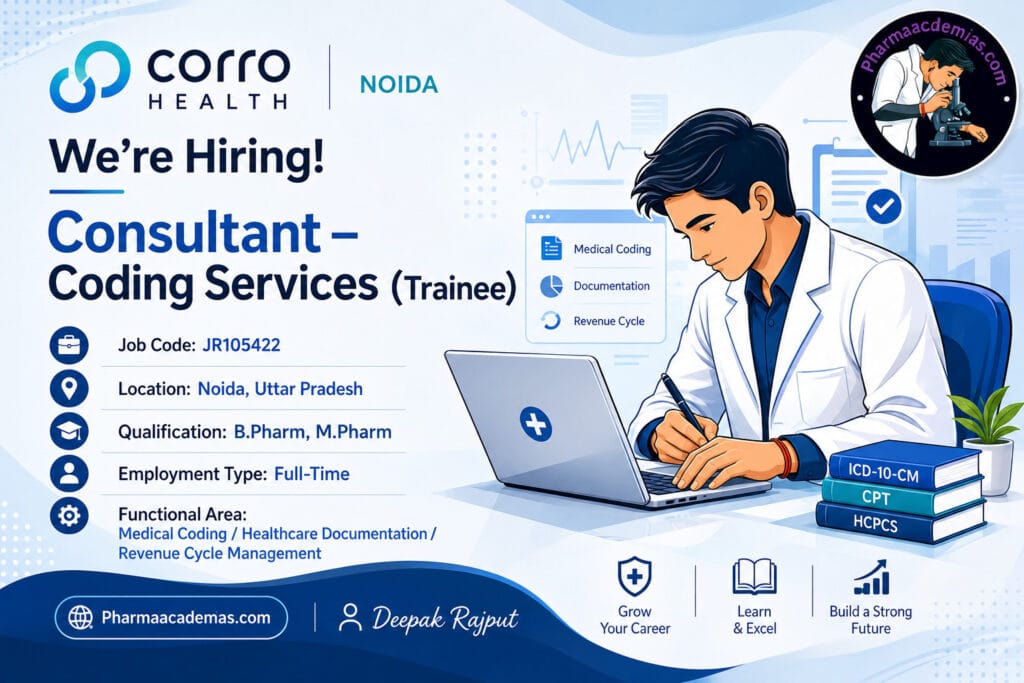
For pharmacy and life science graduates seeking a stable, intellectually engaging, and growth-oriented career, the position of Consultant – Coding Services (Trainee) in Noida (Job Code: JR105422) presents an excellent opportunity to enter the healthcare information management sector.
This role is particularly suitable for B.Pharm and M.Pharm graduates who possess a strong understanding of anatomy, physiology, disease conditions, and medical terminology. It offers an opportunity to contribute to healthcare delivery while building expertise in medical coding, healthcare compliance, and revenue cycle management.
About the Organization
The organization is committed to helping healthcare clients achieve superior financial and operational outcomes. Through advanced technology, analytics-driven solutions, and clinical expertise, the company supports healthcare providers throughout the reimbursement cycle.
The company believes that employee growth is directly linked to organizational success. Therefore, it invests heavily in training, skill development, and career advancement opportunities for its workforce. Employees are encouraged to develop professionally while working in a collaborative and innovation-driven environment.
Organizational Highlights
- Strong presence in healthcare revenue cycle management.
- Advanced technology-driven work environment.
- Continuous learning and professional development opportunities.
- Exposure to global healthcare practices and standards.
- Structured career growth pathways.
- Collaborative and supportive work culture.
Position Overview for Consultant Coding Services Trainee
Job Title: Consultant – Coding Services (Trainee)
Job Code: JR105422
Location: Noida, Uttar Pradesh
Employment Type: Full-Time
Functional Area: Medical Coding / Healthcare Documentation / Revenue Cycle Management
What is Medical Coding?
Medical coding is the process of translating healthcare diagnoses, treatments, procedures, and medical services into universally accepted alphanumeric codes.
Healthcare providers document patient encounters, and medical coders review these records to assign standardized codes that are used for:
- Insurance claims processing
- Reimbursement and billing
- Healthcare analytics
- Clinical research
- Regulatory compliance
- Hospital performance tracking
- Epidemiological studies
Medical coding serves as a bridge between healthcare providers and insurance companies, ensuring accurate communication and appropriate reimbursement.
Why is Medical Coding Important?
Medical coding is one of the most critical components of modern healthcare systems.
Accurate Billing: Proper coding ensures healthcare providers receive accurate reimbursement for services rendered.
Regulatory Compliance: Correct coding helps healthcare organizations comply with government regulations and industry standards.
Data Standardization: Standardized coding facilitates healthcare data analysis and reporting.
Improved Patient Care: Accurate documentation contributes to continuity of care and informed clinical decision-making.
Healthcare Research: Coded healthcare data is widely used in public health studies, clinical research, and healthcare policy development.
Roles and Responsibilities
As a Consultant – Coding Services (Trainee), you will be responsible for reviewing patient records and assigning appropriate medical codes while ensuring compliance with coding guidelines and healthcare regulations.
1. Reviewing Patient Medical Records
The primary responsibility involves examining patient records, discharge summaries, physician notes, operative reports, and other clinical documentation.
You will:
- Analyze medical documentation.
- Understand diagnoses and procedures.
- Verify completeness of records.
- Ensure documentation accuracy.
2. Extracting Clinical Information
Medical records often contain large amounts of information. Coders must identify relevant details necessary for coding purposes.
Examples include:
- Patient diagnosis
- Surgical procedures
- Laboratory findings
- Medical interventions
- Follow-up treatments
3. Assigning Medical Codes
One of the most important responsibilities is assigning standardized medical codes based on documented services and diagnoses.
ICD-10-CM Codes
Used for disease classification and diagnosis coding.
Examples:
- Diabetes Mellitus
- Hypertension
- Asthma
- Chronic Kidney Disease
CPT Codes
Used to report medical procedures and services.
Examples:
- Consultation services
- Surgical procedures
- Diagnostic testing
- Radiological examinations
HCPCS Codes
Used for supplies, equipment, and services not covered by CPT codes.
Examples:
- Wheelchairs
- Prosthetic devices
- Ambulance services
DRG Codes: Used for inpatient reimbursement categorization.
APC Codes: Used primarily in outpatient reimbursement systems.
ASA Codes: Used in anesthesia-related documentation and billing.
4. Conducting Documentation Audits
The trainee will perform audits to verify:
- Coding accuracy
- Documentation completeness
- Compliance with coding standards
- Billing consistency
Regular audits help prevent claim denials and revenue loss.
5. Maintaining Coding Compliance
Healthcare coding guidelines are continuously updated.
You will ensure compliance with:
- ICD coding guidelines
- CPT coding updates
- Medicare regulations
- Insurance requirements
- Internal quality standards
6. Ensuring Diagnosis-Code Accuracy
A coder must verify that assigned codes accurately reflect physician diagnoses and treatments.
Incorrect coding can lead to:
- Claim denials
- Revenue loss
- Legal risks
- Compliance violations
Therefore, attention to detail is essential.
7. Staying Updated with Coding Changes
Healthcare coding systems undergo annual revisions.
Medical coders must regularly learn:
- New diagnosis codes
- Deleted codes
- Modified coding guidelines
- Regulatory updates
Continuous learning is a major aspect of this profession.
8. Resolving Coding and Billing Queries
The role may involve collaborating with:
- Physicians
- Healthcare providers
- Billing departments
- Quality teams
This ensures coding-related concerns are resolved effectively.
Eligibility Criteria
Educational Qualification: The organization is looking for candidates from healthcare and life science backgrounds.
Eligible qualifications include:
Bachelor of Pharmacy (B.Pharm)
Pharmacy graduates possess strong knowledge of:
- Human anatomy
- Physiology
- Pharmacology
- Pathology
- Disease mechanisms
These subjects provide an excellent foundation for medical coding.
Master of Pharmacy (M.Pharm)
M.Pharm graduates bring advanced expertise in:
- Clinical pharmacology
- Therapeutics
- Drug safety
- Healthcare systems
Such knowledge enhances coding accuracy and clinical understanding.
Other Life Science Graduates
Candidates with anatomy and physiology as core subjects may also be eligible.
Preferred Experience
Freshers: Motivated fresh graduates with strong medical knowledge may be considered for trainee roles.
Experienced Candidates
Preferred experience:
- 6 months to 2 years in Medical Coding
- Healthcare documentation
- Medical billing
- Revenue cycle management
Preferred Certifications
Professional coding certifications significantly enhance employability.
AAPC Certifications
CPC (Certified Professional Coder): Industry-recognized certification for physician-based coding.
COC (Certified Outpatient Coder): Focused on outpatient facility coding.
CRC (Certified Risk Adjustment Coder): Specialized in risk-adjustment coding.
CPCP: Compliance-focused certification.
AHIMA Certifications
CCS (Certified Coding Specialist): One of the most respected coding credentials.
CCS-P: Physician-based coding specialization.
CCA: Entry-level coding certification for beginners.
Essential Skills Required
Successful candidates should possess:
Technical Skills
- Medical terminology knowledge
- Anatomy and physiology understanding
- ICD-10-CM coding awareness
- CPT coding concepts
- Computer proficiency
- Documentation review skills
Soft Skills
- Communication skills
- Attention to detail
- Critical thinking
- Time management
- Organizational abilities
- Team collaboration
Why B.Pharm and M.Pharm Graduates Are Ideal for Medical Coding
Pharmacy graduates already possess much of the foundational knowledge required for coding.
They understand:
- Disease pathology
- Drug therapy
- Clinical terminology
- Diagnostic procedures
- Healthcare documentation
As a result, they can transition into medical coding relatively smoothly after appropriate training.
Career Growth Opportunities
Medical coding offers structured career progression.
Entry Level
- Medical Coding Trainee
- Junior Medical Coder
Mid-Level
- Medical Coder
- Senior Medical Coder
- Coding Specialist
Advanced Roles
- Quality Analyst
- Coding Auditor
- Coding Trainer
- Team Leader
- Assistant Manager
Leadership Positions
- Coding Manager
- Operations Manager
- Revenue Cycle Manager
- Healthcare Compliance Manager
Salary Expectations
Salary varies based on education, certification, and experience.
Typical salary ranges in India:
- Freshers: ₹2.5–4.5 LPA
- 1–3 Years Experience: ₹4–7 LPA
- Certified Coders: ₹5–10+ LPA
- Senior Auditors and Managers: ₹10–20+ LPA
Professionals with CPC or CCS certifications often command higher compensation.
Why Choose This Opportunity?
This role provides:
✔ Strong healthcare industry exposure
✔ Professional training and mentorship
✔ Stable and growing career path
✔ Opportunity to apply pharmaceutical knowledge
✔ Exposure to international healthcare standards
✔ Long-term career advancement potential
✔ Skill development in coding, compliance, and healthcare analytics
Apply Now
Final Thoughts
The Consultant – Coding Services (Trainee) position in Noida is an excellent opportunity for B.Pharm, M.Pharm, and life science graduates who wish to build a career in the healthcare industry outside traditional pharmacy practice.
Medical coding continues to be one of the fastest-growing healthcare support professions worldwide. With increasing demand for accurate healthcare documentation, insurance processing, and regulatory compliance, skilled medical coders are becoming indispensable to healthcare organizations.
For pharmacy graduates seeking a stable, rewarding, and future-oriented career, this role can serve as an ideal gateway into healthcare information management, coding compliance, and revenue cycle operations. By combining clinical knowledge with analytical and documentation skills, candidates can establish a successful long-term career in the healthcare domain.