Capsule Sizes: Hard gelatin capsules are manufactured in standardized sizes to accommodate different quantities of drugs and excipients. The selection of capsule size depends on several factors, including the dose of the active pharmaceutical ingredient (API), bulk density of the powder, volume of the formulation, patient acceptability, and ease of swallowing.
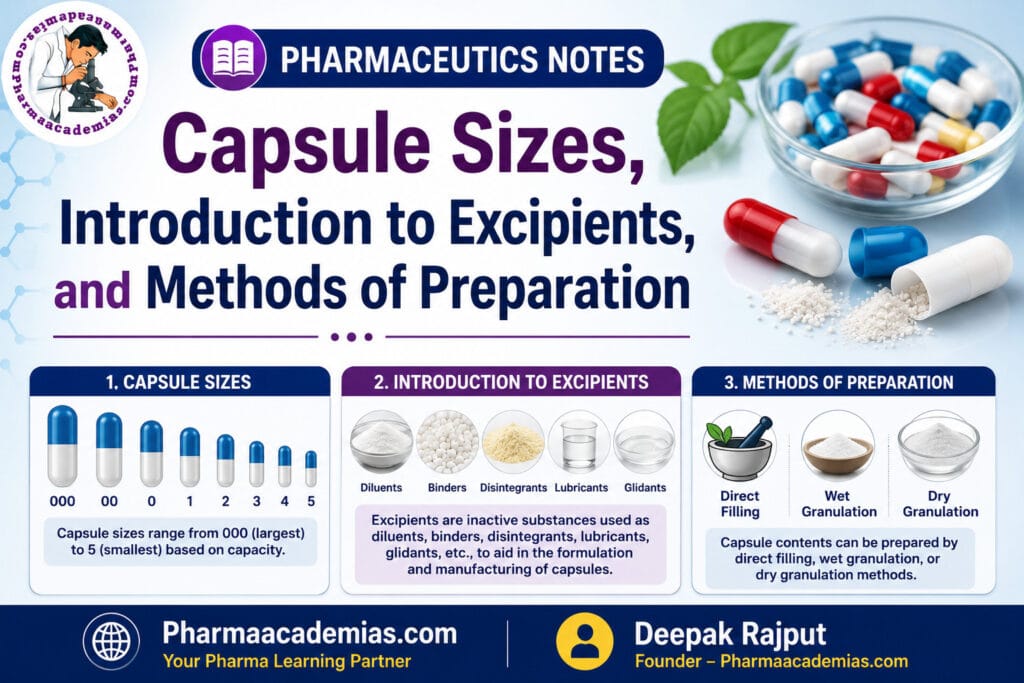
Capsule sizes are identified by numbers. The size 000 is the largest, while 5 is the smallest. Larger capsules are generally used for high-dose formulations, whereas smaller capsules are preferred for potent drugs requiring smaller quantities.
Standard Capsule Sizes
| Capsule Size | Approximate Volume (mL) | Approximate Capacity* | Common Use |
| 000 | 1.37 | 800–1000 mg | Large-dose formulations |
| 00 | 0.95 | 600–800 mg | Antibiotics, nutraceuticals |
| 0 | 0.68 | 400–600 mg | Most common pharmaceutical capsules |
| 1 | 0.50 | 300–400 mg | Moderate-dose formulations |
| 2 | 0.37 | 200–300 mg | Low-dose drugs |
| 3 | 0.30 | 150–200 mg | Potent drugs |
| 4 | 0.21 | 100–150 mg | Pediatric or low-dose preparations |
| 5 | 0.13 | 60–100 mg | Smallest size; potent drugs |
Note: The filling capacity depends on the bulk density of the powder. Light powders occupy more volume than dense powders; therefore, the exact weight that can be filled varies with the formulation.
Selection of Capsule Size
The choice of capsule size depends on several factors:
- Dose of the active pharmaceutical ingredient.
- Bulk density of the powder blend.
- Quantity of excipients added.
- Ease of swallowing by the patient.
- Manufacturing and filling equipment.
- Patient age (adult or pediatric).
For example, size 0 and size 00 capsules are commonly used for adult oral medications, while sizes 3, 4, and 5 are often used for pediatric formulations or potent drugs that require only a small amount of powder.
Introduction to Excipients
Excipients are pharmacologically inactive substances that are mixed with the active pharmaceutical ingredient (API) to prepare a pharmaceutical dosage form. Although they do not produce therapeutic effects, excipients are essential for ensuring the quality, stability, manufacturability, and patient acceptability of medicines.
The word “excipient” originates from the Latin word excipere, meaning “to receive.” Excipients act as carriers for the drug and help convert the active ingredient into a stable and effective dosage form.
Importance of Excipients in Capsules
Capsule formulations contain excipients to improve manufacturing and product performance. Their major functions include:
- Increasing the bulk of low-dose drugs.
- Improving powder flow during capsule filling.
- Enhancing content uniformity.
- Improving drug stability.
- Promoting rapid disintegration and dissolution.
- Protecting the drug from moisture and oxidation.
- Improving patient acceptability by masking taste and odor.
Without suitable excipients, many capsule formulations would not have the desired quality, stability, or therapeutic performance.
Ideal Properties of Excipients
An ideal pharmaceutical excipient should:
- Be pharmacologically inert.
- Be non-toxic and non-irritating.
- Be chemically compatible with the drug.
- Be physically and chemically stable.
- Improve manufacturability.
- Be economical and readily available.
- Comply with pharmacopeial standards.
- Not interfere with drug absorption or therapeutic action.
Classification of Excipients Used in Capsules
1. Diluents (Fillers): Diluents increase the bulk of formulations containing small quantities of drug and ensure proper filling of capsules.
Examples
- Lactose
- Microcrystalline Cellulose (MCC)
- Mannitol
- Dicalcium Phosphate
2. Lubricants: Lubricants reduce friction during capsule filling and prevent sticking of the powder to machinery.
Examples
- Magnesium Stearate
- Stearic Acid
3. Glidants: Glidants improve the flow properties of powders, ensuring uniform capsule filling.
Examples
- Talc
- Colloidal Silicon Dioxide
4. Disintegrants: Disintegrants facilitate the breakup of capsule contents after the shell dissolves, promoting rapid drug release.
Examples
- Sodium Starch Glycolate
- Crospovidone
- Croscarmellose Sodium
5. Wetting Agents: These agents improve the wetting and dissolution of poorly soluble drugs.
Examples
- Sodium Lauryl Sulfate
- Polysorbate 80
6. Preservatives: Preservatives inhibit microbial growth, especially in soft gelatin capsules containing liquid formulations.
Examples
- Methyl Paraben
- Propyl Paraben
7. Antioxidants: Antioxidants protect drugs from oxidative degradation.
Examples
- Ascorbic Acid
- Sodium Metabisulfite
- Butylated Hydroxytoluene (BHT)
8. Coloring and Opacifying Agents: These improve the appearance of capsules and protect light-sensitive drugs.
Examples
- Iron Oxides
- Titanium Dioxide
Methods of Preparation of Capsules
Capsules are prepared by filling the drug formulation into either hard gelatin capsules or soft gelatin capsules. The preparation method depends on the type of capsule and the nature of the formulation.
The two principal methods are:
- Preparation of Hard Gelatin Capsules
- Preparation of Soft Gelatin Capsules
1. Preparation of Hard Gelatin Capsules
Principle
Hard gelatin capsules are prepared by filling accurately weighed powders, granules, pellets, or mini-tablets into empty capsule shells. The capsule body is filled with the formulation, and the cap is then placed over the body to close the capsule.
Steps in the Preparation of Hard Gelatin Capsules
1. Weighing: The active pharmaceutical ingredient and excipients are accurately weighed according to the formulation.
2. Sieving: All ingredients are passed through appropriate sieves to obtain a uniform particle size and remove foreign particles.
3. Mixing: The API is blended uniformly with excipients such as diluents, lubricants, glidants, and disintegrants until a homogeneous mixture is obtained.
4. Capsule Filling: The powder blend is filled into empty hard gelatin capsule shells manually or by automatic capsule-filling machines.
5. Capsule Closing: The capsule cap is fitted securely over the body to prevent leakage or loss of contents.
6. Polishing: The filled capsules are polished to remove any adhering powder from the outer surface, improving appearance.
7. Packaging: Finished capsules are packed in blister packs, strip packs, or bottles to protect them from moisture and contamination.
Advantages of Hard Capsule Preparation
- Simple manufacturing process.
- Suitable for powders, granules, and pellets.
- Accurate dosing.
- Easy quality control.
- Economical for large-scale production.
2. Preparation of Soft Gelatin Capsules
Principle
Soft gelatin capsules are manufactured by filling liquid or semi-solid formulations into soft gelatin shells and sealing them in a single operation.
Unlike hard capsules, soft capsules are prepared, filled, and sealed simultaneously.
Steps in the Preparation of Soft Gelatin Capsules
1. Preparation of Gelatin Mass: Gelatin is mixed with water, plasticizers (glycerin or sorbitol), coloring agents, and preservatives to prepare a flexible gelatin mass.
2. Preparation of Fill Material: The drug is dissolved or dispersed in suitable oils, solvents, or semi-solid vehicles to prepare a uniform filling material.
3. Encapsulation: The gelatin ribbons and fill material are brought together using specialized equipment (commonly the rotary die process), where capsules are formed, filled, and hermetically sealed in a single continuous operation.
4. Drying: Freshly prepared capsules contain excess moisture. They are dried under controlled temperature and humidity until the desired moisture content is achieved.
5. Inspection: Capsules are inspected for leakage, deformation, weight variation, and other defects.
6. Packaging: Finished capsules are packaged in moisture-resistant containers such as blister packs or bottles.
Advantages of Soft Capsule Preparation
- Suitable for oils and liquid formulations.
- Excellent dose uniformity.
- Improved bioavailability of poorly soluble drugs.
- Protection from oxidation and contamination.
- Attractive appearance and easy swallowing.
Flow Chart: Preparation of Hard Gelatin Capsules
Weighing of Drug and Excipients
↓
Sieving
↓
Mixing
↓
Capsule Filling
↓
Capsule Closing
↓
Polishing
↓
Packaging
Flow Chart: Preparation of Soft Gelatin Capsules
Preparation of Gelatin Mass
↓
Preparation of Fill Material
↓
Encapsulation and Sealing
↓
Drying
↓
Inspection
↓
Packaging
Difference Between Preparation of Hard and Soft Gelatin Capsules
| Feature | Hard Gelatin Capsules | Soft Gelatin Capsules |
| Shell | Two-piece | One-piece |
| Fill Material | Powders, granules, pellets | Liquids, oils, semi-solids |
| Filling | Separate operation | Simultaneous with shell formation |
| Sealing | After filling | During manufacture |
| Manufacturing Equipment | Capsule-filling machine | Rotary die process |
| Cost | Lower | Higher |
| Common Examples | Amoxicillin, Omeprazole | Fish Oil, Vitamin E |
Conclusion
Capsules are highly versatile pharmaceutical dosage forms available in standard sizes ranging from 000 (largest) to 5 (smallest) to accommodate different drug doses and formulation requirements. The appropriate capsule size is selected based on the quantity and bulk density of the formulation, as well as patient convenience.
Excipients play a crucial role in capsule formulation by improving powder flow, ensuring uniform filling, enhancing stability, promoting disintegration, and increasing patient acceptability. Depending on the nature of the drug and dosage form, capsules are prepared as hard gelatin capsules or soft gelatin capsules. Hard capsules are mainly used for solid formulations such as powders and granules, while soft gelatin capsules are ideal for liquids, oils, and semi-solid preparations. Proper selection of capsule size, excipients, and manufacturing method ensures the production of safe, stable, and effective pharmaceutical products.