Skip to content

  • Home
  • CoursesExpand
    • B.Pharm Old Syllabus Notes (Archive)Expand
      • SEM-I oldExpand
        • Human Anatomy and Physiology-IExpand
          • Unit 1
          • Unit 2
          • Unit 3
          • Unit 4
          • Unit 5
        • Pharmaceutical AnalysisExpand
          • Unit 1
          • Unit 2
          • Unit 3
          • Unit 4
          • Unit 5
        • Pharmaceutics – 1Expand
          • Unit 1
          • Unit 2
          • Unit 3
          • Unit 4
          • Unit 5
        • Pharmaceutical Inorganic ChemistryExpand
          • Unit 1
          • Unit 2
          • Unit 3
          • Unit 4
          • Unit 5
        • Remedial BiologyExpand
          • Unit 1
          • rb Unit 2
      • SEM-IIExpand
        • Human Anatomy and Physiology – IIExpand
          • Unit 1
          • Unit 2
          • Unit 3
          • Unit 4
          • Unit 5
        • BiochemistryExpand
          • Unit 1
          • Unit 2
          • Unit 3
          • Unit 4
          • Unit 5
        • PathophysiologyExpand
          • Unit 1
          • Unit 2
          • Unit 3
          • Unit 4
          • Unit 5
        • Pharmaceutical Organic Chemistry IExpand
          • poc1 Unit 1
      • SEM-IIIExpand
        • Pharmaceutical Organic Chemistr IIExpand
          • Unit 1
          • Unit 2
          • Unit 3
          • Unit 4
          • Unit 5
        • Physical Pharmaceutics IExpand
          • Unit 1
          • Unit 2
          • Unit 3
          • Unit 4
          • Unit 5
        • Pharmaceutical MicrobiologyExpand
          • Unit 1
          • Unit 2
          • Unit 3
          • Unit 4
          • Unit 5
        • Pharmaceutical EngineeringExpand
          • Unit 1
          • Unit 2
          • Unit 3
          • Unit 4
          • Unit 5
        • Universal human values and professional ethicsExpand
          • value Unit 1
      • SEM-IVExpand
        • Pharmaceutical Organic Chemistry IIIExpand
          • POC 3 Unit 1
          • POC 3 Unit 2
        • Medicinal Chemistry – IExpand
          • Unit 1
        • Physical Pharmaceutics – IIExpand
          • Unit 1
          • pp2 Unit 2
        • Pharmacology-1Expand
          • Unit 1
          • Unit 2
          • Unit 3
          • Unit 4
          • Unit 5
        • Pharmacognosy and Phytochemistry – IExpand
          • Unit 1
          • Unit 2
          • Unit 3
          • Unit 4
          • Unit 5
      • SEM-VExpand
        • Medicinal Chemistry IIExpand
          • mc2 Unit 1
        • Industrial Pharmacy IExpand
          • Unit 1
          • Unit 2
          • BIP Unit 3
          • BIP Unit 4
        • Pharmacology-IIExpand
          • Unit 1
          • Unit 2
          • colo2 Unit 3
        • Pharmacognosy & Phytochemistry IIExpand
          • Unit 1
          • Unit 2
          • cog Unit 3
        • Pharmaceutical JurisprudenceExpand
          • Unit 1
          • Unit 2
          • Unit 3
          • juris Unit 4
      • SEM-VIExpand
        • Medicinal Chemistry IIIExpand
          • MC III Unit 1
        • Herbal Drug TechnologyExpand
          • Unit 1
          • HDT Unit 2
        • Biopharmaceutics & PharmacokineticsExpand
          • kinet Unit 1
          • Kinet Unit 2
        • Pharmaceutical BiotechnologyExpand
          • Unit 1
          • Unit 2
          • biotech Unit 3
        • Pharmaceutical Quality AssuranceExpand
          • Unit 1
      • SEM- VIIExpand
        • Instrumental Method of AnalysisExpand
          • lysis Unit 1
          • Unit 3
          • Unit 4
          • Unit 5
        • Industrial Pharmacy-IIExpand
          • IP 2 Unit 1
        • Pharmacy PracticeExpand
          • Unit 1
          • pp Unit 2
        • Novel Drug Delivery SystemExpand
          • Unit 1
          • ndds Unit 2
      • SEM-VIIIExpand
        • Biostatistics and Research MethodologyExpand
          • Unit 1
        • PharmacovigilanceExpand
          • Unit-1
          • Unit 2
          • Unit 3
          • vigi Unit 4
        • Social and Preventive PharmacyExpand
          • Social Unit 1
    • B.Pharm New PCI Syllabus 2026Expand
      • SEM-1 newExpand
        • Basics of Python Programming for Pharmaceutical SciencesExpand
          • Unit 1
        • General PharmacyExpand
          • Unit 1
          • Unit 2
          • GP Unit 3
        • Healthcare Psychology and Communication SkillsExpand
          • Unit 1
        • Human Anatomy, Physiology and Pathophysiology IExpand
          • New HAP Unit 1
        • Introduction to PharmacognosyExpand
          • ITP Unit 1
        • Pharmaceutical Inorganic and Analytical ChemistryExpand
          • Unit 1
    • D.PharmaExpand
      • PharmaceuticsExpand
        • Chapter 1
        • Chapter 2
        • Chpater 3
        • Chpater 4
        • dceu Chapter 5
      • Pharmaceutical ChemistryExpand
        • Chapter 1
        • Chapter 2
        • Chapter 3
        • Chapter 4
        • Chapter 5
        • dchem Chapter 6
      • PharmacognosyExpand
        • Chapter 3
        • Chapter 1
        • Chapter 2
        • Chapter 4
        • cogno Chapter 5
      • Human Anatomy and PhysiologyExpand
        • Chapter 1
        • Chapter 2
        • Chapter 3
        • Chapter 4
        • Chapter 5
        • Chapter 6
        • Chapter 7
        • Chapter 8
        • Chapter 9
        • Chapter 10
        • Chapter 11
        • Chapter 12
        • Chapter 13
        • Chapter 14
        • Chapter 15
      • Social PharmacyExpand
        • Chapter 1
        • Chapter 2
        • Chapter 3
        • sp Chapter 4
      • PharmacologyExpand
        • Chapter 1
        • Chapter 2
        • Chapter 3
        • Chapter 4
        • Chapter 5
        • Chapter 6
        • Chapter 7
        • Chapter 8
        • Chapter 9
        • Chapter 10
        • Chapter 11
        • Chapter 12
        • Chapter 13
      • Community pharmacy and managementExpand
        • Chapter 1
        • Chapter 2
        • Chapter 3
        • Chapter 5
        • Chapter 6
        • Chapter 7
        • cpm Chapter 8
      • Biochemistry & Clinical PathologyExpand
        • Chapter 1
        • Chapter 2
        • Chapter 3
        • Chapter 4
        • Chapter 5
        • Chapter 6
        • Chapter 7
      • PharmacotherapeuticsExpand
        • Chapter 1
        • the Chapter 2
      • Hospital and Clinical PharmacyExpand
        • Chapter 1
        • Chapter 2
        • hcp Chapter 3
      • Pharmacy law and EthicsExpand
        • Chapter 1
        • Chapter 2
    • M.PharmExpand
      • Pharmacology Branch
    • Pharm DExpand
      • Human Anatomy & Physiology (D)Expand
        • Unit 1
        • Unit 2
        • Unit 3
        • hap Unit 4 (D)
        • Unit 5
        • Unit 6
        • Unit 7
        • Unit 8
        • Unit 9
        • Unit 10
        • Unit 11
        • Unit 12
        • hap Unit 13
    • DMLTExpand
      • dmlt 1 yearExpand
        • Anatomy and Physiology
  • Study MaterialExpand
    • Practicals
    • Notes pdf
    • Previous year papers
    • Books
  • Blog
  • Jobs
  • Syllabus
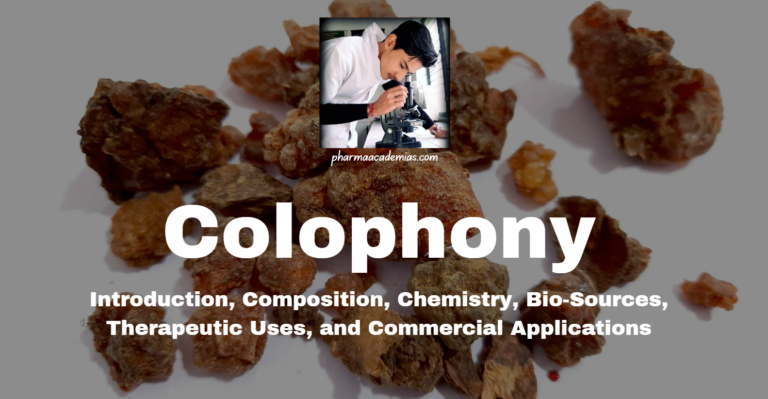
  • Colophony: Introduction, Composition, Chemistry, Bio-Sources, Therapeutic Uses, and Commercial Applications 1. Introduction
    Home | Unit 2

    Colophony: Introduction, Composition, Chemistry, Bio-Sources, Therapeutic Uses, and Commercial Applications 1. Introduction

    ByDeepak Rajput March 29, 2025March 29, 2025

    1. Introduction to Colophony Colophony, also known as rosin, is a natural resin obtained from pine trees (Pinus species). It is a brittle, translucent substance that is primarily composed of resin acids and is widely used in adhesives, coatings, inks, and pharmaceuticals. Colophony has a long history of industrial and medicinal applications, particularly for its…

    Read More Colophony: Introduction, Composition, Chemistry, Bio-Sources, Therapeutic Uses, and Commercial Applications 1. IntroductionContinue

  • Myrrh: Introduction, Composition, Chemistry, Bio-Sources, Therapeutic Uses, and Commercial Applications
    Home | Unit 2

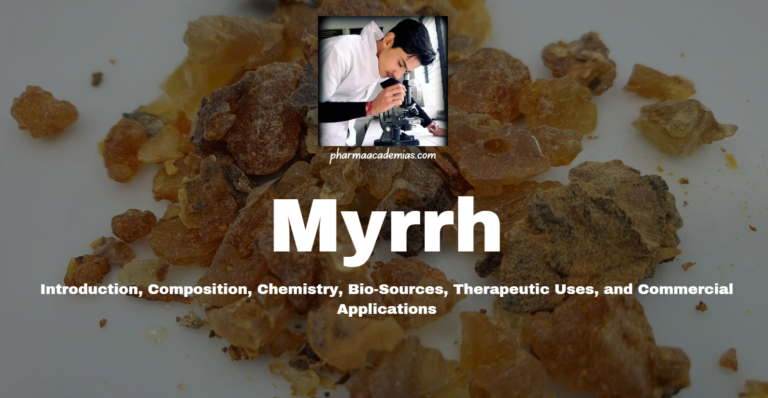
    Myrrh: Introduction, Composition, Chemistry, Bio-Sources, Therapeutic Uses, and Commercial Applications

    ByDeepak Rajput March 29, 2025March 29, 2025

    1. Introduction to Myrrh Myrrh is a natural resin obtained from trees of the genus Commiphora, mainly Commiphora myrrha and Commiphora gileadensis. It has been used since ancient times in traditional medicine, religious rituals, and perfumery. Myrrh is particularly famous for its aromatic properties and medicinal benefits, being an integral part of the pharmacopeias of…

    Read More Myrrh: Introduction, Composition, Chemistry, Bio-Sources, Therapeutic Uses, and Commercial ApplicationsContinue

  • Asafoetida: Introduction, Composition, Chemistry, Bio-Sources, Therapeutic Uses, and Commercial Applications
    Home | Unit 2

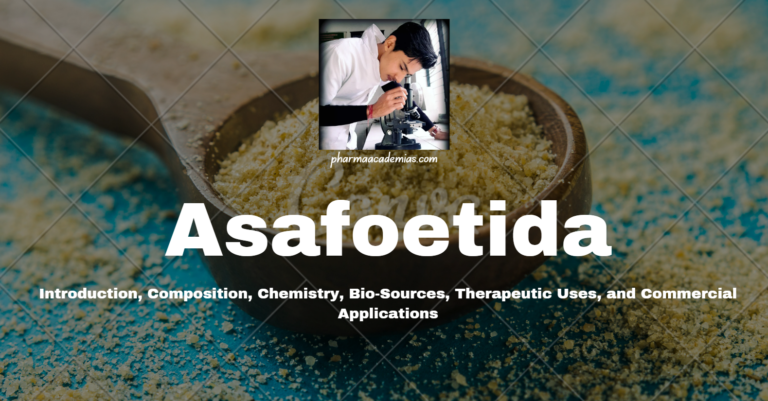
    Asafoetida: Introduction, Composition, Chemistry, Bio-Sources, Therapeutic Uses, and Commercial Applications

    ByDeepak Rajput March 28, 2025March 28, 2025

    1. General Introduction of Asafoetida Asafoetida, commonly known as “Hing”, is a gum resin obtained from the rhizome and taproot of various species of the Ferula genus, mainly Ferula assa-foetida. It is widely used in traditional medicine and as a flavoring agent in cooking, particularly in Indian, Persian, and Middle Eastern cuisines. Asafoetida is known…

    Read More Asafoetida: Introduction, Composition, Chemistry, Bio-Sources, Therapeutic Uses, and Commercial ApplicationsContinue

  • Ginger: Introduction, Composition, Chemistry, Bio-Sources, Therapeutic Uses, and Commercial Applications
    Home | Unit 2

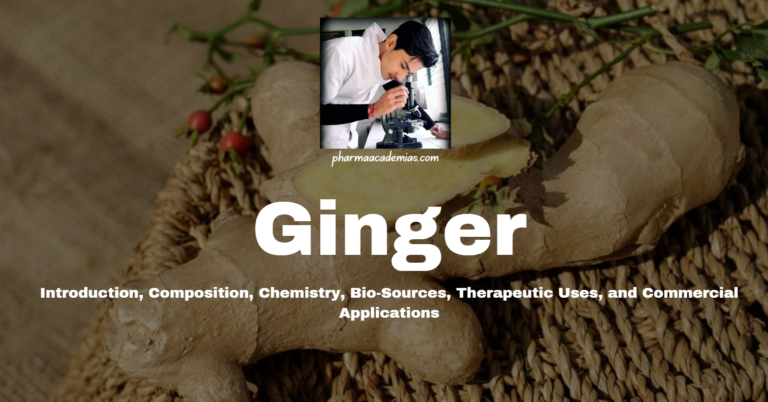
    Ginger: Introduction, Composition, Chemistry, Bio-Sources, Therapeutic Uses, and Commercial Applications

    ByDeepak Rajput March 28, 2025March 28, 2025

    1. General Introduction of Ginger Ginger (Zingiber officinale) is a flowering plant belonging to the family Zingiberaceae and is widely used as a spice, condiment, and medicinal herb. It is native to Southeast Asia and is now cultivated in tropical and subtropical regions worldwide. Ginger has been an integral part of traditional medicine systems, including…

    Read More Ginger: Introduction, Composition, Chemistry, Bio-Sources, Therapeutic Uses, and Commercial ApplicationsContinue

  • Blog

    NIPER JEE-2025: A Gateway to Excellence in Pharmaceutical Sciences

    ByDeepak Rajput March 28, 2025March 28, 2025

    NIPER JEE-2025: The National Institute of Pharmaceutical Education & Research (NIPER) is one of India’s most prestigious institutions dedicated to pharmaceutical education and research. It is recognized as an Institute of National Importance by the Government of India. To ensure the best talent is admitted into its Master’s and Ph.D. programs, NIPER conducts the NIPER…

    Read More NIPER JEE-2025: A Gateway to Excellence in Pharmaceutical SciencesContinue

  • Cancer: Classification, Pathogenesis
    Home | Unit 4

    Cancer: Classification, Pathogenesis

    ByDeepak Rajput March 28, 2025April 7, 2026

    Cancer is a group of diseases characterized by uncontrolled cell growth, invasion, and metastasis. It arises due to genetic and environmental factors that alter normal cellular functions. Understanding the classification, etiology, and pathogenesis of cancer is essential for developing effective diagnostic, therapeutic, and preventive strategies. 1. Classification of Cancer Cancer can be classified based on…

    Read More Cancer: Classification, PathogenesisContinue

  • Gout: Pathophysiology, and Treatment
    Home | Unit 4

    Gout: Pathophysiology, and Treatment

    ByDeepak Rajput March 28, 2025August 6, 2025

    Gout is a form of inflammatory arthritis characterized by the accumulation of uric acid crystals in the joints, causing sudden and severe pain, redness, swelling, and tenderness. It is often referred to as “the disease of kings” due to its historical association with indulgent lifestyles and the consumption of rich foods and alcohol. Epidemiology of…

    Read More Gout: Pathophysiology, and TreatmentContinue

  • Osteoporosis: Pathophysiology and Treatment
    Home | Unit 4

    Osteoporosis: Pathophysiology and Treatment

    ByDeepak Rajput March 28, 2025August 6, 2025

    Osteoporosis is a systemic skeletal disorder characterized by reduced bone mass and deterioration of bone tissue, leading to increased bone fragility and susceptibility to fractures. It is often referred to as a “silent disease” because it typically progresses without symptoms until a fracture occurs. Epidemiology of Osteoporosis Osteoporosis is a common condition that affects millions…

    Read More Osteoporosis: Pathophysiology and TreatmentContinue

  • Rheumatoid arthritis: Pathophysiology
    Home | Unit 4

    Rheumatoid arthritis: Pathophysiology

    ByDeepak Rajput March 27, 2025August 6, 2025

    Rheumatoid arthritis (RA) is a disease where the immune system attacks the body, causing long-term inflammation. It mainly targets flexible (synovial) joints but can also affect other tissues and organs. RA often causes pain and stiffness, especially in the hands and feet, and can lead to disability and difficulty moving if not treated. A key…

    Read More Rheumatoid arthritis: PathophysiologyContinue

  • Alcoholic Liver Disease (ALD): Pathophysiology
    Home | Unit 4

    Alcoholic Liver Disease (ALD): Pathophysiology

    ByDeepak Rajput March 27, 2025August 6, 2025

    Alcoholic liver disease (ALD) refers to liver damage caused by excessive alcohol consumption. The liver processes alcohol, but when intake exceeds the liver’s capacity to metabolize it, toxic byproducts accumulate, leading to liver injury. ALD encompasses a range of liver conditions, from fatty liver to cirrhosis, and is one of the most common causes of…

    Read More Alcoholic Liver Disease (ALD): PathophysiologyContinue

Page navigation

Previous PagePrevious 1 … 41 42 43 44 45 … 212 Next PageNext
  • About Pharmaacademias
  • Contact Us
  • Disclaimer
  • Privacy Policy
  • Terms and Conditions

© 2026 - WordPress Theme by Kadence WP

×

🎓 Pharmacy Students & Aspirants

Notes aur Pharmacy Jobs ki notification pane ke liye Telegram group join karein!

Join Now
  • Home
  • Courses
    • B.Pharm Old Syllabus Notes (Archive)
      • SEM-I old
        • Human Anatomy and Physiology-I
          • Unit 1
          • Unit 2
          • Unit 3
          • Unit 4
          • Unit 5
        • Pharmaceutical Analysis
          • Unit 1
          • Unit 2
          • Unit 3
          • Unit 4
          • Unit 5
        • Pharmaceutics – 1
          • Unit 1
          • Unit 2
          • Unit 3
          • Unit 4
          • Unit 5
        • Pharmaceutical Inorganic Chemistry
          • Unit 1
          • Unit 2
          • Unit 3
          • Unit 4
          • Unit 5
        • Remedial Biology
          • Unit 1
          • rb Unit 2
      • SEM-II
        • Human Anatomy and Physiology – II
          • Unit 1
          • Unit 2
          • Unit 3
          • Unit 4
          • Unit 5
        • Biochemistry
          • Unit 1
          • Unit 2
          • Unit 3
          • Unit 4
          • Unit 5
        • Pathophysiology
          • Unit 1
          • Unit 2
          • Unit 3
          • Unit 4
          • Unit 5
        • Pharmaceutical Organic Chemistry I
          • poc1 Unit 1
      • SEM-III
        • Pharmaceutical Organic Chemistr II
          • Unit 1
          • Unit 2
          • Unit 3
          • Unit 4
          • Unit 5
        • Physical Pharmaceutics I
          • Unit 1
          • Unit 2
          • Unit 3
          • Unit 4
          • Unit 5
        • Pharmaceutical Microbiology
          • Unit 1
          • Unit 2
          • Unit 3
          • Unit 4
          • Unit 5
        • Pharmaceutical Engineering
          • Unit 1
          • Unit 2
          • Unit 3
          • Unit 4
          • Unit 5
        • Universal human values and professional ethics
          • value Unit 1
      • SEM-IV
        • Pharmaceutical Organic Chemistry III
          • POC 3 Unit 1
          • POC 3 Unit 2
        • Medicinal Chemistry – I
          • Unit 1
        • Physical Pharmaceutics – II
          • Unit 1
          • pp2 Unit 2
        • Pharmacology-1
          • Unit 1
          • Unit 2
          • Unit 3
          • Unit 4
          • Unit 5
        • Pharmacognosy and Phytochemistry – I
          • Unit 1
          • Unit 2
          • Unit 3
          • Unit 4
          • Unit 5
      • SEM-V
        • Medicinal Chemistry II
          • mc2 Unit 1
        • Industrial Pharmacy I
          • Unit 1
          • Unit 2
          • BIP Unit 3
          • BIP Unit 4
        • Pharmacology-II
          • Unit 1
          • Unit 2
          • colo2 Unit 3
        • Pharmacognosy & Phytochemistry II
          • Unit 1
          • Unit 2
          • cog Unit 3
        • Pharmaceutical Jurisprudence
          • Unit 1
          • Unit 2
          • Unit 3
          • juris Unit 4
      • SEM-VI
        • Medicinal Chemistry III
          • MC III Unit 1
        • Herbal Drug Technology
          • Unit 1
          • HDT Unit 2
        • Biopharmaceutics & Pharmacokinetics
          • kinet Unit 1
          • Kinet Unit 2
        • Pharmaceutical Biotechnology
          • Unit 1
          • Unit 2
          • biotech Unit 3
        • Pharmaceutical Quality Assurance
          • Unit 1
      • SEM- VII
        • Instrumental Method of Analysis
          • lysis Unit 1
          • Unit 3
          • Unit 4
          • Unit 5
        • Industrial Pharmacy-II
          • IP 2 Unit 1
        • Pharmacy Practice
          • Unit 1
          • pp Unit 2
        • Novel Drug Delivery System
          • Unit 1
          • ndds Unit 2
      • SEM-VIII
        • Biostatistics and Research Methodology
          • Unit 1
        • Pharmacovigilance
          • Unit-1
          • Unit 2
          • Unit 3
          • vigi Unit 4
        • Social and Preventive Pharmacy
          • Social Unit 1
    • B.Pharm New PCI Syllabus 2026
      • SEM-1 new
        • Basics of Python Programming for Pharmaceutical Sciences
          • Unit 1
        • General Pharmacy
          • Unit 1
          • Unit 2
          • GP Unit 3
        • Healthcare Psychology and Communication Skills
          • Unit 1
        • Human Anatomy, Physiology and Pathophysiology I
          • New HAP Unit 1
        • Introduction to Pharmacognosy
          • ITP Unit 1
        • Pharmaceutical Inorganic and Analytical Chemistry
          • Unit 1
    • D.Pharma
      • Pharmaceutics
        • Chapter 1
        • Chapter 2
        • Chpater 3
        • Chpater 4
        • dceu Chapter 5
      • Pharmaceutical Chemistry
        • Chapter 1
        • Chapter 2
        • Chapter 3
        • Chapter 4
        • Chapter 5
        • dchem Chapter 6
      • Pharmacognosy
        • Chapter 3
        • Chapter 1
        • Chapter 2
        • Chapter 4
        • cogno Chapter 5
      • Human Anatomy and Physiology
        • Chapter 1
        • Chapter 2
        • Chapter 3
        • Chapter 4
        • Chapter 5
        • Chapter 6
        • Chapter 7
        • Chapter 8
        • Chapter 9
        • Chapter 10
        • Chapter 11
        • Chapter 12
        • Chapter 13
        • Chapter 14
        • Chapter 15
      • Social Pharmacy
        • Chapter 1
        • Chapter 2
        • Chapter 3
        • sp Chapter 4
      • Pharmacology
        • Chapter 1
        • Chapter 2
        • Chapter 3
        • Chapter 4
        • Chapter 5
        • Chapter 6
        • Chapter 7
        • Chapter 8
        • Chapter 9
        • Chapter 10
        • Chapter 11
        • Chapter 12
        • Chapter 13
      • Community pharmacy and management
        • Chapter 1
        • Chapter 2
        • Chapter 3
        • Chapter 5
        • Chapter 6
        • Chapter 7
        • cpm Chapter 8
      • Biochemistry & Clinical Pathology
        • Chapter 1
        • Chapter 2
        • Chapter 3
        • Chapter 4
        • Chapter 5
        • Chapter 6
        • Chapter 7
      • Pharmacotherapeutics
        • Chapter 1
        • the Chapter 2
      • Hospital and Clinical Pharmacy
        • Chapter 1
        • Chapter 2
        • hcp Chapter 3
      • Pharmacy law and Ethics
        • Chapter 1
        • Chapter 2
    • M.Pharm
      • Pharmacology Branch
    • Pharm D
      • Human Anatomy & Physiology (D)
        • Unit 1
        • Unit 2
        • Unit 3
        • hap Unit 4 (D)
        • Unit 5
        • Unit 6
        • Unit 7
        • Unit 8
        • Unit 9
        • Unit 10
        • Unit 11
        • Unit 12
        • hap Unit 13
    • DMLT
      • dmlt 1 year
        • Anatomy and Physiology
  • Study Material
    • Practicals
    • Notes pdf
    • Previous year papers
    • Books
  • Blog
  • Jobs
  • Syllabus
Search