Aminoglycosides are a highly important class of bactericidal antibiotics mainly used for the treatment of serious aerobic Gram-negative bacterial infections. They are naturally derived from species of Streptomyces and Micromonospora and are chemically characterized by amino sugars linked through glycosidic bonds to an aminocyclitol nucleus. This unique structure allows them to bind strongly to the 30S ribosomal subunit, causing irreversible inhibition of bacterial protein synthesis and ultimately bacterial cell death.
Aminoglycosides are especially valued in hospital practice because of their rapid concentration-dependent killing, post-antibiotic effect, and synergistic action with beta-lactam antibiotics. They are commonly reserved for severe infections such as sepsis, complicated urinary tract infections, intra-abdominal infections, hospital-acquired pneumonia, and Pseudomonas infections.
Classification of Aminoglycosides
Aminoglycosides are classified based on their source and antibacterial spectrum.
The most important members include streptomycin, gentamicin, amikacin, tobramycin, kanamycin, neomycin, plazomicin, and paromomycin.
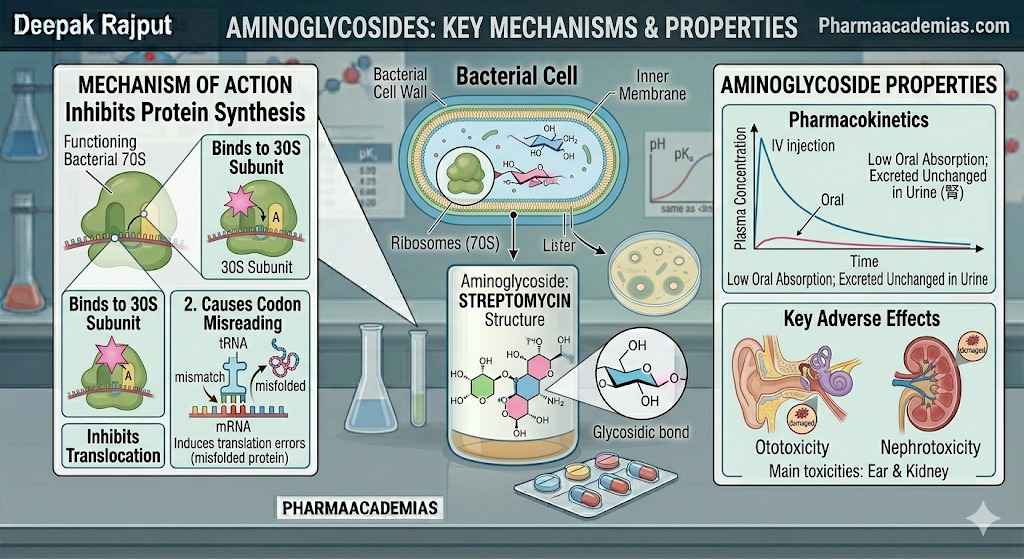
Streptomycin
Streptomycin was the first aminoglycoside discovered and historically the first effective drug used against tuberculosis. It is mainly active against Mycobacterium tuberculosis, Yersinia pestis, and Francisella tularensis.
Gentamicin
Gentamicin is one of the most widely used aminoglycosides in modern clinical practice. It is highly effective against Gram-negative bacilli, including E. coli, Klebsiella, Proteus, Enterobacter, and Pseudomonas.
Amikacin
Amikacin is a semisynthetic derivative with excellent activity against resistant Gram-negative organisms, especially when gentamicin resistance is present. It is highly useful in nosocomial infections and multidrug-resistant pathogens.
Tobramycin
Tobramycin is particularly active against Pseudomonas aeruginosa and is commonly used in severe respiratory infections, including inhalational therapy in cystic fibrosis patients.
Kanamycin
Kanamycin is less frequently used today because newer aminoglycosides provide better safety and resistance profiles.
Dose of Aminoglycosides
The dose of aminoglycosides must always be individualized, as these drugs have a narrow therapeutic index and significant dose-related toxicity.
They are usually given intravenously or intramuscularly, although certain agents such as tobramycin may be inhaled and neomycin may be given orally for bowel sterilization.
Common adult once-daily dosing examples include:
- Gentamicin / Tobramycin: 5–7 mg/kg IV every 24 hours
- Amikacin: 15 mg/kg IV every 24 hours
In severe sepsis and critically ill patients, extended-interval dosing is commonly preferred because it improves bacterial killing while reducing toxicity.
Dose adjustment is essential in:
- renal impairment
- elderly patients
- obese patients
- burn patients
- neonates and pediatrics
Because these drugs are eliminated by glomerular filtration, serum levels and creatinine must be monitored carefully.
Indications of Aminoglycosides
Aminoglycosides are mainly indicated in serious infections caused by aerobic Gram-negative bacilli.
Their major indications include septicemia, complicated urinary tract infections, hospital-acquired pneumonia, peritonitis, intra-abdominal infections, infective endocarditis (in combination), neonatal sepsis, complicated skin infections, and resistant Pseudomonas infections.
They are especially useful in combination therapy with beta-lactam antibiotics because beta-lactams damage the bacterial cell wall, allowing better aminoglycoside penetration and enhanced synergistic killing.
This combination is very important in:
- sepsis
- enterococcal endocarditis
- febrile neutropenia
- severe hospital-acquired infections
Streptomycin remains useful in selected cases of:
- tuberculosis
- plague
- tularemia
- brucellosis
Contraindications of Aminoglycosides
Aminoglycosides must be used cautiously because of their toxicity profile.
The most important contraindication is known hypersensitivity to aminoglycosides, including cross-reactivity within the class.
They should be used with extreme caution in renal impairment, because reduced excretion markedly increases the risk of nephrotoxicity and ototoxicity.
They are also relatively contraindicated in:
- pregnancy, especially streptomycin, due to risk of fetal auditory toxicity
- myasthenia gravis
- Parkinsonism
- pre-existing hearing loss
- vestibular disorders
- concurrent use of nephrotoxic drugs
Aminoglycosides may worsen neuromuscular weakness, making them dangerous in patients with neuromuscular disorders.
Adverse Effects of Aminoglycosides
The three classic toxicities every pharmacology student must remember are:
Nephrotoxicity
This is the most common serious adverse effect. Aminoglycosides accumulate in proximal tubular cells, causing reversible acute tubular injury.
Risk increases with:
- prolonged therapy
- high trough levels
- dehydration
- old age
- renal disease
- concurrent vancomycin or NSAIDs
Ototoxicity
Aminoglycosides can cause cochlear and vestibular damage, leading to:
- tinnitus
- vertigo
- ataxia
- hearing loss
- irreversible deafness
This toxicity may be permanent, especially with prolonged use.
Neuromuscular Blockade
They may prolong neuromuscular paralysis, particularly in patients receiving anesthetic muscle relaxants or those with myasthenia gravis.
This may cause respiratory depression or apnea in severe cases.
Allergic reactions and rash are uncommon but possible.
Precautions and Special Considerations
Because aminoglycosides are potentially toxic, therapeutic drug monitoring (TDM) is essential.
Serum peak and trough levels, serum creatinine, urine output, and sometimes serial audiometry should be monitored during therapy.
Important precautions include:
- use the shortest effective duration
- avoid combination with other nephrotoxic drugs
- ensure adequate hydration
- adjust dose according to creatinine clearance
- prefer once-daily dosing when appropriate
These precautions significantly reduce toxicity while preserving efficacy.
Conclusion
Aminoglycosides are powerful bactericidal antibiotics with excellent activity against serious Gram-negative infections and selected mycobacterial diseases. Their major members include gentamicin, amikacin, tobramycin, streptomycin, and kanamycin.
Despite their excellent antibacterial potency, their use requires careful dosing, renal adjustment, serum level monitoring, and close observation for nephrotoxicity and ototoxicity. When used rationally, they remain life-saving antibiotics in critical care and infectious disease management.