Introduction to Saccharin
Saccharin is one of the oldest artificial sweeteners known to science and has played a crucial role in the development of sugar substitutes. It was discovered in 1879 by the chemist Constantin Fahlberg, and since then, it has been widely used in food, beverages, and pharmaceutical preparations. The primary reason for its popularity lies in its ability to provide intense sweetness without adding calories, making it highly valuable for diabetic patients and individuals managing their weight.
Over the years, saccharin has maintained its importance due to its stability, cost-effectiveness, and long shelf life. Despite the emergence of newer artificial sweeteners, it still holds a strong position in the global market.
Chemical Nature and Structure of Saccharin
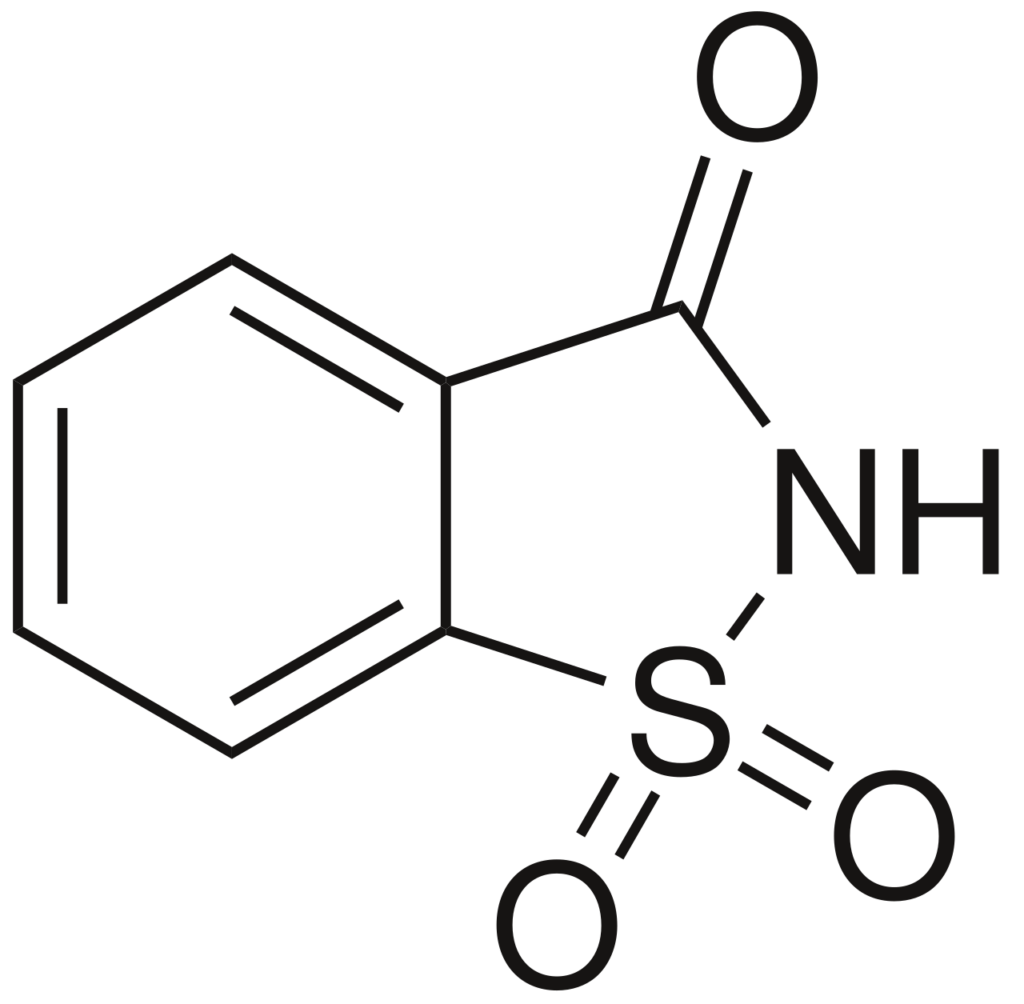
Saccharin is chemically known as benzoic sulfimide and has the molecular formula C₇H₅NO₃S. It belongs to the sulfonamide group of compounds, which contributes significantly to its chemical behavior and stability. The structure of saccharin includes a benzene ring attached to a sulfonyl and imide group, which together are responsible for its intense sweet taste.
This unique chemical structure makes saccharin resistant to chemical changes under normal conditions. It does not easily participate in reactions that typically affect sugars, such as caramelization or fermentation. As a result, it remains stable during storage as well as during cooking processes.
Physical Properties of saccharin
Saccharin appears as a white crystalline powder that is odorless and highly stable. Its taste is intensely sweet, but it may produce a slight bitter or metallic aftertaste, especially when used in higher concentrations. This aftertaste is one of the few limitations associated with its use.
The solubility of saccharin depends on its form. In its pure acidic form, it is only slightly soluble in water, whereas its sodium salt form, known as sodium saccharin, is highly water-soluble. This increased solubility makes it more suitable for liquid pharmaceutical preparations and beverages.
Sweetness and Mechanism of Action
The sweetness of saccharin is remarkably high, estimated to be around 300 to 500 times greater than that of sucrose. Because of this, only a very small amount is required to achieve the desired level of sweetness, which makes it both efficient and economical.
Saccharin produces sweetness by interacting with specific taste receptors on the tongue known as T1R2 and T1R3 receptors. These receptors are responsible for detecting sweet substances. When saccharin binds to these receptors, it triggers a signal to the brain that is interpreted as sweetness. Unlike sugar, saccharin is not metabolized in the body. It passes through the digestive system unchanged and is excreted in urine, which is why it does not contribute any calories or affect blood glucose levels.
Uses and Applications
Saccharin has a wide range of applications in both the food and pharmaceutical industries. In the food sector, it is commonly used in sugar-free and diet products, including beverages, desserts, and chewing gums. Its high sweetness and zero-calorie nature make it particularly suitable for individuals with diabetes or those following calorie-restricted diets.
In pharmaceutical formulations, saccharin is frequently used as a sweetening agent to improve the taste of medicines. It is especially useful in syrups, chewable tablets, lozenges, and oral suspensions where it helps mask the unpleasant taste of active pharmaceutical ingredients. Additionally, it is also found in products like toothpaste and mouthwash, where it enhances palatability without promoting tooth decay.
Advantages of Saccharin
One of the most important advantages of saccharin is that it is completely calorie-free, which makes it ideal for weight management and diabetic patients. Its high sweetness intensity ensures that only a small quantity is needed, making it cost-effective. Another major benefit is its excellent stability, as it can withstand high temperatures and a wide range of pH conditions without degradation.
Saccharin also has a long shelf life and does not support microbial growth, which further enhances its suitability for use in various formulations.
Limitations and Disadvantages
Despite its many benefits, saccharin is not without drawbacks. The most notable limitation is its slightly bitter or metallic aftertaste, which can affect consumer acceptance if used alone in high concentrations. This is why it is often combined with other sweeteners to improve the overall taste profile.
Some individuals may also experience mild sensitivity or digestive discomfort, although such cases are relatively rare. Additionally, there has been ongoing scientific discussion regarding the long-term effects of artificial sweeteners, although saccharin itself has been extensively studied and considered safe within recommended limits.
Safety and Regulatory Status
Saccharin has undergone extensive safety evaluations over the years. Earlier studies in the 1970s suggested a possible link between saccharin and bladder cancer in laboratory rats, which led to concerns and regulatory warnings. However, subsequent research demonstrated that the mechanism observed in rats was not relevant to humans.
Based on comprehensive scientific evidence, major health organizations such as the World Health Organization and the U.S. Food and Drug Administration have declared saccharin safe for human consumption within acceptable daily intake limits. As a result, previous warnings were removed, and saccharin continues to be widely used around the world.
Conclusion
Saccharin remains an important artificial sweetener with a long history of safe and effective use. Its ability to provide intense sweetness without calories, combined with its chemical stability and cost-effectiveness, makes it highly valuable in both food and pharmaceutical industries. While it has minor limitations such as aftertaste, its advantages far outweigh its drawbacks.
Overall, saccharin serves as a classic example of how a simple chemical compound can have a profound impact on public health, nutrition, and pharmaceutical formulation.