
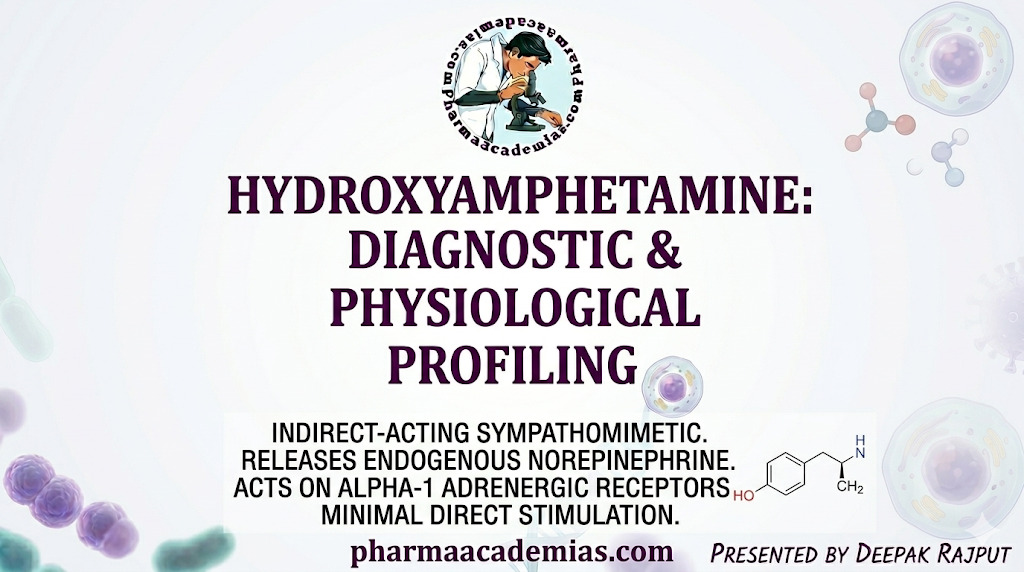
Hydroxyamphetamine is a synthetic sympathomimetic amine used primarily in ophthalmology as a diagnostic and therapeutic agent. Chemically, it is a hydroxylated derivative of amphetamine, structurally similar to endogenous catecholamines, and functions as an indirect adrenergic agonist. Its main pharmacological action is to stimulate the release of norepinephrine from sympathetic nerve endings, leading to contraction of the iris dilator muscles and resulting in pupillary dilation (mydriasis). Unlike direct-acting adrenergic agents such as phenylephrine, hydroxyamphetamine relies on the integrity of postganglionic sympathetic neurons, making it particularly useful in diagnostic testing for neurological conditions such as Horner’s syndrome.
Hydroxyamphetamine is most commonly available as a 1% ophthalmic solution, sometimes in combination with other agents such as tropicamide, which enhances mydriatic effects, or in specialized preparations for sympathetic pathway testing. Its safety profile, relative selectivity, and predictable pharmacodynamics make it a mainstay in ophthalmic diagnostics.
Mechanism of Action of Hydroxyamphetamine
The pharmacological effect of hydroxyamphetamine is primarily due to its indirect sympathomimetic action. Upon topical administration to the eye, it:
- Enters the ocular tissues and reaches the presynaptic terminals of the sympathetic nervous system.
- Promotes the release of stored norepinephrine from postganglionic nerve endings.
- Released norepinephrine binds to alpha-1 adrenergic receptors on the dilator pupillae muscles, causing contraction.
- This contraction results in pupillary dilation (mydriasis), typically occurring within 30–45 minutes of instillation.
This indirect mechanism is particularly advantageous in localizing sympathetic lesions because the response of the pupil depends on the functional status of the postganglionic neurons. If the postganglionic neuron is damaged, no norepinephrine is released, and the pupil fails to dilate, which aids in differentiating preganglionic from postganglionic lesions.
Pharmacokinetics of Hydroxyamphetamine
- Absorption: Hydroxyamphetamine is absorbed locally in ocular tissues. Systemic absorption is minimal when used topically.
- Onset of Action: Pupillary dilation occurs typically within 30–45 minutes.
- Duration: Mydriatic effects generally last 4–6 hours, depending on concentration and individual response.
- Metabolism and Excretion: Minimal systemic metabolism occurs with topical use; any absorbed portion is metabolized hepatically and excreted renally.
Clinical Uses of Hydroxyamphetamine
Hydroxyamphetamine is primarily used for diagnostic purposes, although it also has therapeutic and research applications. Its main uses include:
1. Diagnosis of Horner’s Syndrome
Horner’s syndrome is a neurological disorder caused by lesions in the sympathetic nervous system, characterized by ptosis (drooping eyelid), miosis (constricted pupil), and anhidrosis (absence of sweating). Hydroxyamphetamine helps localize the lesion along the sympathetic pathway:
- Preganglionic Lesion: Pupillary dilation occurs normally because the postganglionic neuron remains intact and can release norepinephrine.
- Postganglionic Lesion: Pupillary dilation fails due to the inability of the damaged postganglionic neuron to release norepinephrine.
This selective action makes hydroxyamphetamine an invaluable tool for neurological localization in patients with partial or subtle Horner’s syndrome.
2. Mydriasis for Ophthalmic Examinations
Hydroxyamphetamine produces moderate dilation of the pupil, facilitating detailed examination of the lens, retina, optic disc, and fundus. It is particularly useful when combined with tropicamide or cyclopentolate for enhanced diagnostic clarity during routine or specialized ophthalmic procedures.
3. Research Applications
In experimental and pharmacological research, hydroxyamphetamine is used to study:
- Sympathetic neurotransmission in ocular tissues
- Mechanisms of norepinephrine release and depletion
- Neuropharmacology of adrenergic receptors in the eye
It serves as a model compound for understanding the indirect adrenergic stimulation of smooth muscles in other organ systems.
4. Adjunct Use in Pharmacological Testing
Hydroxyamphetamine may be used alongside cocaine drops or other mydriatic agents for enhanced diagnostic specificity in ocular sympathetic pathway assessments, providing clinicians with a comprehensive evaluation of neuro-ophthalmic function.
Dosage and Administration
Hydroxyamphetamine is usually administered as a 1% ophthalmic solution, instilled as one drop in the affected eye(s). Clinical guidelines suggest careful monitoring of:
- Pupil response over 30–45 minutes
- Systemic symptoms in sensitive patients (rare with topical administration)
- Avoidance in patients with cardiovascular disorders if systemic absorption is a concern
Repeated dosing is generally unnecessary for diagnostic purposes and may increase the risk of ocular irritation or systemic sympathetic stimulation.
Precautions and Contraindications
- Use cautiously in patients with hypertension, tachycardia, or cardiovascular disease, as systemic absorption may theoretically elevate blood pressure or heart rate.
- Avoid contact with damaged corneal epithelium to prevent local irritation.
- Patients with hypersensitivity to amphetamine derivatives should not use hydroxyamphetamine.
- Should be used under professional supervision in infants and children due to potential systemic effects.
Storage of Hydroxyamphetamine
Proper storage is crucial to maintain drug potency, sterility, and safety. Key guidelines include:
- Temperature: Store the solution in a refrigerated environment (2–8°C). Avoid freezing, which may degrade the active compound.
- Light Protection: Hydroxyamphetamine is sensitive to light, so the solution must be kept in its original amber bottle.
- Shelf Life: Once opened, the solution should be used within 4–6 weeks to prevent contamination or loss of efficacy.
- Hygiene: The dropper tip must never touch the eye or surrounding surfaces to maintain sterility.
- Safety: Store out of reach of children. Accidental ingestion or misuse can lead to sympathomimetic side effects, including nervousness, tachycardia, and elevated blood pressure.
Summary
Hydroxyamphetamine is an indirect sympathomimetic agent of critical importance in ophthalmology and neuro-ophthalmic diagnostics. Its ability to release endogenous norepinephrine from postganglionic neurons allows for precise localization of sympathetic lesions, particularly in Horner’s syndrome. Beyond diagnostic utility, hydroxyamphetamine is used for pupillary dilation, research on sympathetic neurotransmission, and pharmacological testing. Maintaining proper storage conditions, understanding its mechanism of action, and observing clinical precautions ensure safe, effective, and reproducible results during ophthalmic evaluations.