Rh Factors and Blood Transfusion: The Rh blood-group system is one of the most important blood-group systems in transfusion medicine after the ABO system. The term Rh factor most commonly refers to the D antigen, a protein present on the surface of red blood cells in some individuals. People who possess the D antigen are called Rh-positive (Rh⁺), whereas those who lack it are called Rh-negative (Rh⁻).
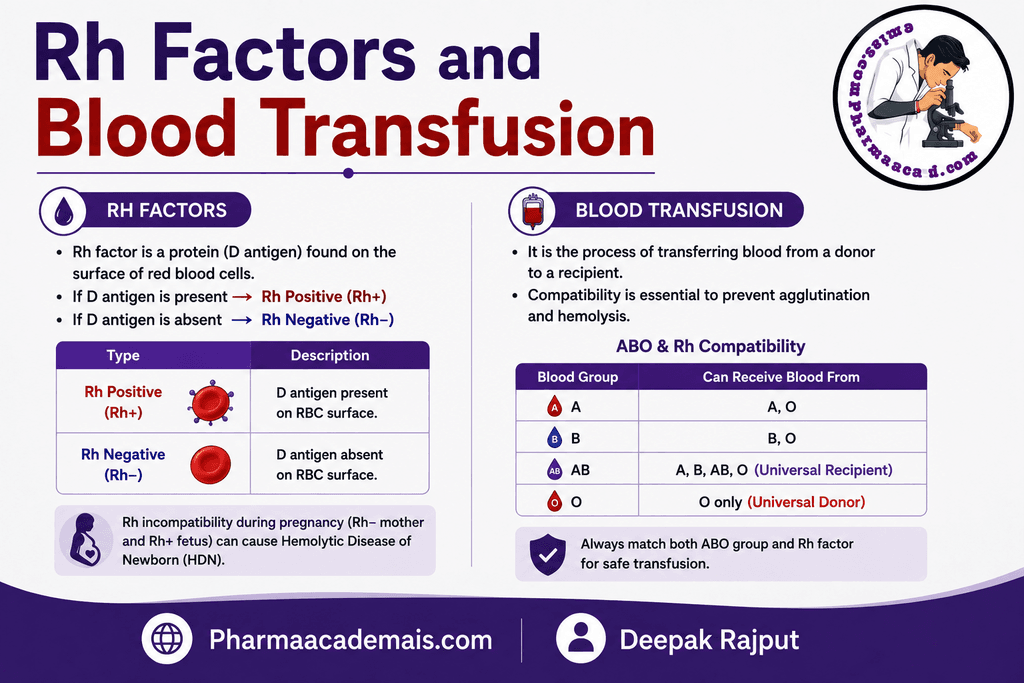
The Rh system is clinically important because Rh antigens can stimulate the formation of antibodies following exposure to incompatible red blood cells. Unlike the ABO system, anti-D antibodies are generally not naturally present. They usually develop after exposure to Rh-positive blood through blood transfusion or pregnancy.
Rh incompatibility is particularly important in two situations:
- Blood transfusion
- Pregnancy, especially when an Rh-negative mother carries an Rh-positive fetus
A proper understanding of Rh factors is therefore essential for safe blood transfusion and prevention of hemolytic disease of the fetus and newborn.
1. Definition of Rh Factor
The Rh factor is a red blood cell antigen belonging to the Rh blood-group system. The most clinically important Rh antigen is the D antigen.
Therefore:
- Rh-positive (Rh⁺): D antigen is present on RBCs.
- Rh-negative (Rh⁻): D antigen is absent from RBCs.
For example:
- A⁺ = A antigen + D antigen
- A⁻ = A antigen + no D antigen
- B⁺ = B antigen + D antigen
- B⁻ = B antigen + no D antigen
- O⁺ = no A/B antigens + D antigen
- O⁻ = no A/B antigens + no D antigen
2. Discovery of the Rh System
The Rh system was discovered through studies of red-cell antigens and transfusion reactions. The name Rh is historically associated with experiments involving rhesus monkeys, although the human Rh system is distinct from the monkey’s blood-group system.
The discovery of Rh antigens helped explain certain transfusion reactions and cases of hemolytic disease of the newborn that could not be explained by ABO incompatibility alone.
3. Major Rh Antigens
The Rh blood-group system contains many antigens, but the five major antigens are commonly represented as:
- D
- C
- c
- E
- e
Among these, the D antigen is the most immunogenic and clinically important.
The presence or absence of D determines the conventional Rh-positive or Rh-negative classification.
4. Rh-Positive Blood
A person is classified as Rh-positive when their red blood cells possess the D antigen.
For example:
A⁺ → A antigen + D antigen
B⁺ → B antigen + D antigen
AB⁺ → A + B + D antigens
O⁺ → D antigen only among the major ABO/Rh markers
Rh-positive individuals generally do not produce anti-D antibodies simply because they possess the D antigen.
5. Rh-Negative Blood
A person is classified as Rh-negative when their red blood cells lack the D antigen.
For example:
A⁻ → A antigen but no D antigen
B⁻ → B antigen but no D antigen
AB⁻ → A and B antigens but no D antigen
O⁻ → neither A nor B nor D antigen
An Rh-negative individual can become sensitized if exposed to Rh-positive red blood cells.
6. Anti-D Antibody
The most important antibody associated with the Rh system is anti-D.
A major difference between the ABO and Rh systems is that anti-D antibodies are generally not naturally occurring.
Instead, anti-D usually develops following exposure to D-positive red blood cells.
Exposure can occur through:
- Blood transfusion
- Pregnancy
- Fetomaternal hemorrhage
- Miscarriage
- Abortion
- Ectopic pregnancy
- Certain invasive obstetric procedures
- Trauma during pregnancy
7. Rh Sensitization
Rh sensitization is the process by which an Rh-negative person develops antibodies against the Rh D antigen after exposure to Rh-positive RBCs.
8. Rh Incompatibility and Blood Transfusion
Rh incompatibility can occur when an Rh-negative recipient receives Rh-positive red blood cells.
The first exposure may cause sensitization rather than an immediate severe reaction in every case.
However, after sensitization, subsequent exposure to Rh-positive blood can produce a rapid and significant immune response.
The resulting anti-D antibodies can bind to D-positive RBCs and promote their destruction.
Therefore, Rh-negative recipients are generally given Rh-negative red blood cells, especially when there is no clinical reason to use Rh-positive blood.
9. Mechanism of Rh-Mediated Hemolysis
Anti-D is primarily an IgG antibody.
After an Rh-negative individual becomes sensitized:
Rh-positive RBC exposure
↓
Anti-D IgG production
↓
Anti-D binds to D antigen on RBCs
↓
Sensitized RBCs are recognized by immune cells
↓
Extravascular hemolysis may occur
↓
Reduction in circulating RBCs
This process is particularly important in pregnancy because IgG antibodies can cross the placenta.
10. Rh Factors and Blood Transfusion
Blood transfusion requires careful consideration of both:
ABO compatibility
and
Rh compatibility
For red blood cell transfusion, an Rh-negative patient is generally preferably given Rh-negative RBCs.
For example:
| Recipient | Preferred RBC type regarding Rh |
| Rh-positive | Rh-positive generally preferred |
| Rh-negative | Rh-negative generally preferred |
In emergencies, Rh-positive blood may sometimes be given to certain Rh-negative patients when Rh-negative supplies are unavailable and the clinical circumstances justify it. This is a medical decision made according to transfusion protocols and the patient’s circumstances.
11. Rh Compatibility in Common Blood Types
The ABO and Rh systems are combined to produce eight commonly recognized types:
| Blood type | Major RBC antigens |
| A⁺ | A + D |
| A⁻ | A |
| B⁺ | B + D |
| B⁻ | B |
| AB⁺ | A + B + D |
| AB⁻ | A + B |
| O⁺ | D |
| O⁻ | None of A, B, D |
This classification is important in transfusion practice.
12. O-Negative Blood and Rh Factor
O-negative red blood cells lack:
- A antigen
- B antigen
- D antigen
For this reason, O-negative RBCs are commonly used when emergency red-cell transfusion is required and the patient’s blood group is not yet known, subject to local transfusion protocols and availability.
O-negative blood is especially valuable in emergency medicine, trauma care, and obstetric emergencies.
However, O-negative does not mean that the blood is universally compatible under every circumstance. Other blood-group antigens and antibodies can still be clinically important.
Conclusion
The Rh blood-group system is a major component of transfusion medicine, with the D antigen being the most clinically important Rh antigen. Individuals possessing the D antigen are Rh-positive, while those lacking it are Rh-negative. Unlike ABO antibodies, anti-D is generally not naturally present; it develops after exposure of an Rh-negative individual to Rh-positive red blood cells.
Rh incompatibility is particularly important in blood transfusion and pregnancy. An Rh-negative person exposed to Rh-positive blood may become sensitized and produce anti-D IgG antibodies. Subsequent exposure to D-positive red blood cells can result in antibody-mediated hemolysis. During pregnancy, maternal anti-D IgG can cross the placenta and destroy Rh-positive fetal red blood cells, potentially causing hemolytic disease of the fetus and newborn.
Editorial Note
This article has been carefully researched and written by Deepak Rajput with a focus on accuracy, clarity, and evidence-based healthcare information