Modified Limit Test for Sulphate: In pharmaceutical analysis, impurity testing is a fundamental aspect of quality control because impurities present in pharmaceutical substances may significantly affect their purity, safety, efficacy, and stability. Among the important inorganic impurities, sulphate ions are commonly encountered due to their presence in raw materials, reagents, solvents, manufacturing processes, water used during production, or storage conditions. Excessive sulphate content may interfere with pharmaceutical formulations, alter chemical properties, and compromise product quality. Therefore, pharmaceutical substances are routinely tested for sulphate impurities according to official pharmacopoeial standards.
The ordinary limit test for sulphate is based on the formation of white turbidity due to precipitation of barium sulphate when sulphate ions react with barium chloride in acidic medium. However, certain pharmaceutical substances cannot be analyzed accurately using the ordinary method because the sample itself may be colored, insoluble, acidic, alkaline, or capable of interfering with the precipitation reaction. Under such circumstances, a modified limit test for sulphate is employed.
The modified limit test for sulphate is an adapted form of the standard sulphate limit test in which special treatments or procedures are used to remove interfering substances and obtain accurate results. The modified method ensures reliable detection and comparison of sulphate impurities in complex pharmaceutical samples.
Definition of Modified Limit Test for Sulphate
The modified limit test for sulphate may be defined as an adapted semi-quantitative analytical procedure used for detecting sulphate impurities in pharmaceutical substances that interfere with the standard sulphate limit test because of color, insolubility, acidity, alkalinity, or the presence of interfering substances.
The purpose of the modification is to eliminate interference and permit accurate turbidity comparison.
Need for Modification in Sulphate Limit Test
The ordinary limit test for sulphate may not always provide reliable results because certain pharmaceutical substances interfere with the formation or observation of barium sulphate turbidity.
Modification becomes necessary when:
- The sample is colored
- The sample is insoluble
- The sample contains interfering ions
- The sample is highly acidic or alkaline
- The sample itself produces turbidity
- The sample forms precipitates with barium chloride
Without suitable modification, the test may produce false-positive or false-negative results.
Therefore, additional treatment procedures are applied before performing the sulphate test.
Principle of the Modified Limit Test for Sulphate
The principle of the modified limit test remains essentially similar to the ordinary sulphate limit test.
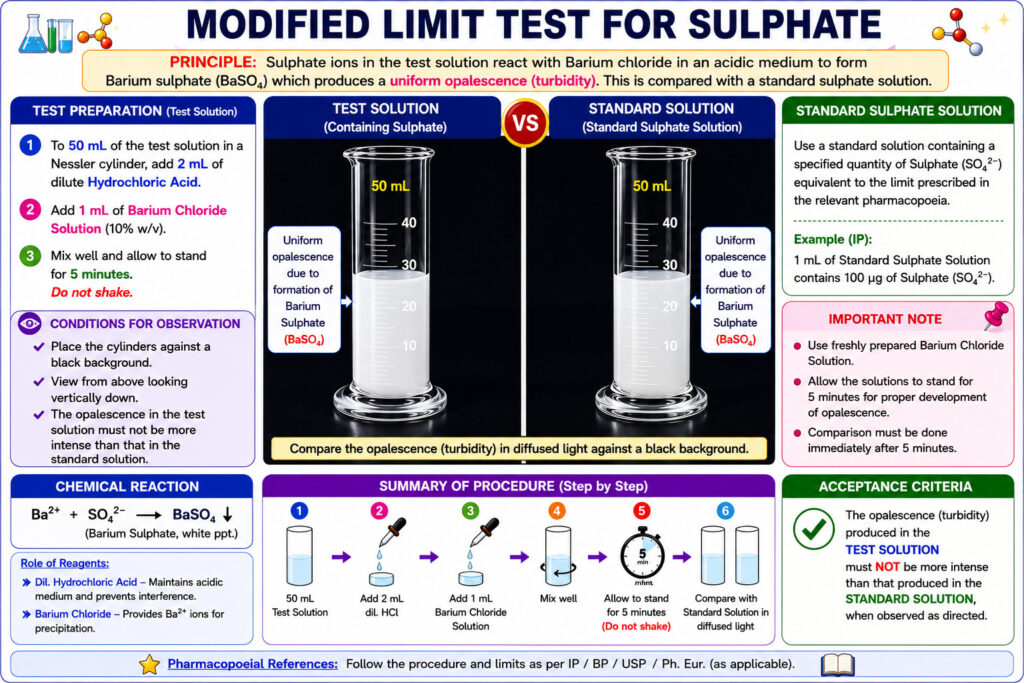
Sulphate ions react with barium chloride in acidic medium to produce white turbidity due to formation of insoluble barium sulphate.
The reaction involved is:
BaCl2 + SO42− → BaSO4↓ + 2Cl−
However, before carrying out the reaction, interfering substances are removed or neutralized by suitable modifications such as:
- Filtration
- Neutralization
- Decolorization
- Ashing
- Extraction
- Digestion
After eliminating interference, the turbidity produced by the test solution is compared visually with that produced by a standard sulphate solution containing a known amount of sulphate impurity.
If the turbidity of the test solution is not greater than that of the standard solution, the sample passes the test.
Situations Requiring Modified Sulphate Limit Test
The modified procedure is necessary under several circumstances.
Colored Substances
Certain pharmaceutical substances possess inherent color that interferes with visual observation of turbidity.
Examples include:
- Iron-containing compounds
- Herbal extracts
- Colored pharmaceutical preparations
Such samples require decolorization before testing.
Insoluble Substances
Some pharmaceutical substances are not completely soluble in water.
Undissolved particles may produce false turbidity unrelated to sulphate impurities.
Such samples require filtration or extraction before testing.
Highly Acidic or Alkaline Samples
Strongly acidic or alkaline samples may interfere with proper precipitation of barium sulphate.
The pH of the solution must therefore be adjusted appropriately before the test.
Samples Containing Interfering Ions
Certain ions may react with barium chloride and produce precipitates other than barium sulphate.
Examples include:
- Carbonates
- Phosphates
- Oxalates
Such interfering ions must be removed or neutralized before analysis.
Common Modifications Used
Different modifications may be adopted depending upon the nature of the pharmaceutical sample.
Neutralization Method
Highly acidic or alkaline samples are carefully neutralized before performing the test.
Improper pH conditions may affect precipitation and turbidity formation.
Neutralization ensures optimal reaction conditions.
Filtration Method
When insoluble materials are present, the sample solution is filtered before adding barium chloride.
This removes suspended particles that may interfere with visual turbidity comparison.
Decolorization Method
Colored solutions may be treated with activated charcoal to remove color.
The solution is then filtered before conducting the sulphate test.
This allows proper visual comparison of turbidity.
Ashing Method
Organic materials that interfere with the test may be destroyed by ignition or ashing.
The residue obtained is dissolved in suitable solvent and subjected to sulphate testing.
Extraction Method
Certain interfering substances may be removed through solvent extraction techniques.
The purified aqueous layer is then used for the sulphate limit test.
Reagents Used in the Modified Limit Test for Sulphate
The reagents used are generally similar to those employed in the ordinary sulphate limit test.
Barium Chloride Reagent: Barium chloride reacts with sulphate ions to form insoluble barium sulphate turbidity.
Hydrochloric Acid: Hydrochloric acid provides acidic conditions necessary for proper precipitation and prevents interference from other ions.
Standard Sulphate Solution: A standard sulphate solution containing a known amount of sulphate impurity is used for comparison.
Activated Charcoal: Activated charcoal may be used to remove color from colored samples.
Purified Water: Distilled or deionized water free from sulphate contamination is essential.
Apparatus Used
The apparatus commonly used includes:
- Nessler cylinders
- Pipettes
- Measuring cylinders
- Funnels
- Filter papers
- Volumetric flasks
Nessler cylinders are particularly important because they facilitate visual comparison of turbidity.
General Procedure for Modified Limit Test for Sulphate
In the modified procedure, the pharmaceutical sample is first subjected to suitable treatment to remove interfering substances.
Depending upon the nature of the sample, the solution may be:
- Neutralized
- Filtered
- Decolorized
- Extracted
- Ignited
After suitable treatment, the prepared solution is transferred into a Nessler cylinder.
Hydrochloric acid is added followed by barium chloride reagent.
Simultaneously, a standard sulphate solution containing the prescribed quantity of sulphate impurity is prepared under identical conditions.
Both solutions are diluted to equal volume and allowed to stand for a specified period to permit complete turbidity development.
The turbidity produced in the test solution is compared visually with that produced in the standard solution.
If the turbidity of the test solution is not greater than that of the standard solution, the sample complies with the modified limit test for sulphate.
Observation in the Test
The principal observation is the intensity of white turbidity produced due to formation of barium sulphate.
Two outcomes are possible.
Pass Condition: If the turbidity in the test solution is lighter than or equal to the standard solution, the sample passes the test.
Fail Condition: If the turbidity in the test solution is greater than the standard solution, the sample fails because sulphate impurities exceed permissible limits.
Interpretation of Results
The modified limit test for sulphate is comparative and semi-quantitative in nature.
It indicates whether:
- Sulphate impurities are within acceptable pharmacopoeial limits
or - Sulphate impurities exceed official standards
Accurate interpretation depends upon complete removal of interfering substances before testing.
Precautions in the Modified Limit Test for Sulphate
Several precautions are essential for obtaining reliable results.
All glassware should be thoroughly cleaned and free from sulphate contamination. Distilled water free from sulphate impurities should be used.
Interfering substances must be completely removed before testing.
Both test and standard solutions should be prepared under identical conditions regarding volume, reagent concentration, temperature, and standing time.
Visual comparison should be carried out under uniform lighting conditions against a dark background.
Freshly prepared reagents should be used for accurate turbidity formation.
Advantages of the Modified Limit Test
The modified limit test for sulphate offers several advantages.
It permits accurate sulphate estimation in pharmaceutical substances that cannot be analyzed properly by the ordinary limit test.
The method is adaptable, economical, and suitable for routine pharmaceutical quality control.
The modified procedure also improves specificity and minimizes analytical interference.
Limitations of the Modified Test
Despite its usefulness, the modified method has certain limitations.
The test remains semi-quantitative and dependent upon visual observation, which may vary between observers.
Different modifications may be required for different pharmaceutical substances, increasing procedural complexity.
Incomplete removal of interfering substances may still affect test accuracy.
Advanced instrumental analytical methods such as ion chromatography provide greater precision and sensitivity.
Pharmaceutical Applications
The modified limit test for sulphate is widely used for pharmaceutical substances that:
- Are colored
- Are insoluble
- Contain interfering ions
- Possess complex composition
The method is applied to:
- Pharmaceutical raw materials
- Herbal preparations
- Mineral products
- Inorganic chemicals
- Complex pharmaceutical formulations
Routine testing ensures compliance with official impurity standards.
Conclusion
The modified limit test for sulphate is an important semi-quantitative analytical procedure used in pharmaceutical analysis when ordinary sulphate limit testing cannot be performed accurately because of sample interference. The test is based on the formation of white barium sulphate turbidity produced by the reaction between sulphate ions and barium chloride in acidic medium.
Various modifications such as filtration, neutralization, decolorization, extraction, and ashing are employed to remove interfering substances and ensure accurate turbidity comparison.
The method plays a vital role in pharmaceutical quality control because sulphate impurities may affect drug purity, stability, quality, and regulatory compliance.
The modified limit test is officially recognized in pharmacopoeial standards such as the Indian Pharmacopoeia Commission, United States Pharmacopeial Convention, and British Pharmacopoeia Commission and remains an important analytical procedure in pharmaceutical industries and quality control laboratories.