Sources and Types of Impurities: In pharmaceutical sciences, the purity of drug substances and pharmaceutical formulations is one of the most important parameters for ensuring safety, efficacy, and quality. Pharmaceutical products are expected to meet strict standards because even very small amounts of unwanted substances may influence therapeutic activity or produce harmful effects. However, complete purity is practically impossible to achieve because pharmaceutical substances are exposed to numerous chemical, environmental, and manufacturing processes during their preparation and storage. As a result, unwanted materials known as impurities become associated with the drug product.
Impurities are undesirable substances that remain present in pharmaceutical products either intentionally or unintentionally. They may arise during synthesis, formulation, purification, storage, packaging, or transportation. The presence of impurities can alter the physical, chemical, and biological properties of pharmaceutical products and may affect their safety and therapeutic effectiveness.
The study of sources and types of impurities is therefore a fundamental aspect of pharmaceutical chemistry, pharmaceutical analysis, quality control, and regulatory science. Modern pharmaceutical industries devote significant resources to impurity profiling and impurity control because international regulatory authorities require strict monitoring and documentation of impurities in all pharmaceutical products.
Sources and Types of Impurities
Impurities may be defined as unwanted chemicals or foreign materials present within a pharmaceutical substance other than the intended active pharmaceutical ingredient (API) or approved excipients.
These impurities may originate from raw materials, manufacturing operations, degradation reactions, environmental exposure, or contamination during storage and handling.
In pharmaceutical terminology, any component that does not contribute to the therapeutic activity of the intended formulation and remains present beyond acceptable limits is considered an impurity.
Sources of Impurities in Pharmaceuticals
Impurities may originate from multiple stages of pharmaceutical development and manufacturing. Understanding the sources of impurities is essential because it helps pharmaceutical scientists identify potential contamination pathways and establish suitable control measures.
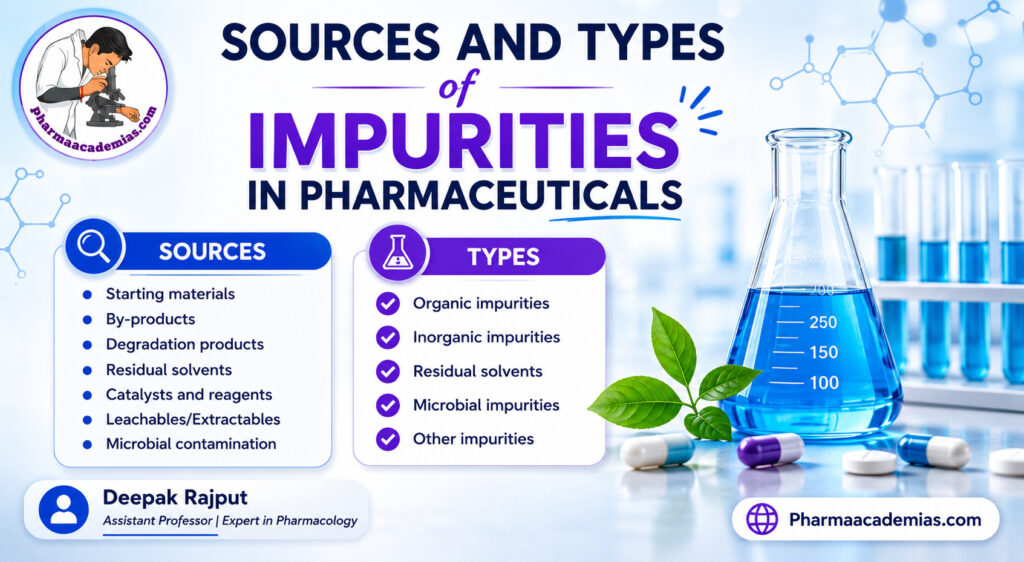
The major sources of impurities in pharmaceuticals include raw materials, manufacturing processes, reagents and catalysts, solvents, equipment, environmental contamination, storage conditions, packaging materials, and degradation reactions.
Impurities Arising from Raw Materials
Raw materials are among the most common sources of pharmaceutical impurities. Pharmaceutical products are synthesized using various chemicals, intermediates, solvents, and excipients. If these materials are impure, the impurities may carry forward into the final product.
For example, contaminated starting materials may introduce organic impurities, heavy metals, or inorganic salts into the drug substance. Natural products and herbal materials are especially susceptible to contamination because they may contain pesticides, microorganisms, soil particles, or environmental toxins.
Excipients used in formulations may also contribute impurities if they are improperly purified or stored. Water used during manufacturing may additionally introduce microbial or inorganic contamination if not adequately treated.
Therefore, pharmaceutical industries perform strict quality testing of all incoming raw materials before use in manufacturing.
Impurities Arising During Manufacturing Processes
Manufacturing operations themselves are major contributors to impurity formation. During chemical synthesis, numerous side reactions may occur in addition to the desired reaction. These side reactions often generate unwanted by-products and intermediates.
Incomplete chemical reactions may leave traces of unreacted starting materials within the final drug substance. Similarly, reaction conditions such as high temperature, pressure, or pH changes may produce decomposition products.
Cross-contamination may also occur when multiple products are manufactured using the same equipment without adequate cleaning procedures.
Improper process control, poor purification techniques, inadequate filtration, or inefficient crystallization may further contribute to impurity retention.
Impurities from Reagents and Catalysts
Various reagents, catalysts, and processing chemicals are used during pharmaceutical synthesis. Residual quantities of these substances may remain in the final product if purification is incomplete.
Examples include:
- Acids
- Alkalis
- Oxidizing agents
- Reducing agents
- Metallic catalysts
Heavy metal catalysts such as palladium, platinum, nickel, copper, and iron are commonly used in synthetic reactions. If not properly removed, these metals may remain as toxic impurities.
Residual reagents may also react with the drug substance during storage and produce additional degradation products.
Impurities Due to Residual Solvents
Organic solvents are widely used during pharmaceutical manufacturing for extraction, synthesis, purification, recrystallization, and chromatography.
After manufacturing, traces of these solvents may remain in the final pharmaceutical product. These are known as residual solvent impurities.
Examples include:
- Methanol
- Ethanol
- Acetone
- Benzene
- Chloroform
- Toluene
- Hexane
Certain residual solvents are toxic, carcinogenic, or neurotoxic. Benzene, for example, is a known carcinogen and must be controlled within extremely low limits.
Residual solvent levels are regulated according to toxicity classification systems established by the International Council for Harmonisation of Technical Requirements for Pharmaceuticals for Human Use.
Impurities Due to Equipment and Containers
Pharmaceutical equipment and storage containers may introduce impurities into drug products through physical or chemical interaction.
Metallic equipment may release iron, chromium, nickel, or other metal particles due to corrosion or abrasion. Glass containers may release alkali into solutions under certain conditions. Plastic containers may leach plasticizers, stabilizers, or polymeric materials into the formulation.
Rubber closures used in injectable products may also release chemical additives or particulate matter.
Such contamination becomes particularly important in sterile products, injectable formulations, and highly sensitive biological preparations.
Environmental Sources of Impurities
Environmental contamination is another important source of pharmaceutical impurities. Dust particles, microorganisms, moisture, and atmospheric gases may enter pharmaceutical products during manufacturing or storage.
Environmental contamination may arise from:
- Air
- Water
- Personnel
- Manufacturing surfaces
- Clothing
- Improper sanitation
Microbial contamination is especially dangerous because microorganisms may multiply rapidly and produce toxins that compromise product safety.
Environmental monitoring and cleanroom technologies are therefore essential in pharmaceutical manufacturing.
Impurities Due to Storage and Degradation
Drug substances may undergo chemical degradation during storage, resulting in the formation of degradation impurities.
Factors responsible for degradation include:
- Heat
- Light
- Moisture
- Oxygen
- pH changes
- Radiation
Chemical degradation reactions commonly include:
- Hydrolysis
- Oxidation
- Reduction
- Photolysis
- Racemization
For example, aspirin undergoes hydrolysis to produce salicylic acid and acetic acid. Similarly, vitamins and antibiotics may degrade upon exposure to heat and light.
Improper storage conditions can therefore significantly increase impurity formation.
Impurities from Packaging Materials
Packaging materials may interact chemically or physically with pharmaceutical products and introduce impurities.
Examples include:
- Leaching of plastic additives
- Migration of ink components
- Release of metal ions
- Adsorption of drug molecules
Certain plastic containers may release toxic compounds into liquid formulations, while rubber stoppers may interact with injectable products.
Packaging compatibility studies are therefore necessary to ensure product stability and safety.
Types of Impurities in Pharmaceuticals
Pharmaceutical impurities are classified according to their chemical nature, source, or method of formation. The major types include organic impurities, inorganic impurities, residual solvents, degradation products, microbial impurities, and elemental impurities.
Organic Impurities
Organic impurities are carbon-containing compounds that arise during synthesis, purification, or storage of pharmaceutical substances.
These impurities may include:
- Starting materials
- Reaction intermediates
- By-products
- Side reaction products
- Degradation compounds
Organic impurities are particularly important because many possess biological or pharmacological activity.
For example, oxidation products formed during storage may alter drug efficacy or increase toxicity. Certain synthetic by-products may also exhibit mutagenic or carcinogenic properties.
Advanced chromatographic methods are commonly used to detect and quantify organic impurities.
Inorganic Impurities
Inorganic impurities consist mainly of non-carbon-containing substances introduced during manufacturing or handling.
Examples include:
- Heavy metals
- Salts
- Ash residues
- Filter aids
- Residual catalysts
Heavy metal impurities are especially dangerous because they may accumulate in the body and produce toxic effects.
Common heavy metal contaminants include:
- Lead
- Mercury
- Arsenic
- Cadmium
Strict regulatory limits are therefore established for elemental impurities in pharmaceutical products.
Residual Solvent Impurities
Residual solvent impurities consist of volatile organic solvents remaining after manufacturing or purification processes.
Although some solvents possess low toxicity, others may produce serious health hazards if present beyond permissible limits.
Residual solvents are classified into:
- Class 1 solvents (high toxicity)
- Class 2 solvents (moderate toxicity)
- Class 3 solvents (low toxicity)
Gas chromatography is widely used for residual solvent analysis.
Degradation Impurities
Degradation impurities are formed when drug substances undergo chemical decomposition during storage or transportation.
These impurities may result from:
- Hydrolysis
- Oxidation
- Photolysis
- Thermal degradation
Degradation products may alter color, odor, potency, or safety of pharmaceutical products.
Stability testing is therefore essential for identifying degradation pathways and determining shelf life.
Microbial Impurities
Microbial impurities include bacteria, fungi, yeasts, viruses, and microbial toxins contaminating pharmaceutical products.
These impurities are especially significant in:
- Sterile products
- Injectable preparations
- Ophthalmic products
- Biological formulations
Microbial contamination may arise from poor hygiene, contaminated water, improper handling, or inadequate sterilization procedures.
Microbial limit tests and sterility tests are therefore essential quality control measures.
Elemental Impurities
Elemental impurities refer to metallic contaminants present in pharmaceutical products.
These may arise from:
- Catalysts
- Raw materials
- Water
- Equipment corrosion
Examples include:
- Lead
- Mercury
- Arsenic
- Nickel
- Chromium
- Palladium
Elemental impurities are highly regulated because of their toxicological significance.
The International Council for Harmonisation of Technical Requirements for Pharmaceuticals for Human Use guideline Q3D specifically addresses elemental impurity control.
Toxic and Genotoxic Impurities
Certain impurities possess mutagenic or carcinogenic potential and are therefore classified as toxic or genotoxic impurities.
These impurities can damage DNA and increase the risk of cancer or genetic abnormalities.
Nitrosamine impurities are important examples of genotoxic contaminants that have led to several international drug recalls in recent years.
Regulatory agencies require extremely strict monitoring and risk assessment for such impurities.
Regulatory Significance of Impurities
Modern pharmaceutical regulations place enormous emphasis on impurity control because impurities directly affect patient safety and product quality.
Organizations such as:
- World Health Organization
- United States Food and Drug Administration
- European Medicines Agency
- International Council for Harmonisation of Technical Requirements for Pharmaceuticals for Human Use
have established detailed guidelines for impurity testing, reporting, qualification, and control.
Pharmaceutical manufacturers must demonstrate that impurity levels remain within acceptable safety limits throughout the product shelf life.
Methods for Control of Impurities
Impurity control requires careful monitoring throughout all stages of pharmaceutical production.
Important measures include:
- Use of high-purity raw materials
- Proper manufacturing practices
- Equipment maintenance
- Controlled environmental conditions
- Analytical testing
- Stability studies
- Proper packaging
- Validation of manufacturing processes
Implementation of Good Manufacturing Practices (GMP) significantly reduces the risk of contamination and impurity formation.
Conclusion
Impurities are unavoidable but critically important components of pharmaceutical products. They may arise from raw materials, manufacturing processes, reagents, solvents, environmental exposure, packaging materials, or degradation during storage.
Pharmaceutical impurities are broadly classified into organic impurities, inorganic impurities, residual solvents, degradation products, microbial impurities, elemental impurities, and toxic impurities. Each type possesses unique characteristics and potential risks to product quality and patient safety.
Understanding the sources and types of impurities is essential for pharmaceutical scientists because effective impurity control ensures drug purity, stability, efficacy, and regulatory compliance. Modern pharmaceutical industries therefore employ advanced analytical methods, strict quality assurance systems, and international regulatory guidelines to minimize impurity-related risks.
Consequently, impurity analysis and control remain fundamental aspects of pharmaceutical chemistry, quality control, drug development, and patient safety assurance.