Primary and Secondary Standards Solutions: Quantitative chemical analysis is one of the most important aspects of pharmaceutical analysis and analytical chemistry. In volumetric analysis or titration methods, accurate determination of concentration is essential for obtaining reliable analytical results. To achieve this accuracy, solutions of known concentration called standard solutions are used.
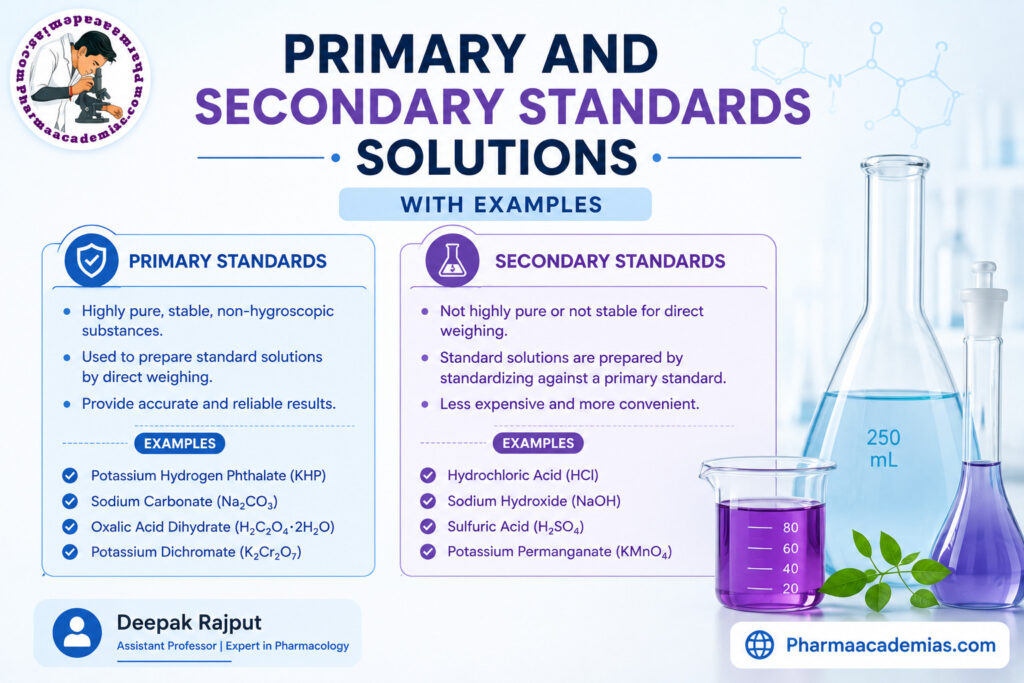
Standard solutions are solutions whose concentrations are accurately known. These solutions are prepared using substances known as standards. Depending upon their purity, stability, and method of preparation, standards are classified into two major categories:
- Primary standards
- Secondary standards
Primary and secondary standards play a vital role in pharmaceutical analysis, quality control, research laboratories, and industrial chemistry. Accurate preparation and standardization of these solutions are necessary for assay procedures, analytical estimations, and pharmaceutical calculations.
A clear understanding of primary and secondary standards is essential for pharmacy students, chemists, analysts, and healthcare professionals involved in analytical work.
Primary and Secondary Standards Solutions
Standard Solution
A standard solution may be defined as:
“A solution whose concentration is accurately known and used in quantitative analysis.”
Standard solutions are extensively used in:
- Acid-base titrations
- Redox titrations
- Complexometric titrations
- Precipitation titrations
Classification of Standards
Standards used in analytical chemistry are mainly classified into:
- Primary standards
- Secondary standards
Primary Standards
A primary standard is a highly pure, stable, non-hygroscopic substance that can be accurately weighed and directly used for preparation of a standard solution of known concentration.
Primary standards are used to prepare standard solutions without requiring further standardization.
Characteristics of Primary Standards
A substance must possess several important properties to qualify as a primary standard.
High Purity: Primary standards should possess very high purity, usually greater than 99.9%.Impurities may affect the accuracy of analytical results.
Stability: The substance should remain chemically stable during storage and handling.It should not decompose upon exposure to air, moisture, or light.
Non-Hygroscopic Nature: Primary standards should not absorb moisture from the atmosphere.Hygroscopic substances cannot be weighed accurately because their weight changes due to water absorption.
High Molecular Weight: A high molecular weight minimizes weighing errors.Small weighing inaccuracies become less significant with heavier molecular substances.
Easy Availability: The substance should be easily available and reasonably inexpensive.
Solubility: The substance should dissolve readily in suitable solvents, usually water.
Definite Chemical Composition: Primary standards must possess a well-defined chemical formula and composition.
Non-Volatile Nature: The substance should not evaporate or lose mass during weighing and storage.
Preparation of Standard Solution Using Primary Standard
Since primary standards are highly pure and stable, their solutions can be prepared directly by:
- Accurately weighing the required amount.
- Dissolving in solvent.
- Making the volume up to a fixed mark in a volumetric flask.
The resulting solution possesses accurately known concentration.
Examples of Primary Standards
Several substances are commonly used as primary standards in pharmaceutical and chemical analysis.
Sodium Carbonate (Na2CO3): Used for standardization of acids such as hydrochloric acid and sulfuric acid.
Properties
- High purity
- Stable
- Non-hygroscopic
- Easily available
Oxalic Acid (H2C2O4 . 2H2O): Used for standardization of potassium permanganate solutions.
Properties
- Stable crystalline compound
- High purity
- Readily soluble in water
Potassium Dichromate (K2Cr2O7): Used in redox titrations.
Properties
- Highly pure
- Stable
- Non-hygroscopic
- High molecular weight
Sodium Oxalate (Na2C2O4): Used for standardization of potassium permanganate.
Properties
- Stable
- Pure
- Non-hygroscopic
Potassium Hydrogen Phthalate (KHP): Widely used for standardization of sodium hydroxide solutions.
Properties
- High purity
- Stable
- High molecular weight
- Non-hygroscopic
Advantages of Primary Standards
Primary standards offer several advantages in analytical chemistry.
They provide highly accurate analytical results because their concentration can be determined directly by weighing.
They are stable during storage and handling and do not require frequent standardization.
Primary standards also improve precision and reliability in volumetric analysis.
Limitations of Primary Standards
- Very few substances fulfill all the requirements of an ideal primary standard.
- Some primary standards may require careful drying before use.
- Others may have limited solubility in certain solvents.
Secondary Standards
A secondary standard is a substance whose solution concentration cannot be determined accurately by direct weighing and therefore must be standardized against a primary standard.
Secondary standard solutions require periodic standardization because their concentration may change over time.
Characteristics of Secondary Standards
Secondary standards generally do not fulfill all the properties required for primary standards.
Lower Purity: Secondary standards may contain small impurities.
Hygroscopic Nature: Many secondary standards absorb moisture from the atmosphere.
Instability: Their solutions may decompose or react during storage.
Volatility: Some secondary standard substances may lose material by evaporation.
Requirement of Standardization: Their exact concentration must be determined using a primary standard.
Preparation of Secondary Standard Solution
Secondary standard solutions are prepared approximately by dissolving the substance in solvent.
The exact concentration is then determined by titration against a primary standard solution.
This process is called standardization.
Examples of Secondary Standards
Several commonly used analytical reagents act as secondary standards.
Hydrochloric Acid (HCl): Used in acid-base titrations.
Reason for Secondary Standard Status
Concentrated HCl is volatile and its concentration changes upon storage.
Therefore, it cannot be prepared accurately by direct weighing.
Sodium Hydroxide (NaOH): Used extensively in acid-base titrations.
Reason for Secondary Standard Status
NaOH absorbs:
- Moisture
- Carbon dioxide
from the atmosphere, altering its concentration.
Potassium Permanganate (KMnO4): Used in redox titrations.
Reason for Secondary Standard Status
KMnO₄ solutions slowly decompose during storage and may contain manganese dioxide impurities.
Silver Nitrate (AgNO3): Used in precipitation titrations.
Reason for Secondary Standard Status
Silver nitrate solutions are sensitive to light and may decompose gradually.
Importance of Standardization of Secondary Standards
Since secondary standards are unstable or impure, standardization is necessary to determine their exact concentration.
This ensures:
- Accuracy
- Precision
- Reliability
of analytical results.
Standardization is usually performed using appropriate primary standards.
Difference Between Primary and Secondary Standards
- Primary standards are highly pure, stable substances used directly for preparation of standard solutions, whereas secondary standards require standardization before use.
- Primary standards possess fixed and accurately known composition, while secondary standards may undergo changes during storage.
- Primary standard solutions remain stable for long periods, whereas secondary standard solutions often require frequent re-standardization.
- Primary standards are generally non-hygroscopic and non-volatile, while secondary standards may absorb moisture or lose material.
Importance in Pharmaceutical Analysis
Primary and secondary standards are extremely important in pharmaceutical analysis and quality control.
They are used for:
- Assay of pharmaceutical substances
- Determination of purity
- Standardization of reagents
- Quantitative estimation
- Drug quality evaluation
Accurate analytical procedures depend heavily upon proper preparation and use of standard solutions.
In pharmaceutical industries, regulatory agencies require validated analytical procedures using properly standardized solutions.
Applications in Volumetric Analysis
Acid-Base Titrations
- Primary standard: Potassium hydrogen phthalate
- Secondary standard: Sodium hydroxide
Redox Titrations
- Primary standard: Oxalic acid
- Secondary standard: Potassium permanganate
Precipitation Titrations
- Primary standard: Sodium chloride
- Secondary standard: Silver nitrate
Complexometric Titrations
- Primary standard: Calcium carbonate
- Secondary standard: EDTA solution
Conclusion
Primary and secondary standards are essential components of quantitative chemical and pharmaceutical analysis. Primary standards are highly pure, stable, and accurately weighable substances used for direct preparation of standard solutions. Secondary standards, on the other hand, require standardization against primary standards because they are less stable or less pure.
Both types of standards play vital roles in volumetric analysis, pharmaceutical quality control, research laboratories, and industrial chemistry. Proper understanding and correct use of these standards ensure accurate, reliable, and reproducible analytical results.
The selection of appropriate primary and secondary standards is fundamental for maintaining precision and quality in pharmaceutical and analytical sciences.