Historical Milestones in Drug Discovery: The discovery of drugs has been one of the greatest achievements in the history of medical science. Since ancient times, humans have searched for substances capable of relieving pain, curing diseases, and improving health. Early medicines were mainly obtained from natural sources such as plants, animals, and minerals. Over time, scientific advancements in chemistry, pharmacology, microbiology, and biotechnology transformed traditional remedies into modern therapeutic agents.
Certain drug discoveries are considered historical milestones because they revolutionized medicine and changed the treatment of diseases worldwide. These discoveries not only saved millions of lives but also laid the foundation for modern pharmaceutical research and drug development.
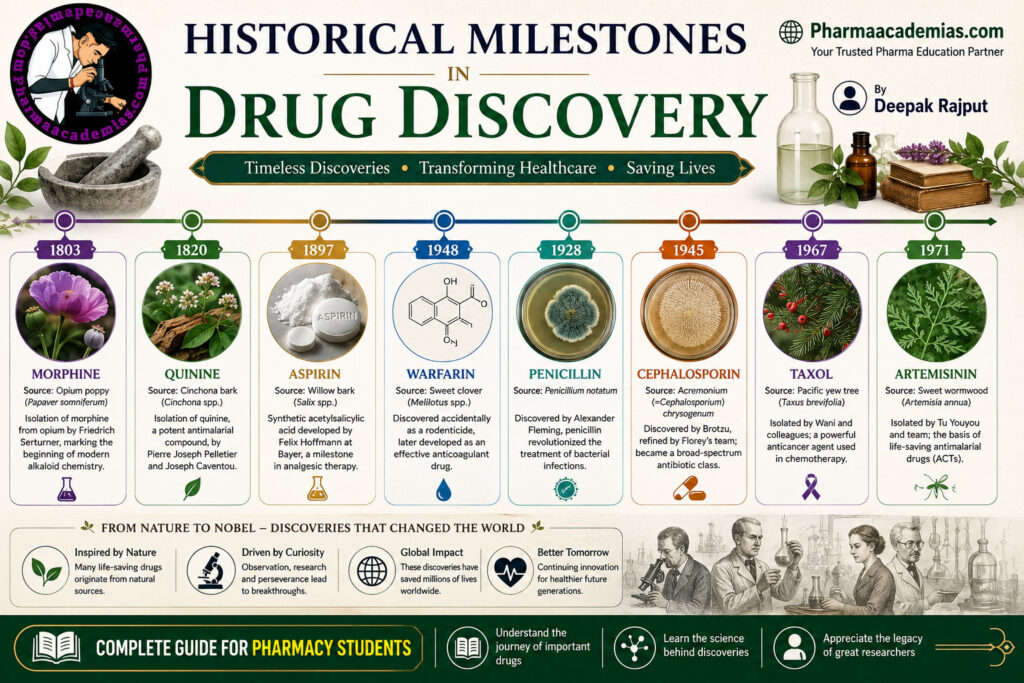
Some of the most important milestone drugs include morphine, quinine, aspirin, warfarin, penicillin, cephalosporin, taxol, and artemisinin. Each of these drugs has a unique history and has contributed significantly to the advancement of medicine.
Historical Milestones in Drug Discovery
Morphine
Morphine is considered one of the earliest pure active compounds isolated from a medicinal plant. It was isolated in 1804 by the German pharmacist Friedrich Sertürner from opium, which is obtained from the latex of the opium poppy (Papaver somniferum).
Before the discovery of morphine, opium had been used for centuries as a pain-relieving substance. However, its effects were unpredictable because crude opium contained a mixture of compounds. Sertürner successfully isolated the active alkaloid responsible for the analgesic effect and named it “morphium” after Morpheus, the Greek god of dreams.
The discovery of morphine marked the beginning of alkaloid chemistry and modern pharmacology. It was the first alkaloid isolated in pure form from a plant source.
Importance in Medicine
Morphine became widely used as a powerful analgesic for severe pain. It played an especially important role during wars and surgical procedures. The invention of the hypodermic syringe in the 19th century further increased its medical use because morphine could be administered by injection for rapid pain relief.
Morphine remains an important drug for managing severe pain, cancer pain, postoperative pain, and palliative care.
Impact on Drug Discovery
The isolation of morphine demonstrated that medicinal plants contain specific active chemical constituents responsible for therapeutic effects. This discovery inspired scientists to isolate many other alkaloids such as quinine, atropine, strychnine, and caffeine.
Morphine therefore represents a major milestone in the scientific study of natural products and pharmaceutical chemistry.
Quinine
Quinine is an alkaloid obtained from the bark of the cinchona tree (Cinchona species). The medicinal use of cinchona bark originated in South America, where indigenous people used it to treat fever.
In the 17th century, Jesuit missionaries introduced cinchona bark to Europe, where it became known as “Jesuit’s bark” or “Peruvian bark.” The bark proved highly effective in treating malaria, a deadly disease that caused widespread mortality.
In 1820, French chemists Pierre Joseph Pelletier and Joseph Bienaimé Caventou isolated quinine from cinchona bark. This achievement was a major advancement in medicinal chemistry.
Importance in Medicine
Quinine became the first effective treatment for malaria and saved millions of lives worldwide. It played a critical role during colonial expansion and military campaigns in tropical regions where malaria was prevalent.
Quinine remained the primary antimalarial drug for many years until synthetic antimalarial drugs were developed.
Impact on Drug Discovery
The discovery of quinine demonstrated the enormous therapeutic potential of plant alkaloids. It encouraged scientific exploration of medicinal plants and established the importance of natural products in infectious disease treatment.
Quinine also contributed significantly to the development of organic chemistry and stereochemistry.
Aspirin
Aspirin is one of the most widely used drugs in medical history. Its origin can be traced to the use of willow bark (Salix species) in ancient civilizations for the treatment of pain and fever.
Willow bark contains salicin, which was later converted into salicylic acid. Although salicylic acid was effective, it caused severe gastric irritation.
In 1897, Felix Hoffmann, a chemist working at Bayer, synthesized acetylsalicylic acid, a safer derivative of salicylic acid. The drug was marketed under the name aspirin.
Importance in Medicine
Aspirin possesses analgesic, antipyretic, anti-inflammatory, and antiplatelet properties. It became widely used for pain relief, fever reduction, and treatment of inflammatory conditions.
Later, aspirin was found to reduce platelet aggregation, making it highly valuable in preventing heart attacks and strokes.
Impact on Drug Discovery
Aspirin revolutionized pharmaceutical chemistry and became one of the first successful synthetic modifications of a natural product. It also contributed to the understanding of prostaglandins and cyclooxygenase enzymes.
The success of aspirin established the pharmaceutical industry’s interest in synthetic drug development.
Warfarin
The discovery of warfarin originated from an unusual veterinary problem in the 1920s. Cattle in North America developed fatal bleeding after consuming spoiled sweet clover hay.
Scientists discovered that spoiled sweet clover contained dicoumarol, a natural anticoagulant formed by fungal action on coumarin compounds.
Researchers at the Wisconsin Alumni Research Foundation developed a more potent synthetic derivative called warfarin. Initially, it was used as a rat poison because of its anticoagulant effects.
Later, its controlled use in humans proved effective and safe for preventing blood clot formation.
Importance in Medicine
Warfarin became one of the most important oral anticoagulant drugs used in the prevention and treatment of thromboembolic disorders such as deep vein thrombosis, pulmonary embolism, and stroke.
Impact on Drug Discovery
Warfarin demonstrated how observations in veterinary medicine and natural toxicology could lead to important therapeutic discoveries. It also advanced understanding of blood coagulation mechanisms and vitamin K metabolism.
Penicillin
Penicillin is regarded as one of the greatest medical discoveries of all time. It was discovered accidentally in 1928 by Alexander Fleming while working at St. Mary’s Hospital in London.
Fleming observed that a mold called Penicillium notatum inhibited the growth of bacteria on a culture plate. He identified the antibacterial substance produced by the mold and named it penicillin.
However, large-scale production became possible only during the 1940s through the efforts of Howard Florey, Ernst Chain, and their research team.
Importance in Medicine
Penicillin revolutionized the treatment of bacterial infections. Before antibiotics, diseases such as pneumonia, septicemia, syphilis, and wound infections often caused death.
Penicillin saved millions of lives during World War II and marked the beginning of the antibiotic era.
Impact on Drug Discovery
The discovery of penicillin transformed medicine and pharmaceutical research. It demonstrated the therapeutic power of microorganisms and led to the search for many other antibiotics.
Penicillin also contributed significantly to microbiology, fermentation technology, and medicinal chemistry.
Cephalosporin
Cephalosporins were discovered in 1945 by the Italian scientist Giuseppe Brotzu from a fungus called Cephalosporium acremonium obtained from seawater near sewage outlets in Sardinia.
Brotzu observed that the fungus produced substances capable of inhibiting bacterial growth. Later, scientists isolated cephalosporin compounds and developed semisynthetic derivatives.
Importance in Medicine
Cephalosporins are broad-spectrum antibiotics effective against many bacterial infections. They are widely used in respiratory infections, urinary tract infections, meningitis, and surgical prophylaxis.
They became particularly important because some bacteria resistant to penicillin remained sensitive to cephalosporins.
Impact on Drug Discovery
Cephalosporins expanded the antibiotic arsenal and encouraged the development of semisynthetic antibiotics with improved activity and safety profiles.
Their discovery highlighted the importance of environmental microorganisms as sources of novel drugs.
Taxol
Taxol, also known as paclitaxel, is an important anticancer drug obtained from the bark of the Pacific yew tree (Taxus brevifolia).
The compound was discovered during a screening program conducted by the United States National Cancer Institute in the 1960s. Scientists Monroe Wall and Mansukh Wani isolated taxol in 1971.
Taxol showed remarkable anticancer activity, but its development faced challenges due to low natural availability and difficulties in extraction.
Importance in Medicine
Taxol became one of the most effective anticancer drugs used in the treatment of ovarian cancer, breast cancer, lung cancer, and Kaposi’s sarcoma.
Its mechanism of action is unique because it stabilizes microtubules and prevents cancer cell division.
Impact on Drug Discovery
Taxol demonstrated the immense potential of plant-derived compounds in cancer therapy. It also emphasized the importance of biodiversity conservation and sustainable drug production methods.
The development of semisynthetic production techniques and plant tissue culture methods for taxol marked significant advancements in pharmaceutical biotechnology.
Artemisinin
Artemisinin is an antimalarial drug obtained from the plant Artemisia annua, commonly known as sweet wormwood.
The discovery of artemisinin was part of a Chinese research program during the 1960s aimed at finding new treatments for malaria. Chinese scientist Tu Youyou successfully isolated artemisinin from the plant based on traditional Chinese medicinal knowledge.
Her work led to the development of highly effective antimalarial therapies.
Importance in Medicine
Artemisinin and its derivatives are highly effective against multidrug-resistant malaria caused by Plasmodium falciparum.
Artemisinin-based combination therapies (ACTs) are now recommended worldwide as first-line treatment for malaria.
Impact on Drug Discovery
The discovery of artemisinin highlighted the importance of traditional medicine as a source of modern drug discovery. It also demonstrated the value of integrating ethnopharmacology with modern scientific research.
Tu Youyou received the Nobel Prize in Physiology or Medicine in 2015 for her contribution.
Conclusion
The discovery of milestone drugs such as morphine, quinine, aspirin, warfarin, penicillin, cephalosporin, taxol, and artemisinin transformed medical science and significantly improved human health. These drugs originated from diverse natural sources including plants, microorganisms, and traditional medicinal systems.
Each discovery not only provided effective treatments for major diseases but also advanced scientific understanding in chemistry, pharmacology, microbiology, and biotechnology. These milestone drugs demonstrated the enormous therapeutic potential of natural products and inspired continued exploration of nature for new medicines.
The history of drug discovery shows that observation, traditional knowledge, scientific curiosity, and technological advancement together play crucial roles in the development of life-saving therapies. Even today, natural products continue to serve as valuable sources for future drug discovery and pharmaceutical innovation.