
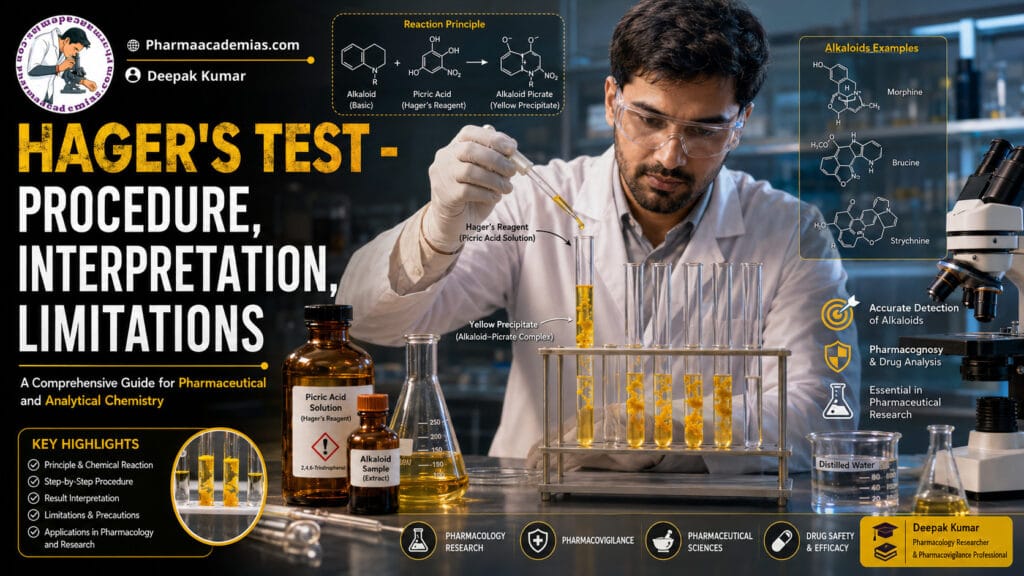
Hager’s Test is a chemical test that detect alkaloids, a class of naturally occurring organic compounds with basic nitrogen atoms that often exhibit pharmacological activities. This test is based on the formation of yellow precipitates when alkaloids react with Hager’s reagent. Hager’s reagent typically contains picric acid and is employed as a qualitative alkaloid screening method.
In the field of pharmacognosy and phytochemistry, the identification of alkaloids is of enormous significance because alkaloids constitute one of the largest and most therapeutically important groups of naturally occurring secondary metabolites. These compounds possess remarkable pharmacological activities and have been used for centuries in medicine for the treatment of pain, infections, cardiovascular disorders, neurological diseases, and various other pathological conditions.
The test is named after the scientist who introduced the reagent used in the procedure, commonly referred to as Hager’s reagent, which consists of a saturated solution of picric acid. When alkaloidal compounds are treated with this reagent, they react chemically to form yellow-colored precipitates known as alkaloidal picrates. The appearance of these precipitates serves as an indication of the presence of alkaloids in the test sample.
Hager’s Test is regarded as a preliminary or presumptive test rather than a confirmatory analytical method. Nevertheless, despite the emergence of sophisticated modern analytical techniques such as High-Performance Liquid Chromatography (HPLC), Gas Chromatography-Mass Spectrometry (GC-MS), Nuclear Magnetic Resonance (NMR), and Fourier Transform Infrared Spectroscopy (FTIR), Hager’s Test continues to occupy an important place in pharmaceutical education and laboratory screening procedures because of its simplicity, rapidity, low cost, and ease of execution.
In pharmacognostic laboratories, this test is routinely used during phytochemical screening to identify alkaloidal constituents in medicinal plants. Since alkaloids often contribute significantly to the therapeutic actions of herbal drugs, preliminary detection through Hager’s Test provides valuable insight into the medicinal potential of plant materials. The test is also useful in academic practicals for demonstrating acid-base interactions, precipitation reactions, and the qualitative analysis of nitrogen-containing compounds.
Principle of Hager’s Test
The principle underlying Hager’s Test is based upon the chemical interaction between alkaloids and picric acid. Alkaloids are generally basic nitrogen-containing organic compounds, while picric acid is a strongly acidic aromatic compound. When an alkaloid-containing solution is treated with picric acid, an acid-base reaction takes place, leading to the formation of insoluble alkaloidal picrate complexes.
These complexes appear as yellow crystalline precipitates or turbidity in the solution. The formation of such precipitates is considered evidence for the presence of alkaloidal substances.
Chemically, the reaction may be represented as follows:
Alkaloid + Picric Acid → Alkaloid Picrate (Yellow precipitate)
The nitrogen atom present in alkaloids possesses a lone pair of electrons, which imparts basic properties to these compounds. Picric acid, due to the presence of three strongly electron-withdrawing nitro groups attached to the phenolic ring, exhibits highly acidic characteristics. As a result, ionic interactions occur between the positively charged alkaloidal ions and negatively charged picrate ions, causing precipitation.
The reaction is particularly valuable because many naturally occurring alkaloids readily form sparingly soluble picrate salts, allowing visual identification through the appearance of precipitates.
Hager’s Reagent
The reagent employed in Hager’s Test is known as Hager’s reagent, which is essentially a saturated aqueous solution of picric acid.
Chemical Nature of Picric Acid
- Chemical name: 2,4,6-Trinitrophenol
- Molecular formula: C₆H₃N₃O₇
- Appearance: Bright yellow crystalline solid
- Nature: Strong acidic aromatic compound
Picric acid is highly nitrated and exhibits strong acidic behavior because of the electron-withdrawing effects of the nitro groups. This high acidity enables it to react efficiently with basic alkaloids.
Preparation of Hager’s Reagent
The preparation of Hager’s reagent is relatively simple and involves the preparation of a saturated aqueous solution of picric acid.
Procedure for Preparation
- Take an excess quantity of picric acid crystals.
- Add them to distilled water.
- Stir continuously until saturation is achieved.
- Filter the solution to remove undissolved particles.
- Store the clear yellow solution in an amber-colored glass bottle.
The reagent should be stored carefully because picric acid is chemically hazardous and may become explosive under dry conditions.
Requirements for Performing Hager’s Test
Apparatus Required
The following apparatus are generally used:
- Test tubes
- Test tube stand
- Pipettes or droppers
- Measuring cylinder
- Glass rod
- Filter paper
- Funnel
- Beakers
Chemicals Required
- Hager’s reagent
- Distilled water
- Dilute hydrochloric acid
- Sample extract or test solution
Preparation of Sample Solution
The sample used for Hager’s Test may consist of:
- Crude powdered drugs
- Plant extracts
- Herbal formulations
- Alkaloidal fractions
- Pharmaceutical preparations
In the case of plant materials, proper extraction is essential to isolate alkaloidal constituents.
General Extraction Procedure
- The plant material is dried thoroughly.
- It is then powdered using a grinder or mortar and pestle.
- The powder is treated with dilute hydrochloric acid.
- The acidic mixture is filtered.
- The filtrate containing alkaloidal salts is used for testing.
Acidification enhances alkaloid extraction because alkaloids become more water-soluble in acidic medium.
Procedure of Hager’s Test
The procedure of Hager’s Test is simple, rapid, and convenient.
Step 1: Preparation of Test Solution
Take approximately 1–2 mL of the prepared extract or sample solution in a clean and dry test tube.
If the sample is insoluble:
- Dissolve it in dilute hydrochloric acid or distilled water before testing.
Step 2: Addition of Hager’s Reagent
Add a few drops of Hager’s reagent slowly into the test solution using a dropper.
Usually:
- 2–5 drops are sufficient.
The reagent should be added gradually while gently shaking the test tube.
Step 3: Observation
Observe the solution carefully against a light background.
A positive reaction is indicated by:
- Yellow turbidity
- Yellow crystalline precipitate
- Cloudiness in the solution
The precipitate may appear immediately or after standing for a short duration depending upon alkaloid concentration.
Interpretation of Hager’s Test
Positive Result
A positive Hager’s Test is characterized by the formation of a yellow precipitate or yellow crystalline complex after addition of Hager’s reagent.
This indicates:
- Presence of alkaloids
- Presence of basic nitrogenous compounds
- Possible pharmacologically active constituents
The intensity of precipitation may vary depending upon:
- Type of alkaloid
- Concentration of alkaloid
- Purity of sample
- Extraction efficiency
In some cases, heavy precipitates are produced instantly, whereas in dilute solutions only faint turbidity may appear.
Negative Result
If no precipitate or turbidity appears after addition of the reagent, the test is considered negative.
This may indicate:
- Absence of alkaloids
- Extremely low alkaloid concentration
- Improper extraction procedure
- Decomposition of alkaloidal constituents
Mechanism of Reaction of Hager’s Test
The mechanism of Hager’s Test involves ionic interactions between alkaloids and picric acid.
Alkaloids are weak organic bases because of nitrogen atoms containing lone pair electrons. In acidic medium, alkaloids form positively charged ions. Picric acid dissociates to yield picrate ions.
When both come into contact:
- Ionic attraction occurs
- Insoluble alkaloidal picrate salts are formed
- These salts separate out as yellow precipitates
The precipitation reaction is fundamentally an acid-base neutralization followed by salt formation.
Applications of Hager’s Test
1. Preliminary Phytochemical Screening
Hager’s Test is extensively employed in phytochemical studies to screen medicinal plants for alkaloidal constituents. It serves as one of the standard qualitative tests during phytochemical investigations.
2. Pharmacognostic Evaluation
In pharmacognosy, the test helps in:
- Identification of crude drugs
- Authentication of medicinal plants
- Detection of adulteration
- Standardization of herbal materials
3. Pharmaceutical Analysis
The test is useful in pharmaceutical laboratories for:
- Preliminary alkaloid detection
- Quality control studies
- Analysis of herbal formulations
4. Educational Demonstration
Hager’s Test is commonly included in:
- Pharmacy practicals
- Organic chemistry experiments
- Pharmaceutical analysis laboratories
It provides students with practical understanding of:
- Precipitation reactions
- Alkaloid chemistry
- Qualitative analytical methods
5. Natural Product Research
Researchers use the test during:
- Isolation of plant constituents
- Bioactive compound screening
- Drug discovery studies
Advantages of Hager’s Test
Hager’s Test possesses several practical advantages that contribute to its continued use in laboratories.
Simplicity: The procedure is straightforward and easy to perform without requiring advanced technical expertise.
Rapid Results: Results can usually be observed within a few minutes.
Economical Method: Only inexpensive reagents and basic laboratory apparatus are needed.
Useful for Initial Screening: The test is valuable during the preliminary stages of phytochemical analysis before advanced investigations are conducted.
Educational Importance: It remains an excellent teaching tool for demonstrating classical chemical testing procedures.
Limitations of Hager’s Test
Despite its usefulness, Hager’s Test suffers from numerous limitations that restrict its reliability and specificity.
Lack of Specificity
One of the major limitations of Hager’s Test is its poor specificity. Picric acid may react not only with alkaloids but also with several other nitrogen-containing substances.
Compounds capable of causing false-positive reactions include:
- Amines
- Certain proteins
- Synthetic nitrogenous drugs
- Other basic organic compounds
Therefore, a positive result does not conclusively prove the presence of alkaloids.
Inability to Identify Specific Alkaloids
The test merely indicates the probable presence of alkaloidal compounds. It cannot:
- Differentiate between various alkaloids
- Identify molecular structure
- Determine chemical class
Advanced analytical methods are required for proper characterization.
Poor Quantitative Capability
Hager’s Test is entirely qualitative in nature. It does not provide information regarding:
- Alkaloid concentration
- Potency
- Purity
- Quantitative estimation
Thus, it cannot replace instrumental quantitative methods.
Interference from Plant Constituents
Plant extracts contain numerous secondary metabolites such as:
- Tannins
- Resins
- Glycosides
- Phenolic compounds
- Pigments
These substances may interfere with the reaction by producing turbidity or masking the precipitate.
Sensitivity Issues
The test may fail to detect alkaloids present in very low concentrations. Weak alkaloidal solutions may produce only faint turbidity that is difficult to observe visually.
This can result in:
- False-negative results
Subjective Interpretation
Interpretation of the test depends largely upon visual observation by the analyst. Slight turbidity may be interpreted differently by different individuals.
Therefore:
- Human error can affect accuracy.
Dependence on Extraction Procedure
Improper extraction can significantly affect results. Several factors influence alkaloid extraction including:
- pH
- Solvent choice
- Temperature
- Extraction time
- Sample quality
Poor extraction efficiency may lead to inaccurate conclusions.
Safety Concerns
Picric acid is hazardous and potentially explosive when dry. Improper handling or storage can create serious laboratory hazards.
Safety Precautions
Since picric acid is hazardous, strict safety measures should be followed.
Precautions
- Wear gloves and protective goggles.
- Avoid direct skin contact.
- Perform the test in a well-ventilated area.
- Keep picric acid away from heat and flame.
- Never allow picric acid to dry completely.
- Store reagent in tightly closed containers.
Comparison with Other Alkaloid Tests
Several other classical alkaloid tests are used alongside Hager’s Test.
| Test | Reagent Used | Observation |
| Hager’s Test | Picric acid | Yellow precipitate |
| Mayer’s Test | Potassium mercuric iodide | Cream precipitate |
| Wagner’s Test | Iodine-potassium iodide | Brown precipitate |
| Dragendorff’s Test | Potassium bismuth iodide | Orange-red precipitate |
Each test differs in sensitivity and specificity.
Importance in Pharmacognosy and Pharmaceutical Sciences
The importance of Hager’s Test extends beyond simple qualitative analysis. It plays a foundational role in pharmacognosy because alkaloids represent one of the most therapeutically valuable groups of plant constituents.
The test contributes significantly to:
- Herbal drug evaluation
- Crude drug authentication
- Medicinal plant research
- Quality assurance studies
- Pharmaceutical education
Even in modern laboratories, classical alkaloid tests continue to complement advanced analytical techniques during preliminary investigations.
Conclusion
Hager’s Test is a classical qualitative chemical test widely used for the preliminary detection of alkaloids in medicinal plants, herbal preparations, and pharmaceutical samples. The test relies upon the formation of yellow insoluble alkaloidal picrate complexes following reaction with picric acid present in Hager’s reagent. Because of its simplicity, rapidity, low cost, and convenience, the test remains an important tool in pharmacognosy, phytochemistry, pharmaceutical analysis, and educational laboratories.
However, despite its practical utility, Hager’s Test possesses significant limitations, including poor specificity, inability to identify individual alkaloids, susceptibility to interference, and lack of quantitative capability. Consequently, positive findings obtained through Hager’s Test should always be supported and confirmed using advanced analytical and instrumental techniques.
Nevertheless, the historical importance, educational value, and practical applicability of Hager’s Test ensure its continued relevance in pharmaceutical sciences and phytochemical research.


One Comment