Components and Types of Feedback Systems: A feedback system in human physiology is a regulatory mechanism by which the body monitors and controls its internal environment to maintain homeostasis. Homeostasis refers to the ability of the body to maintain a relatively constant internal environment despite continuous changes in external and internal conditions. Feedback systems ensure that physiological variables such as body temperature, blood glucose level, blood pressure, blood pH, water balance, and hormone levels remain within their normal physiological ranges. Pharmaacademias.com
The human body contains numerous feedback mechanisms that continuously detect changes in physiological conditions and initiate appropriate responses to restore normal function. These regulatory systems involve the coordinated action of the nervous system, endocrine system, receptors, control centers, and effector organs. Most physiological processes are regulated by negative feedback, whereas positive feedback is observed only in a few specialized physiological events.
Components and Types of Feedback Systems
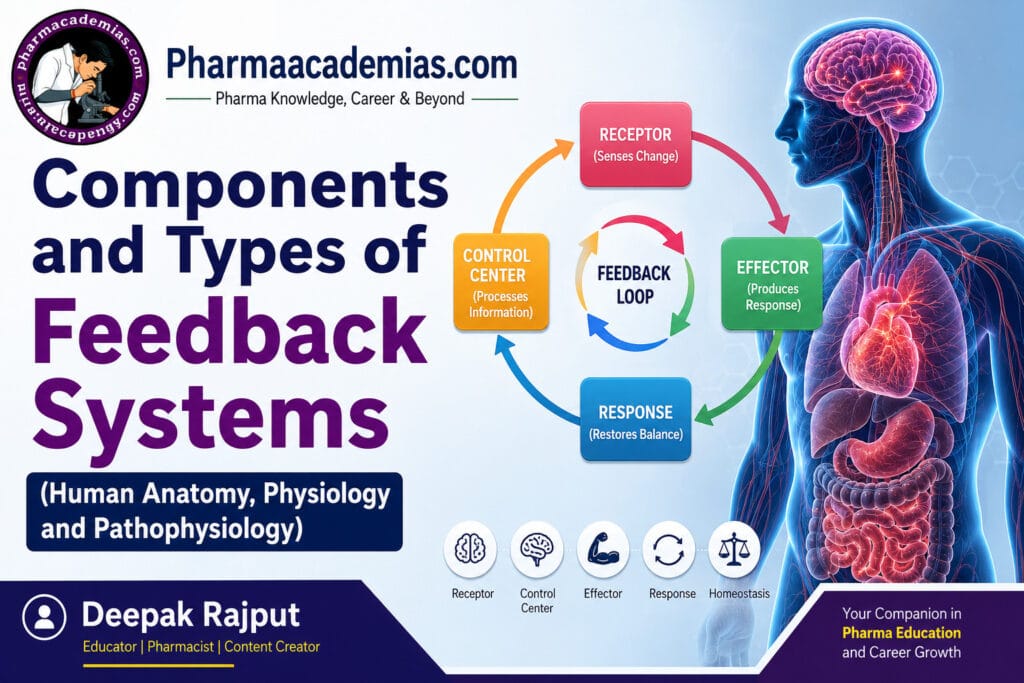
A physiological feedback system consists of three major components: the receptor (sensor), the control center (integrator), and the effector. These components work together to detect changes in the internal environment, process the information, and produce an appropriate response to maintain homeostasis.
1. Receptor (Sensor)
The receptor, also known as the sensor, is the first component of a feedback system. Its function is to detect changes (stimuli) occurring within the internal or external environment. Receptors continuously monitor physiological variables such as body temperature, blood pressure, blood glucose concentration, oxygen level, carbon dioxide level, osmolarity, and blood pH. Whenever a change occurs, the receptor converts the stimulus into nerve impulses or chemical signals and sends this information to the control center.
Different types of receptors are specialized to detect different physiological changes. For example, thermoreceptors located in the skin and hypothalamus detect changes in body temperature, baroreceptors present in the carotid sinus and aortic arch monitor blood pressure, chemoreceptors detect changes in blood oxygen, carbon dioxide, and pH levels, while osmoreceptors in the hypothalamus monitor the osmotic concentration of body fluids.
The accuracy of the feedback system largely depends on the sensitivity of these receptors, as they provide the initial information required for physiological regulation.
2. Control Center (Integrator)
The control center, also called the integrator, receives information from the receptors, compares it with the normal physiological value (set point), and determines the appropriate response. It acts as the decision-making center of the feedback system.
In the human body, the control center is usually located in the brain, particularly the hypothalamus, or within endocrine glands such as the pancreas, pituitary gland, or thyroid gland. After analyzing the incoming information, the control center sends commands to the appropriate effector organs through nerve impulses or hormones.
For example, when body temperature rises above the normal range, the hypothalamus detects the change and activates mechanisms such as sweating and vasodilation to reduce body temperature. Similarly, when blood glucose levels increase after a meal, the pancreas secretes insulin to restore glucose levels to normal.
Thus, the control center coordinates physiological responses and ensures that homeostasis is maintained.
3. Effector
The effector is the organ, tissue, gland, or muscle that carries out the response directed by the control center. Effectors receive signals through nerves or hormones and produce the necessary physiological changes to restore normal conditions.
Effectors may include skeletal muscles, smooth muscles, cardiac muscle, sweat glands, blood vessels, kidneys, liver, pancreas, endocrine glands, or other organs depending on the specific physiological process being regulated.
For example, during an increase in body temperature, sweat glands produce sweat while blood vessels in the skin dilate to enhance heat loss. During low blood glucose levels, the liver releases stored glucose into the bloodstream under the influence of glucagon. These responses help return physiological variables to their normal ranges.
The coordinated action of receptors, control centers, and effectors enables the body to maintain a stable internal environment despite constant external and internal changes.
Working of a Physiological Feedback System
The functioning of a physiological feedback system begins when a change occurs in the body’s internal environment. This change is detected by specialized receptors, which transmit information to the control center. The control center compares the detected value with the normal physiological set point and determines whether corrective action is required. If necessary, it sends signals through the nervous or endocrine system to the appropriate effector organs. The effectors then produce a physiological response that either reverses or enhances the original stimulus, depending on the type of feedback mechanism involved. Once the normal condition has been restored, the response gradually decreases, thereby maintaining homeostasis.
Types of Feedback Systems
Based on the effect of the response on the original stimulus, physiological feedback systems are classified into negative feedback and positive feedback mechanisms.
1. Negative Feedback System
A negative feedback system is the most common regulatory mechanism in the human body. In this type of feedback, the response produced by the effector opposes or reverses the original stimulus. As a result, the physiological variable returns to its normal range, thereby maintaining homeostasis.
Negative feedback acts like a thermostat, continuously correcting deviations from the normal physiological set point. Because of its stabilizing effect, it is responsible for regulating most body functions.
One of the best examples is the regulation of body temperature. The normal body temperature is approximately 37°C. When body temperature rises due to exercise or a hot environment, thermoreceptors send signals to the hypothalamus. The hypothalamus activates sweat glands and causes dilation of blood vessels in the skin, allowing heat to be lost from the body. As the temperature returns to normal, sweating decreases and the response stops.
Another important example is the regulation of blood glucose levels. After a meal, blood glucose concentration increases. The pancreas detects this increase and secretes insulin, which promotes the uptake of glucose by body cells and its storage as glycogen in the liver. Consequently, blood glucose returns to the normal range. Conversely, when blood glucose falls during fasting, the pancreas secretes glucagon, which stimulates the breakdown of glycogen into glucose, thereby increasing blood glucose levels.
Other examples of negative feedback include the regulation of blood pressure, blood calcium concentration, blood pH, water balance, thyroid hormone secretion, and respiratory rate.
The major advantage of negative feedback is that it maintains internal stability, prevents excessive physiological changes, and ensures proper functioning of organs. Since most body processes require a stable internal environment, negative feedback is considered the principal mechanism of homeostatic regulation.
2. Positive Feedback System
A positive feedback system is much less common than negative feedback. In this mechanism, the response produced by the effector enhances or amplifies the original stimulus instead of reversing it. As a result, the physiological process continues to intensify until a specific event is completed.
Positive feedback mechanisms are generally associated with rapid physiological events rather than long-term homeostasis. Once the desired outcome has been achieved, the feedback loop is terminated.
A classic example is childbirth (parturition). As the baby’s head presses against the cervix, stretch receptors send nerve impulses to the hypothalamus, which stimulates the posterior pituitary gland to release oxytocin. Oxytocin causes stronger uterine contractions, which further increase cervical stretching. This leads to the release of even more oxytocin, creating a cycle that continues until the baby is delivered.
Another example is blood clotting. When a blood vessel is injured, platelets adhere to the damaged area and release chemicals that attract additional platelets. The accumulation of platelets continues until a stable blood clot is formed, preventing excessive blood loss.
Positive feedback also occurs during milk ejection (let-down reflex) in breastfeeding. Suckling by the infant stimulates the release of oxytocin, which causes contraction of myoepithelial cells surrounding the mammary glands, resulting in milk release. Continued suckling maintains the positive feedback until feeding ends.
Although positive feedback is essential for certain physiological processes, it is not suitable for maintaining homeostasis because it amplifies rather than corrects deviations from the normal state.
Difference Between Negative and Positive Feedback Systems
| Feature | Negative Feedback | Positive Feedback |
| Response to stimulus | Opposes or reverses the stimulus | Amplifies or enhances the stimulus |
| Primary function | Maintains homeostasis | Completes a specific physiological event |
| Occurrence | Very common in the body | Relatively rare |
| Stability | Promotes stability | Temporarily reduces stability until the event is completed |
| Effect on physiological variable | Returns it to normal | Moves it further away from the initial state until completion |
| Examples | Regulation of body temperature, blood glucose, blood pressure, blood calcium, blood pH | Childbirth, blood clotting, milk ejection during lactation |
Importance of Feedback Systems in Human Physiology
Feedback systems are essential for maintaining life because they ensure that the body’s internal environment remains stable despite continuous changes in external conditions. They regulate vital physiological processes such as body temperature, blood glucose concentration, blood pressure, respiration, hormone secretion, fluid balance, electrolyte concentration, and acid-base balance. Proper functioning of these systems is necessary for normal cellular metabolism, organ function, and overall health.
Disruption of feedback mechanisms can lead to various diseases and pathological conditions. For example, failure of blood glucose regulation results in diabetes mellitus, impaired temperature regulation may cause hyperthermia or hypothermia, abnormal calcium regulation can lead to osteoporosis or tetany, and disturbances in blood pressure regulation may result in hypertension or hypotension. Therefore, understanding feedback systems is fundamental to the study of human anatomy, physiology, and pathophysiology.
Conclusion
Feedback systems are the body’s natural control mechanisms that maintain homeostasis by continuously monitoring and regulating physiological variables. A typical physiological feedback system consists of a receptor, control center, and effector, which work together to detect changes and produce appropriate responses. Negative feedback is the predominant mechanism responsible for maintaining stable internal conditions, whereas positive feedback occurs in specialized physiological events such as childbirth, blood clotting, and lactation. Together, these mechanisms ensure the proper functioning of the human body and play a crucial role in health and disease.