
Limit Test for Chloride: In pharmaceutical analysis, the purity of pharmaceutical substances is of immense importance because impurities present even in small quantities may influence the safety, efficacy, stability, and therapeutic activity of drugs. Therefore, pharmaceutical substances are routinely subjected to various impurity tests to ensure that unwanted materials remain within permissible limits prescribed by pharmacopoeias. Among these impurity tests, the limit test for chloride is one of the most important inorganic impurity tests performed in pharmaceutical quality control laboratories.
The limit test for chloride is a semi-quantitative analytical test used to detect and control small amounts of chloride impurities present in pharmaceutical substances. Chloride impurities may originate from raw materials, manufacturing processes, water used in production, reagents, or contamination during storage and handling. Excessive chloride content may affect the quality, stability, and purity of pharmaceutical preparations, making its control essential.
The test is based on the reaction between chloride ions and silver nitrate in the presence of nitric acid, resulting in the formation of a white precipitate of silver chloride. The intensity of turbidity produced by the test solution is compared visually with that produced by a standard chloride solution containing a known amount of chloride impurity.
The limit test does not determine the exact amount of chloride present; rather, it indicates whether the chloride impurity is within the prescribed pharmacopoeial limit.
Definition of Limit Test for Chloride
The limit test for chloride may be defined as a semi-quantitative analytical test designed to detect and control small quantities of chloride impurities in pharmaceutical substances by comparing the turbidity produced with a standard chloride solution under specified experimental conditions.
The test ensures that chloride impurities do not exceed the acceptable pharmacopoeial limit.
Principle of the Limit Test for Chloride
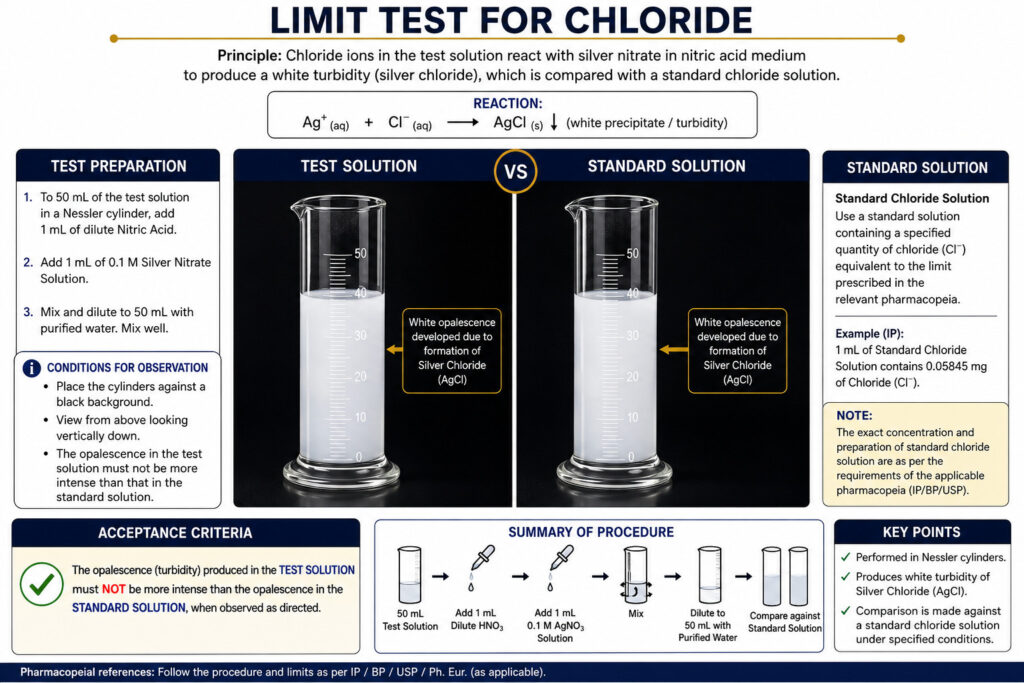
The principle of the limit test for chloride is based on the reaction between chloride ions and silver nitrate in an acidic medium to produce a white precipitate of silver chloride.
The chloride ions present in the sample react with silver nitrate according to the following reaction:
AgNO3 + Cl– → AgCl ↓ + NO3–
Silver chloride formed during the reaction appears as a white turbidity or precipitate. Nitric acid is added to maintain acidic conditions and to prevent interference from other ions such as carbonates or phosphates.
The turbidity produced in the test solution is visually compared with that produced by a standard chloride solution containing a known concentration of chloride ions. If the turbidity of the test solution is less than or equal to the standard, the sample passes the test.
Sources of Chloride Impurities
Chloride impurities may enter pharmaceutical substances from several sources during manufacturing, processing, or storage.
Common sources include:
- Hydrochloric acid used during synthesis
- Chloride-containing reagents
- Impure raw materials
- Water used during manufacturing
- Contamination from processing equipment
- Residual salts from purification procedures
Improper washing during manufacturing may also leave traces of chloride-containing compounds within the final product.
Importance of the Limit Test for Chloride
The limit test for chloride is important because excessive chloride impurities may:
- Affect drug stability
- Alter chemical reactions
- Influence product quality
- Interfere with analytical procedures
- Cause incompatibility in formulations
In injectable and parenteral preparations, excessive chloride content may additionally influence physiological compatibility and product safety.
The test therefore helps ensure compliance with pharmacopoeial purity standards.
Reagents Used in the Limit Test for Chloride
Several reagents are required for performing the limit test for chloride.
Silver Nitrate Solution
Silver nitrate acts as the primary reagent that reacts with chloride ions to produce silver chloride precipitate.
The reagent must be freshly prepared and protected from light because silver nitrate undergoes photochemical decomposition.
Nitric Acid
Nitric acid provides an acidic medium necessary for the reaction.
It prevents interference from carbonate, phosphate, or hydroxide ions that may otherwise form precipitates with silver ions.
Nitric acid also improves the sensitivity and specificity of the test.
Standard Chloride Solution
A standard chloride solution containing a known amount of chloride impurity is used for comparison.
The standard is generally prepared using sodium chloride dissolved in purified water.
Purified Water
Water used in the test must be chloride-free to avoid false-positive results.
Distilled or deionized water is generally used.
Apparatus Used
The apparatus commonly used in the limit test includes:
- Nessler cylinders
- Measuring cylinders
- Pipettes
- Glass rods
- Volumetric flasks
Nessler cylinders are specially designed transparent glass cylinders that facilitate visual comparison of turbidity.
Procedure for the Limit Test for Chloride
The test is generally performed by preparing both a test solution and a standard solution under identical conditions.
In the test procedure, the specified quantity of the pharmaceutical substance is dissolved in water or another suitable solvent. Nitric acid is then added followed by silver nitrate solution.
Simultaneously, a standard chloride solution containing the prescribed amount of chloride impurity is prepared in another Nessler cylinder under the same conditions.
Both solutions are allowed to stand for a specified period, usually about five minutes, protected from direct sunlight.
The turbidity developed in the test solution is then compared visually with that of the standard solution against a dark background.
If the turbidity produced in the test solution is not greater than that of the standard, the substance complies with the limit test for chloride.
Chemical Reaction Involved
The reaction involved in the test is precipitation of silver chloride.
Ag+ + Cl− → Ag Cl↓
Silver chloride appears as a curdy white precipitate or turbidity.
The intensity of turbidity corresponds approximately to the amount of chloride impurity present.
Role of Nitric Acid in the Test
Nitric acid plays a very important role in the limit test for chloride.
Its functions include:
- Providing acidic medium
- Preventing precipitation of other silver salts
- Eliminating interference from carbonates and phosphates
- Enhancing accuracy of the test
Without nitric acid, silver ions may react with unwanted ions and produce misleading turbidity.
Observation in the Test
The main observation in the limit test for chloride is the degree of turbidity produced.
Two situations may arise:
Pass Condition: If the turbidity of the test solution is less than or equal to the standard turbidity, the sample passes the test.
Fail Condition: If the turbidity of the test solution is greater than the standard turbidity, the sample fails the test because chloride impurities exceed permissible limits.
Interpretation of Results
The limit test is a comparative test rather than an exact quantitative determination.
The test indicates whether:
- Chloride impurities are within acceptable limits
or - Chloride impurities exceed prescribed pharmacopoeial standards
Visual comparison should be performed carefully under identical lighting conditions for accurate interpretation.
Precautions in the Limit Test for Chloride
Several precautions are necessary to obtain reliable results.
The glassware used must be thoroughly cleaned and free from chloride contamination. Reagents should be freshly prepared, and purified water must be chloride-free.
Both test and standard solutions should be prepared under identical conditions regarding volume, reagent concentration, temperature, and observation time.
The comparison should be performed against a dark background under uniform lighting conditions.
Silver nitrate solution should be protected from light because exposure may lead to decomposition and reduced sensitivity.
Advantages of the Limit Test for Chloride
The limit test for chloride possesses several advantages.
The procedure is simple, rapid, economical, and easy to perform. It does not require sophisticated instruments and can detect small quantities of chloride impurities effectively.
The method is suitable for routine pharmaceutical quality control and pharmacopoeial analysis.
Limitations of the Test
Despite its usefulness, the test has certain limitations.
The test is semi-quantitative and depends largely on visual observation, which may vary from person to person.
Very low levels of chloride may not produce easily visible turbidity. Colored or opaque samples may also interfere with visual comparison.
The method is less precise than instrumental analytical techniques such as ion chromatography or potentiometric analysis.
Pharmaceutical Applications of the Limit Test for Chloride
The limit test for chloride is widely used in pharmaceutical analysis for testing:
- Raw materials
- Pharmaceutical substances
- Excipients
- Inorganic chemicals
- Water used in manufacturing
The test is commonly applied to substances such as:
- Sodium bicarbonate
- Magnesium sulfate
- Potassium nitrate
- Calcium salts
- Pharmaceutical-grade chemicals
The test helps ensure that pharmaceutical substances comply with official pharmacopoeial purity standards.
Regulatory Importance
Pharmacopoeias such as:
- Indian Pharmacopoeia Commission
- United States Pharmacopeial Convention
- British Pharmacopoeia Commission
include official procedures and permissible limits for chloride impurities.
Compliance with these standards is essential for:
- Drug approval
- Quality assurance
- Regulatory compliance
- Patient safety
Pharmaceutical industries routinely perform chloride limit tests as part of quality control programs.
Difference Between Limit Test and Quantitative Analysis
The limit test differs from quantitative analysis in several ways.
The limit test only determines whether the impurity level is within a prescribed limit, whereas quantitative analysis determines the exact concentration of the impurity.
Limit tests are simpler, faster, and less expensive, making them suitable for routine quality control.
Conclusion
The limit test for chloride is an important semi-quantitative analytical procedure used in pharmaceutical analysis to detect and control chloride impurities within permissible limits. The test is based on the formation of white silver chloride turbidity when chloride ions react with silver nitrate in the presence of nitric acid.
Chloride impurities may arise from raw materials, reagents, solvents, water, manufacturing processes, or environmental contamination. Excessive chloride content may adversely affect pharmaceutical quality, stability, and safety.
The test provides a simple, economical, and effective method for routine impurity control and is widely included in official pharmacopoeias such as the Indian Pharmacopoeia Commission, United States Pharmacopeial Convention, and British Pharmacopoeia Commission.
Thus, the limit test for chloride plays a significant role in pharmaceutical quality assurance by ensuring the purity, safety, and regulatory compliance of pharmaceutical substances and formulations.