Sources of Drugs: Drugs are substances used for the prevention, diagnosis, treatment, or cure of diseases. Since ancient times, humans have relied on natural sources for medicines. Even today, despite the tremendous advancement in synthetic chemistry and biotechnology, a large number of important drugs continue to originate from natural sources. These natural drugs possess significant therapeutic value and often serve as the basis for the development of modern medicines. Pharmaacademias.com
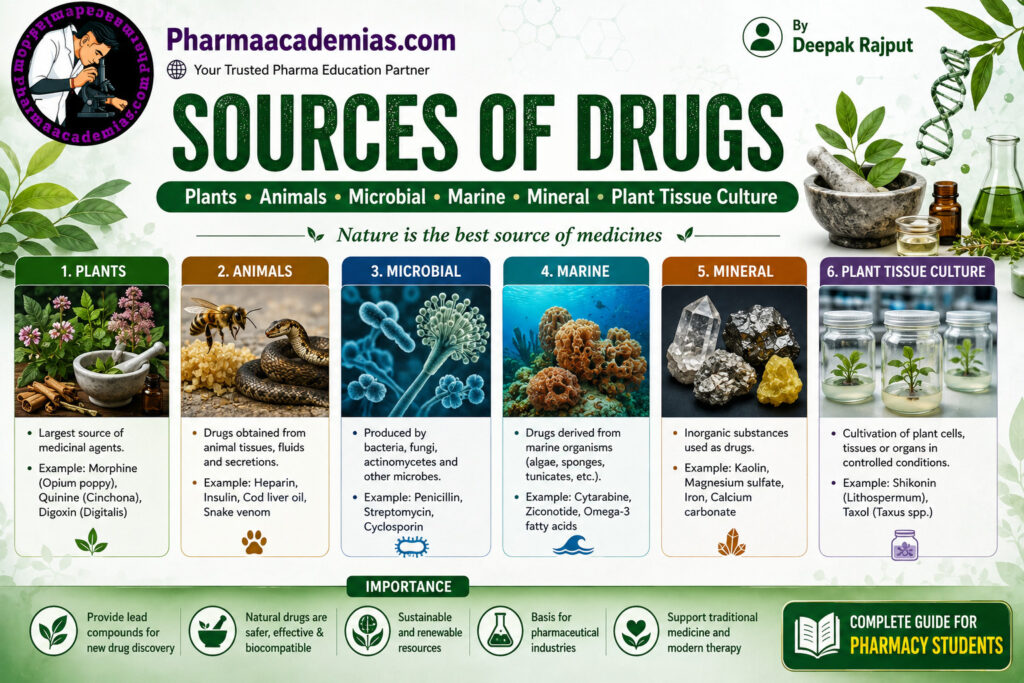
In pharmacognosy, the term “source of drugs” refers to the origin from which medicinal substances are obtained. Drugs may be derived from plants, animals, microorganisms, marine organisms, minerals, and modern biotechnological techniques such as plant tissue culture. Each source contributes unique medicinal compounds with specific pharmacological activities.
Natural sources remain highly important because they provide structurally diverse bioactive compounds that are difficult to synthesize artificially. Many life-saving medicines such as antibiotics, anticancer agents, cardiac glycosides, hormones, and vaccines are directly or indirectly obtained from natural sources.
The major sources of drugs include:
- Plant sources
- Animal sources
- Microbial sources
- Marine sources
- Mineral sources
- Plant tissue culture sources
Drugs Obtained from Plants
Plants are the oldest and most important source of drugs. Since prehistoric times, medicinal plants have been used for the treatment of diseases and maintenance of health. Ancient systems of medicine such as Ayurveda, Unani, Siddha, and Traditional Chinese Medicine are largely based on medicinal plants.
Plant-derived drugs contain a wide variety of chemical constituents such as alkaloids, glycosides, tannins, flavonoids, volatile oils, terpenoids, resins, steroids, and saponins. These constituents are known as secondary metabolites and are mainly responsible for the medicinal properties of plants.
Medicinal substances may be obtained from different parts of plants including roots, rhizomes, stems, bark, leaves, flowers, fruits, seeds, and latex.
Plants remain a major source of modern medicines because they provide pharmacologically active compounds with diverse therapeutic activities.
Importance of Plant Sources
Plant sources are extremely important in pharmacognosy because:
- They provide a large number of crude drugs.
- Many modern drugs originate from plants.
- Plant drugs are often safer and economical.
- They serve as raw materials for pharmaceutical industries.
- They are important in traditional medicine systems.
Examples of Plant-Derived Drugs
Morphine: Morphine is obtained from the latex of the opium poppy (Papaver somniferum). It is a powerful analgesic used for severe pain relief.
Quinine: Quinine is obtained from the bark of Cinchona species. It is used in the treatment of malaria.
Digitalis: Digitalis glycosides are obtained from Digitalis purpurea and are used in heart failure.
Atropine: Atropine is obtained from Atropa belladonna and is used as an anticholinergic drug.
Vincristine and Vinblastine: These anticancer drugs are obtained from Catharanthus roseus.
Artemisinin: Artemisinin is obtained from Artemisia annua and is highly effective against malaria.
Advantages of Plant Sources
Plant drugs are renewable and widely available. They possess structural diversity and often show multiple pharmacological activities. Herbal medicines are also culturally accepted and economically affordable in many parts of the world.
Limitations of Plant Sources
The quality and quantity of active constituents may vary due to environmental conditions, climate, soil, and harvesting methods. Overexploitation of medicinal plants may also lead to depletion and extinction of valuable species.
Drugs Obtained from Animals
Animals are another important source of drugs and medicinal substances. Animal-derived drugs are obtained from body organs, glands, tissues, secretions, and fluids of animals. These drugs are particularly important because many biological substances produced by animals closely resemble human physiological compounds.
Animal products have been used medicinally for centuries. Modern pharmaceutical science has greatly expanded the use of animal-derived substances, especially hormones, enzymes, vaccines, sera, and biological products.
Importance of Animal Sources
Animal-derived drugs are important because:
- They contain hormones and enzymes essential for therapy.
- Some drugs cannot be synthesized easily.
- They are valuable in replacement therapy.
- They play important roles in immunization and diagnostics.
Examples of Animal-Derived Drugs
Insulin: Initially, insulin was obtained from the pancreas of pigs and cattle. It is used in the treatment of diabetes mellitus.
Heparin: Heparin is obtained from the intestinal mucosa of pigs and lungs of cattle. It acts as an anticoagulant.
Thyroxine: Thyroxine hormone is obtained from the thyroid gland and is used in hypothyroidism.
Cod Liver Oil: Cod liver oil obtained from fish liver is rich in vitamins A and D.
Pepsin: Pepsin is an enzyme obtained from the stomach mucosa of pigs and is used as a digestive aid.
Vaccines and Antisera: Vaccines and antisera are often prepared using animal tissues or blood products.
Advantages of Animal Sources
Animal-derived drugs possess high biological activity and compatibility with human physiology. Many hormones and enzymes show excellent therapeutic effectiveness.
Limitations of Animal Sources
There is a risk of contamination and transmission of diseases. Ethical concerns, religious objections, and high purification costs are also major limitations.
Drugs Obtained from Microorganisms
Microorganisms such as bacteria, fungi, and actinomycetes are important sources of medicinal compounds. The discovery of antibiotics revolutionized medicine and demonstrated the therapeutic importance of microbes.
Microbial sources are especially valuable for the production of antibiotics, enzymes, vitamins, vaccines, amino acids, and biotechnology-derived products.
Importance of Microbial Sources
Microorganisms grow rapidly and can be cultured on a large scale under controlled conditions. They are capable of producing highly potent bioactive compounds through fermentation processes.
Examples of Microbial Drugs
Penicillin: Penicillin is obtained from the fungus Penicillium notatum. It was discovered by Alexander Fleming and became the first widely used antibiotic.
Streptomycin: Streptomycin is obtained from Streptomyces griseus and is used in tuberculosis treatment.
Tetracycline: Tetracycline antibiotics are produced by species of Streptomyces.
Cyclosporine: Cyclosporine is produced by fungi and is used as an immunosuppressant during organ transplantation.
Vitamin B12: Vitamin B12 is produced by microbial fermentation.
Advantages of Microbial Sources
Microbial production is economical and suitable for large-scale manufacturing. Fermentation processes can be controlled precisely, ensuring consistent drug quality.
Limitations of Microbial Sources
Microbial contamination and mutation may affect production. Some microorganisms may also produce toxic substances.
Drugs Obtained from Marine Sources
Marine pharmacognosy is a rapidly developing branch that deals with drugs obtained from marine organisms such as algae, sponges, corals, mollusks, tunicates, and marine microorganisms.
The marine environment contains enormous biological diversity and unique chemical compounds not found in terrestrial organisms. Many marine compounds possess potent pharmacological activities.
Importance of Marine Sources
Marine organisms produce bioactive compounds as defense mechanisms against predators and environmental stress. These compounds have become important sources for anticancer, antiviral, anti-inflammatory, and antimicrobial drugs.
Examples of Marine-Derived Drugs
Cytarabine: Cytarabine, an anticancer drug, was originally derived from marine sponges.
Vidarabine: Vidarabine is an antiviral drug obtained from marine sources.
Omega-3 Fatty Acids: Fish oils rich in omega-3 fatty acids help reduce cardiovascular diseases.
Ziconotide: Ziconotide is derived from cone snail venom and is used for severe chronic pain.
Advantages of Marine Sources
Marine organisms provide structurally unique compounds with powerful biological activities. They represent an enormous reservoir for future drug discovery.
Limitations of Marine Sources
Collection and isolation of marine compounds are difficult and expensive. Environmental conservation is also an important concern.
Drugs Obtained from Mineral Sources
Minerals have been used medicinally since ancient times. Mineral drugs include naturally occurring inorganic substances used for therapeutic purposes.
Minerals are important because they serve as nutritional supplements, antacids, laxatives, hematinics, and pharmaceutical aids.
Examples of Mineral Drugs
Ferrous Sulfate: Used in the treatment of iron deficiency anemia.
Magnesium Sulfate: Used as a laxative and anticonvulsant.
Kaolin: Used as an adsorbent in diarrhea.
Talc: Used as a dusting powder and pharmaceutical excipient.
Zinc Oxide: Used in ointments and skin preparations.
Sodium Bicarbonate: Used as an antacid.
Advantages of Mineral Sources
Minerals are stable, economical, and readily available. Many mineral drugs are essential for maintaining physiological functions.
Limitations of Mineral Sources
Excessive intake of minerals may cause toxicity. Some minerals may accumulate in the body and produce adverse effects.
Drugs Obtained from Plant Tissue Culture
Plant tissue culture is a modern biotechnological technique involving the cultivation of plant cells, tissues, or organs under sterile and controlled laboratory conditions on nutrient media.
This technique has become highly important in pharmacognosy because it allows the production of medicinal compounds independent of environmental conditions.
Plant tissue culture is widely used for:
- Mass propagation of medicinal plants
- Production of secondary metabolites
- Conservation of endangered plants
- Genetic improvement of plants
Types of Plant Tissue Culture
Common types include:
- Callus culture
- Cell suspension culture
- Organ culture
- Meristem culture
- Anther culture
Importance in Drug Production
Plant tissue culture enables the production of valuable secondary metabolites such as alkaloids, glycosides, flavonoids, and terpenoids on a commercial scale.
Examples of Drugs Produced through Tissue Culture
Shikonin: Produced from cell cultures of Lithospermum erythrorhizon.
Taxol (Paclitaxel): Produced through tissue culture of Taxus species and used as an anticancer drug.
Berberine: Produced through tissue culture techniques from medicinal plants.
Advantages of Plant Tissue Culture
Plant tissue culture allows rapid multiplication of plants and continuous production of medicinal compounds throughout the year. It reduces dependence on natural habitats and helps conserve endangered medicinal plants.
The technique also enables production of disease-free plants and uniform-quality raw materials.
Limitations of Plant Tissue Culture
The technique requires sophisticated laboratory facilities and skilled personnel. Production costs may be high, and some metabolites are difficult to produce in large quantities.
Conclusion
Natural sources continue to play a vital role in medicine and pharmaceutical sciences. Plants, animals, microorganisms, marine organisms, minerals, and plant tissue culture each contribute important therapeutic agents used in modern healthcare.
Among all sources, plants remain the most significant source of drugs due to their enormous chemical diversity and traditional medicinal value. Microbial and marine sources have greatly expanded opportunities for discovering novel antibiotics and anticancer agents. Animal sources provide essential hormones and biological products, while minerals remain important in therapeutic and pharmaceutical applications. Modern plant tissue culture techniques have further strengthened pharmacognosy by enabling sustainable production of medicinal compounds.
The continuous exploration of natural sources remains essential for the development of safer, more effective, and innovative medicines for the future.
Editorial Note
This article has been carefully researched and written by Deepak Rajput with a focus on accuracy, clarity, and evidence-based healthcare information.