Fundamentals of Pharmacognosy: Pharmacognosy is one of the oldest branches of pharmaceutical sciences and forms the foundation for the study of medicines obtained from natural sources. The term pharmacognosy is derived from two Greek words: “Pharmakon” meaning drug and “Gnosis” meaning knowledge. Therefore, pharmacognosy literally means the knowledge of drugs. Pharmaacademias.com
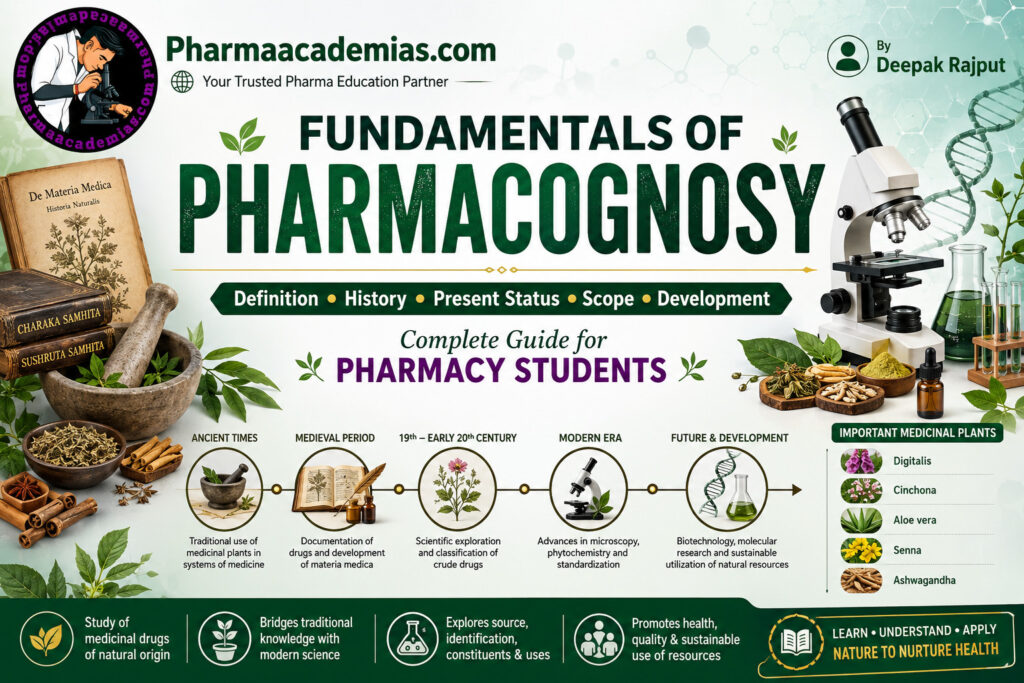
Pharmacognosy deals with the study of crude drugs obtained from natural sources such as plants, animals, minerals, marine organisms, and microorganisms. It includes the identification, collection, cultivation, processing, isolation, evaluation, preservation, and therapeutic uses of natural drugs. In simple terms, pharmacognosy is the scientific study of medicinal substances of natural origin.
Natural products have been used for thousands of years for the treatment and prevention of diseases. Ancient civilizations depended largely on herbs and plant preparations for healthcare because synthetic medicines were not available. Even today, many modern medicines are directly or indirectly derived from natural products. Thus, pharmacognosy serves as an important bridge between traditional medicine and modern pharmaceutical science.
The study of pharmacognosy is essential because it provides knowledge about medicinal plants, their active chemical constituents, quality control methods, adulteration detection, and therapeutic applications. It also contributes significantly to drug discovery and development.
Definition of Pharmacognosy
Different scientists and scholars have defined pharmacognosy in various ways depending on the scope of the subject.
Pharmacognosy may be defined as:
“The branch of science that deals with the study of crude drugs obtained from natural sources including plants, animals, minerals, and microorganisms.”
Another commonly accepted definition is:
“Pharmacognosy is the study of physical, chemical, biochemical, and biological properties of drugs obtained from natural origin as well as the search for new drugs from natural sources.”
According to modern concepts, pharmacognosy not only includes the study of crude drugs but also involves phytochemistry, ethnobotany, biotechnology, marine pharmacognosy, herbal drug technology, and natural product research.
History of Pharmacognosy
Early History
The history of pharmacognosy is as old as human civilization itself. Primitive humans learned through experience that certain plants and natural substances could relieve pain, cure diseases, or act as poisons. This knowledge was passed from generation to generation and gradually developed into traditional systems of medicine.
Ancient civilizations such as Indian, Chinese, Egyptian, Greek, and Roman cultures made extensive use of medicinal plants.
In India, the Ayurvedic system of medicine developed around 3000–5000 years ago. Ancient Indian texts such as the Rigveda, Atharvaveda, Charaka Samhita, and Sushruta Samhita contain detailed descriptions of medicinal plants and their therapeutic uses. Ayurveda described numerous herbal preparations for the treatment of diseases.
In China, medicinal plants were extensively documented in the ancient text Pen Tsao, compiled by Emperor Shen Nung around 2700 BC. This book described hundreds of herbal medicines and their medicinal properties.
The Egyptians also possessed significant knowledge of medicinal plants. The famous Ebers Papyrus written around 1550 BC included information on several crude drugs such as aloe, castor oil, opium, and garlic.
The Greek physician Hippocrates, often called the “Father of Medicine,” emphasized the scientific use of natural drugs. Dioscorides, a Greek physician of the first century AD, wrote the famous book De Materia Medica, which described about 600 medicinal plants and remained an important reference for many centuries.
Galen, another important physician, contributed greatly to the preparation and formulation of herbal medicines. The term “galenicals” is still used for certain herbal preparations derived from his methods.
Medieval Period
During the medieval period, Arab physicians preserved and expanded the knowledge of medicinal plants. They introduced several new drugs such as senna, camphor, cloves, and nutmeg into medicine.
The development of trade routes allowed the exchange of medicinal plants and crude drugs between different countries. Herbal medicine became more organized, and pharmacognosy gradually developed as a scientific discipline.
Modern Period
The scientific development of pharmacognosy accelerated during the 18th and 19th centuries with advances in botany, chemistry, and pharmacology.
In 1815, the term “Pharmacognosy” was first introduced by the Austrian physician Johann Adam Schmidt in his textbook Lehrbuch der Materia Medica. Later, C.A. Seydler used the term more formally in his work Analecta Pharmacognostica in 1817.
The isolation of active constituents from medicinal plants marked a major milestone in pharmacognosy. Examples include:
- Morphine from opium
- Quinine from cinchona bark
- Atropine from belladonna
- Digitalis glycosides from foxglove
The discovery of these compounds revolutionized medicine and established the importance of natural products in drug development.
With the development of synthetic chemistry in the 20th century, synthetic drugs became popular. However, pharmacognosy remained important because many synthetic drugs were originally derived from natural compounds.
Present Status of Pharmacognosy
Today, pharmacognosy has become a highly advanced and interdisciplinary branch of pharmaceutical science. Modern pharmacognosy combines traditional knowledge with advanced scientific techniques such as chromatography, spectroscopy, molecular biology, biotechnology, and genetic engineering.
There is renewed global interest in herbal medicines and natural products due to several reasons:
- Increasing side effects of synthetic drugs
- Growing preference for natural therapies
- Rising antimicrobial resistance
- Demand for safer and cost-effective medicines
The World Health Organization (WHO) recognizes the importance of traditional medicine and encourages the use of medicinal plants in primary healthcare.
At present, pharmacognosy plays a vital role in:
- Herbal drug standardization
- Isolation of bioactive compounds
- Quality control of herbal medicines
- Development of phytopharmaceuticals
- Nutraceutical and cosmeceutical industries
- Drug discovery research
Many important modern drugs continue to originate from natural sources. Examples include paclitaxel from Taxus species for cancer treatment, artemisinin from Artemisia annua for malaria, and vincristine from Catharanthus roseus for leukemia.
Modern pharmacognosy also explores marine organisms, microorganisms, and biotechnology-derived products as potential sources of new medicines.
Scope of Pharmacognosy
The scope of pharmacognosy is very broad and continuously expanding. It covers multiple scientific fields related to natural drugs and medicinal substances.
Study of Crude Drugs
Pharmacognosy involves the identification, classification, cultivation, collection, processing, preservation, and evaluation of crude drugs obtained from natural sources.
Phytochemistry
Phytochemistry deals with the study of chemical constituents present in medicinal plants. Pharmacognosy helps in isolation, purification, and characterization of active compounds such as alkaloids, glycosides, flavonoids, tannins, volatile oils, and resins.
Drug Discovery and Development
Natural products serve as valuable sources for new drug discovery. Many modern drugs are derived directly or indirectly from plants and microorganisms. Pharmacognosy contributes significantly to the search for novel therapeutic agents.
Herbal Drug Technology
Pharmacognosy is essential in the formulation, standardization, and quality control of herbal medicines. It ensures the safety, efficacy, and purity of herbal products.
Cultivation and Conservation of Medicinal Plants
The subject includes methods for cultivation, harvesting, drying, storage, and conservation of medicinal plants. It also focuses on sustainable utilization of natural resources.
Biotechnology and Tissue Culture
Modern pharmacognosy utilizes plant tissue culture, genetic engineering, and biotechnology for the production of secondary metabolites and improvement of medicinal plants.
Nutraceuticals and Cosmeceuticals
Pharmacognosy contributes to the development of health supplements, functional foods, herbal cosmetics, and wellness products.
Pharmacological and Toxicological Studies
Natural products are studied for their pharmacological activities and toxic effects to ensure their therapeutic safety and effectiveness.
Development of Pharmacognosy
The development of pharmacognosy has occurred through several stages over centuries.
Initially, pharmacognosy was mainly descriptive and involved simple identification of medicinal plants based on morphology. Gradually, the subject became more scientific with the inclusion of taxonomy, microscopy, phytochemistry, and pharmacology.
The discovery of active constituents during the 19th century transformed pharmacognosy into an experimental science. Chemical analysis techniques allowed scientists to isolate pure compounds from crude drugs.
In the 20th century, advanced analytical techniques such as chromatography, spectrophotometry, and electrophoresis further enhanced the study of natural products.
Modern pharmacognosy has now entered the molecular era. Sophisticated techniques such as:
- High-performance liquid chromatography (HPLC)
- Gas chromatography (GC)
- Mass spectrometry (MS)
- Nuclear magnetic resonance (NMR)
- DNA fingerprinting
- Molecular docking
- Metabolomics
are widely used for authentication, quality control, and drug discovery.
Biotechnology has also revolutionized pharmacognosy through plant tissue culture, production of secondary metabolites, and genetic modification of medicinal plants.
Today, pharmacognosy is not limited to traditional medicinal plants. It includes marine pharmacognosy, microbial pharmacognosy, ethnopharmacology, and pharmaceutical biotechnology.
Importance of Pharmacognosy
Pharmacognosy is extremely important in pharmaceutical sciences and healthcare because it:
- Provides knowledge of medicinal plants and natural drugs
- Helps identify adulteration in crude drugs
- Contributes to discovery of new medicines
- Supports herbal drug standardization
- Promotes safe and effective use of natural products
- Preserves traditional medicinal knowledge
- Encourages conservation of medicinal plants
- Bridges traditional and modern medicine
Conclusion
Pharmacognosy is a dynamic and essential branch of pharmaceutical science that deals with drugs obtained from natural sources. From ancient herbal remedies to modern drug discovery, pharmacognosy has played a vital role in the development of medicine. The subject has evolved from simple identification of medicinal plants to advanced scientific research involving phytochemistry, biotechnology, molecular biology, and pharmacological studies.
The growing global interest in herbal medicines and natural therapies has further increased the importance of pharmacognosy in healthcare and pharmaceutical industries. With continuous advancements in science and technology, pharmacognosy remains a promising field for the discovery of safer, effective, and innovative therapeutic agents.
Editorial Note
This article has been carefully researched and written by Deepak Rajput with a focus on accuracy, clarity, and evidence-based healthcare information. Pharmaacademias.com