Filtration is a vital unit operation used for the separation of suspended solid particles from fluids (liquids or gases) using a porous barrier. It plays a central role in industries such as pharmaceuticals, biotechnology, food processing, water treatment, and chemical manufacturing. The efficiency, selectivity, and economic feasibility of any filtration process are determined by two fundamental components: filter media and filter aids.
Filter media act as the primary barrier that retains solids, whereas filter aids are auxiliary materials used to enhance filtration performance. In pharmaceutical manufacturing, where sterility and clarity are critical, the correct selection and use of these components directly influence product quality, regulatory compliance, and process efficiency.
Filter Aids and Filter Media
Concept, Structure, and Functional Role
Filter media are specially designed porous materials that allow the passage of fluids while retaining particulate matter. The structure of the filter medium determines its permeability, retention efficiency, and resistance to fouling. Depending on the type of filtration, the media may function either by surface retention or by depth entrapment of particles.
The performance of filter media is governed by parameters such as pore size distribution, porosity, thickness, and surface characteristics. These factors collectively influence the rate of filtration and the quality of the filtrate.
Detailed Mechanisms of Filtration Through Media
Filtration through filter media is not a simple sieving process but involves multiple simultaneous mechanisms:
- Straining (Sieving Action) occurs when particles larger than the pore size are physically retained on the surface. This is predominant in surface filtration systems such as membrane filters.
- Interception and Impaction occur when particles following fluid streamlines come into contact with the fibers of the filter medium and adhere to them.
- Adsorption involves the attachment of fine particles onto the surface of the medium due to electrostatic or van der Waals forces.
- Depth Entrapment is a key mechanism in depth filtration, where particles are trapped within the internal structure of the medium rather than on the surface.
These mechanisms often operate together, making filtration a highly complex and dynamic process.
Classification of Filter Media
Surface Filter Media
Surface filter media are characterized by a well-defined pore structure that retains particles primarily on the surface. These are commonly used in applications requiring high precision and clarity.
Typical examples include membrane filters, filter papers, and metallic screens. These media provide excellent control over particle size removal but are prone to rapid clogging due to cake formation, which can reduce flow rate over time.
Depth Filter Media
Depth filter media consist of thick, fibrous, or granular materials that trap particles throughout their volume. Unlike surface filters, they do not rely on a single retention layer.
Materials such as cellulose fibers, fiberglass, and sintered polymers are commonly used. These filters have high dirt-holding capacity and are particularly effective for removing colloidal and fine particles from viscous fluids.
Membrane Filter Media
Membrane filters represent an advanced category of filter media with highly controlled pore sizes. These are widely used in pharmaceutical and biotechnological applications, especially for sterilization.
Depending on pore size, membrane filters are classified into:
- Microfiltration (0.1–10 µm)
- Ultrafiltration (0.01–0.1 µm)
- Nanofiltration (0.001–0.01 µm)
These filters are critical in processes such as sterile filtration of injectables, protein purification, and viral removal.
Granular Filter Media
Granular media consist of particles such as sand, gravel, or activated carbon arranged in layers. Filtration occurs as fluid passes through these layers, with particles being trapped within the interstitial spaces.
These media are widely used in water and wastewater treatment due to their cost-effectiveness and scalability.
Fabric and Synthetic Filter Media
Fabric filters are made from woven or non-woven materials such as cotton, wool, nylon, polyester, and polypropylene. These are widely used in industrial filtration systems, including dust collectors and liquid filtration units.
Their flexibility, durability, and ease of cleaning make them suitable for repeated use in large-scale operations.
Key Properties of Ideal Filter Media
An ideal filter medium should possess:
- High permeability with minimal resistance to flow
- Adequate mechanical strength to withstand pressure differentials
- Chemical and thermal stability under operating conditions
- Resistance to fouling and microbial growth
- Uniform pore size distribution for consistent performance
Factors Influencing Selection of Filter Media
The selection of an appropriate filter medium is a critical step and depends on several interconnected factors:
- The nature, size, and concentration of particles to be removed
- The viscosity and temperature of the fluid
- Required degree of clarity or sterility
- Compatibility with chemicals and solvents
- Economic considerations including cost, lifespan, and maintenance
Filter Aids in Filtration
Definition and Scientific Basis
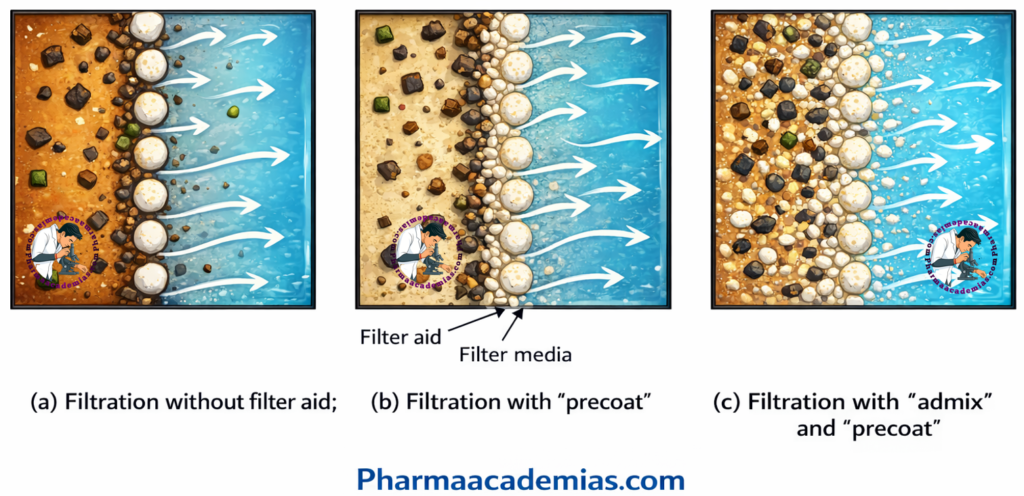
Filter aids are finely divided, inert, and highly porous materials that are added to improve filtration efficiency. They are particularly useful when filtering suspensions containing fine, gelatinous, or compressible particles that tend to clog the filter medium.
Unlike filter media, filter aids do not act as the primary barrier but modify the structure of the filter cake to enhance permeability.
Mechanism of Action of Filter Aids
Filter aids improve filtration through several mechanisms:
- They form a porous and permeable layer that prevents clogging of the filter medium
- They increase the porosity of the filter cake, thereby enhancing flow rate
- They reduce resistance to filtration and maintain consistent filtration efficiency
- They trap fine particles that would otherwise pass through the filter medium
This results in improved clarity of the filtrate and reduced filtration time.
Types of Filter Aids
Diatomaceous Earth (Kieselguhr)
Diatomaceous earth is the most widely used filter aid, composed of the fossilized remains of diatoms. Its highly porous structure provides excellent filtration properties.
It is widely used in pharmaceutical, food, and beverage industries due to its high efficiency and chemical inertness.
Perlite
Perlite is a naturally occurring volcanic glass that expands upon heating. It is lightweight, chemically stable, and provides good filtration characteristics.
It is often used as a safer alternative to diatomaceous earth in certain applications.
Cellulose-Based Filter Aids
These are derived from plant fibers and are biodegradable. They are especially useful in pharmaceutical and food industries where organic and non-toxic materials are preferred.
Other Specialized Filter Aids
Some advanced filtration systems use polymeric or synthetic filter aids designed for specific applications, including high-temperature or highly corrosive environments.
Methods of Application of Filter Aids
Filter aids are applied in two primary ways:
- Precoat Filtration involves depositing a layer of filter aid on the filter medium before filtration begins. This layer acts as the actual filtering surface and prevents direct contact of particles with the medium.
- Body Feed Method involves adding filter aid directly to the slurry. This ensures uniform distribution and maintains cake porosity throughout the filtration process.
Advantages of Filter Aids
Filter aids offer several operational and technical benefits:
- Improved filtration rate and reduced processing time
- Enhanced clarity and quality of filtrate
- Prevention of clogging and fouling of filter media
- Increased operational efficiency and reduced downtime
Limitations and Challenges
Despite their advantages, filter aids have certain limitations:
- Additional cost and handling requirements
- Risk of contamination if not properly selected
- Disposal issues, especially in large-scale industrial operations
- Potential loss of product due to adsorption
Integrated Role of Filter Media and Filter Aids
Filter media and filter aids work synergistically to achieve efficient filtration. While the filter medium provides the structural framework for separation, the filter aid modifies the properties of the filter cake to enhance performance.
In many industrial applications, especially in pharmaceuticals, the combination of appropriate filter media with suitable filter aids is essential for achieving optimal results.
Applications in Pharmaceutical and Industrial Fields
Filter media and filter aids are extensively used in:
- Pharmaceutical industries for sterile filtration, clarification of syrups, and separation of precipitates
- Biotechnology for protein purification and cell culture clarification
- Food and beverage industries for clarification of juices, wines, and oils
- Water treatment for removal of suspended solids and contaminants
- Chemical industries for purification and recovery of products
Conclusion
Filter aids and filter media are indispensable components of modern filtration technology. Their proper selection, understanding, and application significantly influence the efficiency, quality, and cost-effectiveness of filtration processes. Advances in material science continue to improve their performance, making filtration more efficient and adaptable to complex industrial requirements.