
Anesthetics are a class of drugs used to induce loss of sensation, with or without loss of consciousness, primarily to facilitate surgical procedures, diagnostic interventions, and pain management. They are essential in modern medicine because they allow complex surgeries to be performed without pain, distress, or reflex responses.
The concept of anesthesia revolutionized medical science after the introduction of ether anesthesia in the 19th century, transforming surgery from a painful and risky procedure into a controlled and safe practice. Today, anesthetics are widely used not only in surgery but also in dentistry, obstetrics, emergency medicine, and intensive care units.
Definition
An anesthetic is a pharmacological agent that reversibly blocks nerve conduction, resulting in loss of sensation (analgesia), loss of consciousness, or both, depending on the type and dose of the drug administered.
Classification of Anesthetics
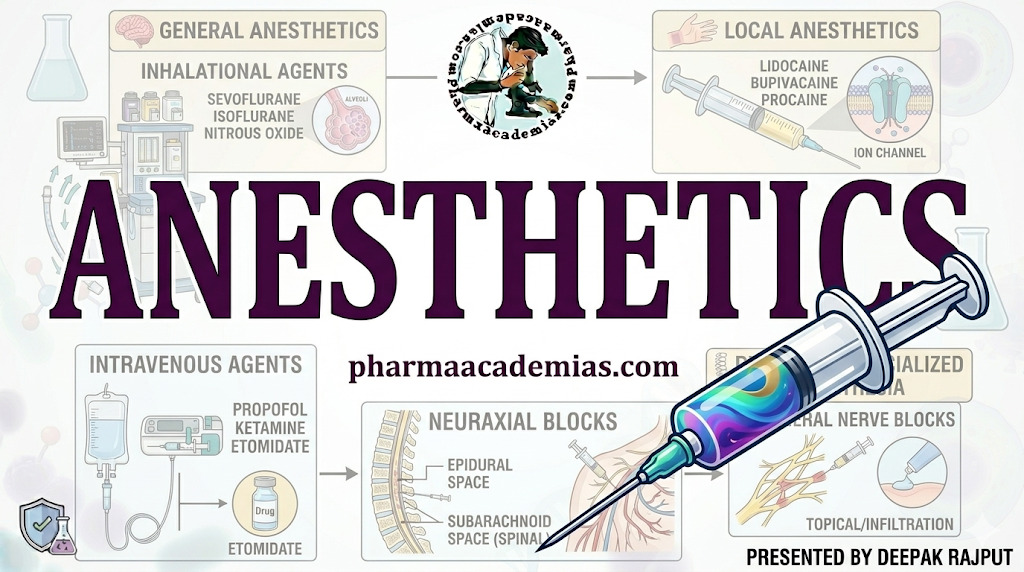
Anesthetics are broadly classified into general anesthetics and local anesthetics, based on their site and extent of action.
1. General Anesthetics
General anesthetics are drugs that produce reversible loss of consciousness along with analgesia, muscle relaxation, and loss of reflexes. They act primarily on the central nervous system (CNS), especially the brain and spinal cord.
They are further divided into inhalational and intravenous anesthetics.
Inhalational anesthetics: Inhalational anesthetics are administered through the respiratory tract and include agents such as halothane, nitrous oxide, and isoflurane. These agents are commonly used for maintenance of anesthesia because their depth can be easily controlled by adjusting inhaled concentration.
Intravenous anesthetics: Intravenous anesthetics, such as propofol, thiopental sodium, and ketamine, are administered directly into the bloodstream. They produce rapid onset of anesthesia, making them ideal for induction before surgery.
General anesthetics act by depressing neuronal activity in the brain, enhancing inhibitory neurotransmitters like GABA and reducing excitatory transmission.
2. Local Anesthetics
Local anesthetics are drugs that cause reversible loss of sensation in a specific area of the body without affecting consciousness. They work by blocking voltage-gated sodium channels, thereby preventing nerve impulse conduction.
Common local anesthetics include lidocaine, bupivacaine, and procaine. These agents are widely used in minor surgical procedures, dental treatments, and regional anesthesia techniques.
Local anesthetics can be further categorized based on their chemical structure into:
- Ester-type anesthetics (e.g., procaine)
- Amide-type anesthetics (e.g., lidocaine, bupivacaine)
Amide anesthetics are generally preferred due to their greater stability and lower risk of allergic reactions.
Uses of Anesthetics
Anesthetics play a vital role across various fields of medicine due to their ability to eliminate pain and facilitate medical procedures.
In surgical practice, general anesthetics are used to induce unconsciousness, allowing surgeons to perform major operations such as cardiac, neurological, or abdominal surgeries without patient discomfort. Local anesthetics are used for minor surgeries, such as suturing wounds, biopsies, and dental procedures, where only a specific area needs to be numbed.
In obstetrics, anesthetics are used during labor and delivery to provide pain relief, especially through epidural or spinal anesthesia. In dentistry, local anesthetics like lidocaine are routinely used to perform procedures such as tooth extraction and root canal treatment.
Anesthetics also play a role in pain management, including chronic pain conditions and postoperative pain control. Certain anesthetic agents are used in diagnostic procedures, such as endoscopy or imaging techniques, where patient immobility is required.
Compersion of of Anesthetics
| Parameter | General Anesthetics | Local Anesthetics |
| Definition | Drugs that produce reversible loss of consciousness, analgesia, and muscle relaxation | Drugs that cause loss of sensation in a specific area without affecting consciousness |
| Site of Action | Act on the central nervous system (brain and spinal cord) | Act on peripheral nerves at the site of administration |
| Mechanism of Action | Enhance GABA-mediated inhibition, reduce excitatory transmission (NMDA inhibition), leading to CNS depression | Block voltage-gated Na⁺ channels, preventing nerve impulse conduction |
| Level of Effect | Whole body (systemic effect) | Localized (restricted to specific area) |
| Types | Inhalational (e.g., isoflurane, nitrous oxide) and Intravenous (e.g., propofol, ketamine) | Ester type (procaine) and Amide type (lidocaine, bupivacaine) |
| Examples | Propofol, Thiopental sodium, Ketamine, Halothane, Isoflurane, Nitrous oxide | Lidocaine, Bupivacaine, Procaine, Ropivacaine |
| Onset of Action | Rapid (seconds to minutes, especially IV agents like propofol) | Variable: Rapid (lidocaine) to slow (bupivacaine) depending on drug and site |
| Duration of Action | Short to long depending on drug (minutes to hours); easily controlled in inhalational agents | Short (lidocaine ~1–2 hrs) to long (bupivacaine ~4–8 hrs) |
| Administration Route | Inhalation or intravenous injection | Topical, infiltration, nerve block, spinal, epidural |
| Consciousness | Loss of consciousness present | Consciousness remains intact |
| Muscle Relaxation | Produces significant muscle relaxation | Minimal or no muscle relaxation |
| Pain Sensation | Completely abolished | Abolished only in targeted area |
| Monitoring Required | Intensive monitoring (ECG, BP, respiration, oxygen saturation) | Minimal monitoring in most cases |
| Clinical Uses | Major surgeries (cardiac, brain, abdominal), ICU sedation, procedures requiring unconsciousness | Minor surgeries, dental procedures, suturing, regional anesthesia, pain relief |
| Use in Obstetrics | Used in cesarean sections (general anesthesia if required) | Widely used (epidural, spinal anesthesia for labor pain) |
| Toxicity | CNS depression, respiratory depression, cardiovascular suppression, malignant hyperthermia | CNS toxicity (tremors, seizures), cardiotoxicity (especially bupivacaine), allergic reactions (esters) |
| Side Effects | Nausea, vomiting, hypotension, respiratory depression, delayed recovery | Dizziness, numbness beyond site, allergic reactions, local irritation |
| Safety Profile | Requires controlled environment (operation theatre) | Relatively safer when used in correct dose |
| Reversibility | Fully reversible with elimination of drug | Fully reversible as drug diffuses away |
| Drug Interactions | Significant (with CNS depressants, opioids, sedatives) | Less significant but caution with vasoconstrictors (e.g., adrenaline) |
| Use with Vasoconstrictors | Not applicable | Common (e.g., adrenaline added to prolong action and reduce systemic absorption) |
Side Effects of Anesthetics
Although anesthetics are generally safe when used appropriately, they can produce various side effects depending on the type, dose, and patient condition.
General anesthetics may cause central nervous system depression, leading to drowsiness, confusion, or delayed recovery. Respiratory depression is a significant concern, as these drugs can reduce breathing rate and depth, requiring careful monitoring. Cardiovascular effects such as hypotension, arrhythmias, or decreased cardiac output may also occur. Some patients experience postoperative nausea and vomiting (PONV), which is one of the most common adverse effects. Rarely, a life-threatening condition known as malignant hyperthermia may occur with certain inhalational anesthetics.
Local anesthetics, while safer, can also produce adverse effects if absorbed systemically in large amounts. These may include central nervous system toxicity, presenting as dizziness, tremors, or seizures, followed by cardiovascular depression in severe cases. Allergic reactions are more common with ester-type anesthetics, whereas amide-type agents are generally well tolerated.
Prolonged or improper use of local anesthetics can lead to nerve damage or tissue irritation, although this is relatively uncommon with proper technique.
Conclusion
Anesthetics are indispensable in modern medicine, providing the foundation for safe and pain-free surgical and diagnostic procedures. Their classification into general and local anesthetics reflects differences in mechanism, site of action, and clinical use. While these drugs offer significant therapeutic benefits, understanding their side effects and proper administration is essential to ensure patient safety and optimal outcomes.
A strong grasp of anesthetics is crucial for pharmacy students and healthcare professionals, as it enables them to contribute effectively to patient care, drug selection, and monitoring during anesthesia.
Key Concepts for Study
- General vs local anesthetics
- Mechanism: CNS depression vs sodium channel blockade
- Clinical applications in surgery, dentistry, and obstetrics
- Adverse effects: CNS, respiratory, and cardiovascular systems
References
- Goodman & Gilman, The Pharmacological Basis of Therapeutics, 13th Edition.
- Katzung, B.G. Basic and Clinical Pharmacology, 14th Edition.
- Tripathi, K.D. Essentials of Medical Pharmacology, 8th Edition.
- Rang & Dale’s Pharmacology, 9th Edition.






One Comment