
Pharmacist Role in Medication Adherence: The pharmacist plays a central and highly influential role in improving medication adherence and in the continuous monitoring of whether patients are taking medicines correctly. In modern hospital pharmacy, clinical pharmacy, and community pharmacy practice, pharmacists are considered the medicine experts who bridge the gap between the prescription and the patient’s real-life medicine-taking behavior. Recent systematic reviews show that pharmacist-led interventions significantly improve adherence in chronic diseases and complex therapies, especially through counseling, tailored education, and follow-up monitoring.
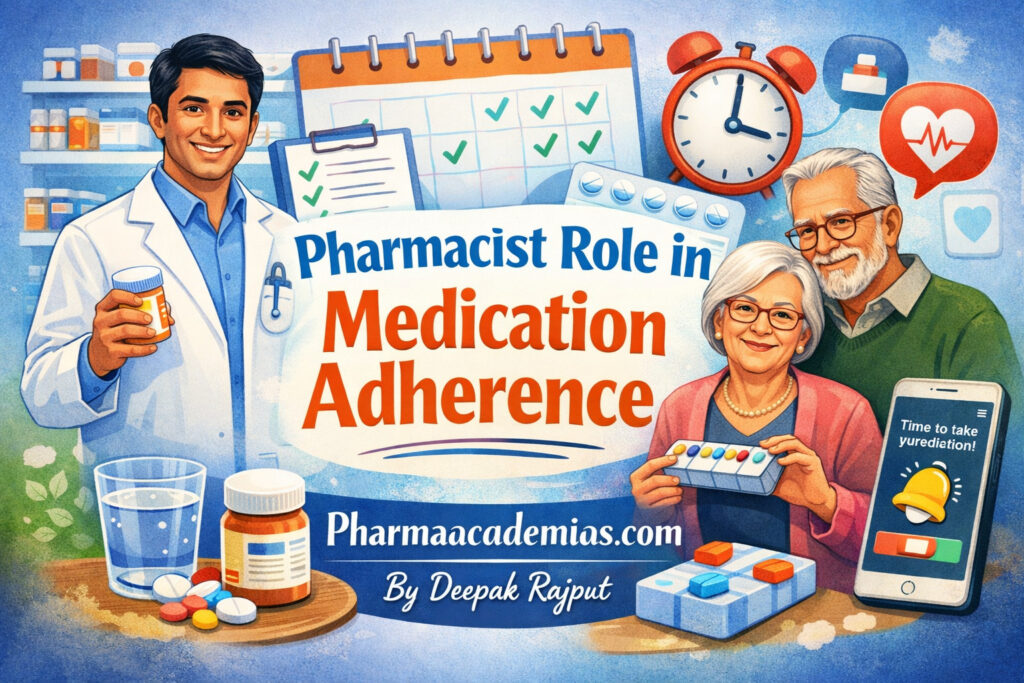
Medication adherence is not only about telling the patient to take medicines on time; it involves patient education, behavior assessment, regimen simplification, side-effect management, refill supervision, and continuous therapeutic follow-up, all of which fall strongly within the pharmacist’s professional responsibilities.
Pharmacist Role in Medication Adherence
The first and most important role of the pharmacist is patient counseling and education. Many patients fail to take medicines properly because they do not understand the disease, the purpose of the medicine, or the consequences of missing doses. The pharmacist explains, in simple and patient-friendly language, why the medicine is prescribed, how it works, how long it should be taken, and what may happen if therapy is stopped early.
For example, in hypertension, diabetes, tuberculosis, asthma, epilepsy, and HIV, symptoms may improve before the disease is fully controlled. The pharmacist reinforces that treatment must continue even when the patient feels better.
A major pharmacist role is identifying barriers to adherence. During interaction, the pharmacist assesses whether the patient is missing doses due to:
- forgetfulness
- fear of side effects
- high medicine cost
- poor understanding
- social stigma
- difficulty swallowing dosage forms
- complicated schedules
- poor access to pharmacy refills
Once the cause is identified, the pharmacist provides a patient-specific solution instead of generic advice.
Another major role is simplification of medication regimens. Polypharmacy and multiple daily dosing schedules reduce adherence. Pharmacists work with prescribers to reduce unnecessary duplication, recommend once-daily alternatives, fixed-dose combinations, synchronized dosing times, and easier dosage forms such as sustained-release tablets, inhalers, insulin pens, or blister packs.
The pharmacist also has a major responsibility in management of side effects and adverse drug reactions, because many patients stop therapy after early unpleasant effects. By counseling on expected adverse effects, prevention strategies, and when to seek help, pharmacists reduce fear-based discontinuation. Studies repeatedly show that pharmacist counseling improves long-term persistence with therapy.
The role further extends to motivational interviewing and behavioral reinforcement, where the pharmacist helps patients set medication routines linked to meals, sleep, work, prayer time, or daily habits. This is particularly effective in chronic lifelong therapies.
Pharmacists also contribute by:
- recommending pill boxes and adherence packaging
- medicine synchronization
- refill reminder calls
- SMS/app alerts
- family caregiver education
- discharge counseling
- follow-up telepharmacy support
These interventions are especially useful in elderly and chronic disease patients.
Monitoring of Patient Medication Adherence by Pharmacist
The monitoring of medication adherence is a continuous pharmacist-led process that determines whether the patient is actually following the prescribed regimen.
The most direct method is patient interview and follow-up questioning. During every refill or clinical visit, the pharmacist asks structured questions such as:
- How many doses were missed this week?
- Any difficulty in taking the medicine?
- Any side effects?
- Any financial issues?
- Are refills delayed?
This conversational assessment often reveals the true reason for poor adherence.
Another important monitoring method is prescription refill review. By checking refill frequency, proportion of days covered (PDC), and medication possession ratio (MPR), pharmacists can objectively estimate adherence. Delayed refills strongly suggest missed doses. Meta-analyses show these pharmacist-led refill-based monitoring methods are effective and evidence-supported.
The pharmacist also monitors pill counts, especially in hospital discharge follow-up, HIV therapy, tuberculosis DOTS, psychiatric treatment, and transplant medicine. Remaining tablets are compared with the expected count based on the prescribed schedule.
In advanced settings, pharmacists use electronic adherence monitoring, including:
- smart pill bottles
- electronic blister packs
- mobile reminder apps
- digital inhaler counters
- insulin pen memory devices
- real-time adherence tracking tools
These technologies help detect missed doses early.
Clinical pharmacists also monitor adherence indirectly through therapeutic outcomes, such as:
- uncontrolled blood pressure
- elevated HbA1c
- seizure recurrence
- transplant rejection risk
- uncontrolled INR
- repeated asthma exacerbations
- poor lipid control
When therapeutic goals are not achieved despite an apparently correct prescription, non-adherence is actively investigated.
For narrow therapeutic index medicines, pharmacists may correlate adherence with Therapeutic Drug Monitoring (TDM) values, such as with phenytoin, lithium, tacrolimus, or digoxin.
Importance of Pharmacist-Led Adherence Monitoring
Pharmacist monitoring is highly valuable because it:
- prevents therapeutic failure
- reduces hospital readmissions
- minimizes relapse
- improves chronic disease control
- lowers healthcare cost
- reduces antimicrobial resistance
- improves transplant success
- prevents complications
- improves quality of life
Recent evidence strongly supports that pharmacist-led adherence interventions improve clinical outcomes in hypertension, diabetes, COPD, epilepsy, CKD, and cardiovascular diseases.
Conclusion
The pharmacist plays a vital role in both improving medication adherence and continuously monitoring whether the patient follows the prescribed treatment plan.
Through patient counseling, identification of barriers, regimen simplification, side-effect management, refill review, pill counts, digital tools, and therapeutic follow-up, pharmacists ensure that medicines are not only prescribed correctly but also used correctly by the patient.
Thus, pharmacist-led adherence services are one of the most powerful tools in clinical pharmacy, hospital pharmacy, community pharmacy, and chronic disease management, directly improving therapeutic outcomes and patient safety.
Editorial Note
This article has been carefully researched and written by Deepak Rajput with a focus on accuracy, clarity, and evidence-based healthcare information. Pharmaacademias.com