Resins are naturally occurring, complex, amorphous plant substances that are insoluble in water but generally soluble in organic solvents such as alcohol, chloroform, ether, and acetone. These substances are often viscous, sticky, or brittle, depending on their composition and origin, and they frequently contain essential oils, gums, or other secondary metabolites. Resins have played a pivotal role in traditional and modern medicine, perfumery, industrial applications, and food processing due to their therapeutic, aromatic, and adhesive properties. Their medicinal properties are varied, ranging from anti-inflammatory, antimicrobial, and antioxidant activities to expectoration and wound-healing effects. Consequently, the isolation of resins is a key procedure in pharmacognosy, pharmaceutical research, and phytochemistry, enabling the study of their chemical nature, pharmacological effects, and potential therapeutic uses.
Sources and Nature of Resins
Resins are secreted in specialized structures such as secretory ducts, resin canals, or cavities within the plant. They are typically obtained from tree exudates or from specific plant parts where resin-producing cells are concentrated. The major natural sources of resins include Boswellia species (frankincense), Commiphora species (myrrh), Pinus species (pine resins including oleoresin and rosin), and Shorea robusta (dammar). Chemically, resins may be classified into pure resins, which are devoid of essential oils, oleoresins, which contain a mixture of resin and volatile oils, and balsams, which are resins combined with aromatic acids such as benzoic or cinnamic acid. The chemical complexity of resins necessitates meticulous isolation techniques to obtain pure, pharmacologically active fractions suitable for research or therapeutic applications.
Principles of Resin Isolation
The isolation of resins is primarily guided by their solubility in organic solvents and insolubility in water. The goal of isolation is to separate the resin from plant matrices, water-soluble compounds, gums, and other impurities. Resins may be either soft and sticky or hard and brittle, influencing the choice of extraction methodology. The isolation process generally involves solvent extraction, precipitation, filtration, and evaporation, often followed by purification techniques to enhance purity and stability.
Methods of Resin Isolation
Cold or Direct Extraction Method
Cold extraction is particularly suitable for resins that naturally exude from plants, such as those obtained from oleoresins or naturally exuded resins. The process begins with the collection of resinous exudates from the plant surface. These exudates, if hard or brittle, are finely pulverized to increase the surface area for solvent contact. The resin is then dissolved in an appropriate organic solvent, commonly ethanol, chloroform, or acetone, which selectively dissolves the resinous fraction while leaving insoluble impurities behind. The solution is filtered to remove debris, and the solvent is subsequently evaporated under reduced pressure, yielding a crude resin. While this method is simple and rapid, it often produces crude fractions that may contain essential oils or other plant constituents, necessitating further purification for research or medicinal use.
Alcoholic Extraction Method
Alcoholic extraction is the most frequently employed method for the isolation of plant resins that are soluble in ethanol or methanol. In this method, the powdered plant material containing resin is soaked or macerated in 95% ethanol for an extended period, allowing the alcohol to dissolve the resin effectively. The mixture is then filtered to remove solid plant residues, and the filtrate is concentrated using a rotary evaporator or under gentle heating. To remove water-soluble impurities, the concentrated extract may be washed with water, and the residue is then dried to obtain a relatively pure resin. This technique is particularly valuable because it not only isolates the resin but also preserves some of its bioactive components for pharmacological evaluation.
Cold Water Precipitation from Oleoresins
Oleoresins, such as pine rosin, often require specific techniques due to their mixture of resin and volatile oils. Cold water precipitation is a classical method wherein the oleoresin is first dissolved in a volatile organic solvent like ether. Gradual addition of cold water induces precipitation of the resin, which can then be separated by filtration or decantation. This method is widely used in the preparation of rosin from pine resin, producing a solid resin suitable for industrial, pharmaceutical, or research purposes.
Soxhlet Extraction Method
For resins embedded within hard or fibrous plant materials, Soxhlet extraction offers a highly efficient and continuous extraction technique. The powdered plant material is placed in a Soxhlet apparatus and subjected to repeated washing with a suitable solvent, such as ethanol or chloroform, over several cycles. The solvent continuously dissolves the resin, which accumulates in the flask. After sufficient extraction, the solvent is concentrated to yield crude resin. Soxhlet extraction is highly efficient and ensures maximal recovery of resin, although it requires careful control of temperature to prevent thermal degradation of heat-sensitive compounds.
Purification of Isolated Resins
Crude resins frequently contain impurities such as gums, chlorophyll, or volatile oils. Purification is essential to obtain a resin suitable for pharmaceutical or analytical purposes. Techniques for purification include solvent washing, recrystallization, or chromatographic separation. Solvent washing involves dissolving the crude resin in a selective solvent and precipitating impurities by adding a nonsolvent. Column chromatography can separate resin fractions based on polarity or molecular size, while recrystallization is applied to resins capable of forming crystals, such as balsams. The purified resin is generally amorphous, brittle, and pale in color, distinct from the raw exudate.
Characterization and Quality Assessment
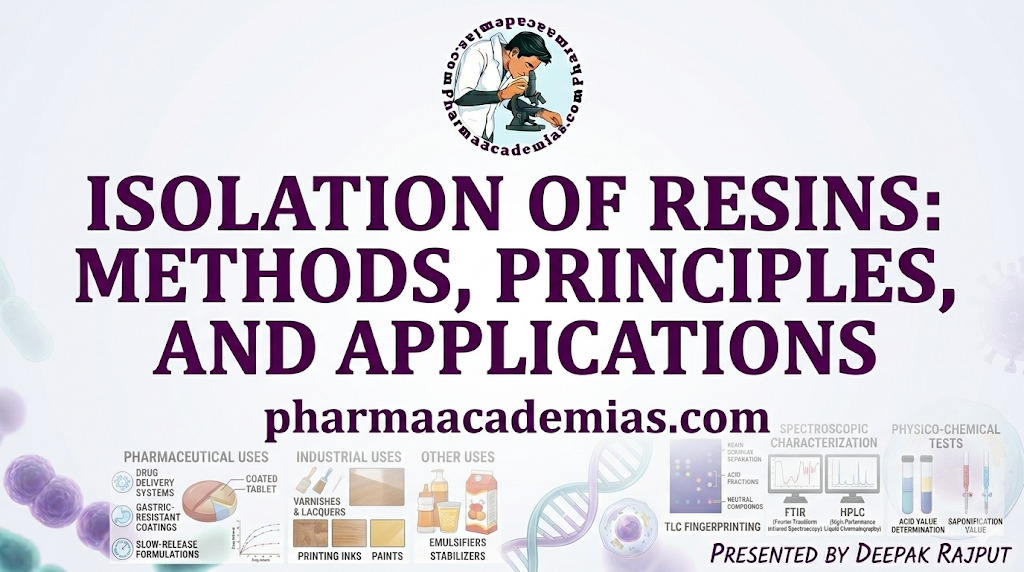
Once isolated, resins are subjected to rigorous characterization to determine their chemical composition, purity, and pharmacological potential. Physical properties such as color, odor, solubility, and melting point are routinely evaluated. Chemical tests, including reactions with acetic anhydride, nitric acid, or alkali, help confirm the presence of characteristic resin constituents. Advanced techniques such as spectroscopy (UV, IR, NMR) and chromatography (TLC, HPLC) provide detailed information about the molecular structure and purity of the resin. These methods ensure that isolated resins meet pharmaceutical standards and are suitable for further applications in medicine, research, or industry.
Applications of Isolated Resins
Resins have broad-ranging applications across multiple industries. In pharmacy, they are used as active medicinal agents, exhibiting properties such as antimicrobial, anti-inflammatory, expectorant, and antioxidant effects. In perfumery and incense production, aromatic resins such as frankincense and myrrh provide natural fragrance and therapeutic benefits. Industrially, resins are utilized in adhesives, varnishes, inks, and coatings due to their binding and film-forming properties. From a therapeutic perspective, resins play an important role in traditional and modern medicine, serving as topical protectants, stimulants, or carriers for other active ingredients.
Conclusion
The isolation of resins is a fundamental technique in pharmacognosy and natural product chemistry, providing access to phytochemically and pharmacologically active compounds. Careful selection of extraction methods, solvents, and purification techniques ensures the highest yield and purity of the resin, facilitating its use in pharmaceutical formulations, industrial applications, and research studies. The ability to isolate and characterize resins enhances our understanding of plant secondary metabolites and supports the discovery of novel therapeutic agents.