Levels of Structural Organization: The human body is a highly organized and complex living system composed of trillions of cells working together in a coordinated manner. To maintain life, every part of the body must function in harmony with all other parts. This remarkable coordination is possible because the body is organized into different structural levels, beginning from the smallest chemical substances and progressing to the complete organism.
Understanding the levels of structural organization helps explain how simple components combine to form complex structures capable of performing sophisticated functions. Similarly, the study of body systems provides knowledge about how groups of organs work together to maintain health, survival, growth, and reproduction.
The organization of the human body follows a definite hierarchy where each level builds upon the previous one. Any disturbance at one level can affect the higher levels and ultimately influence the entire body.
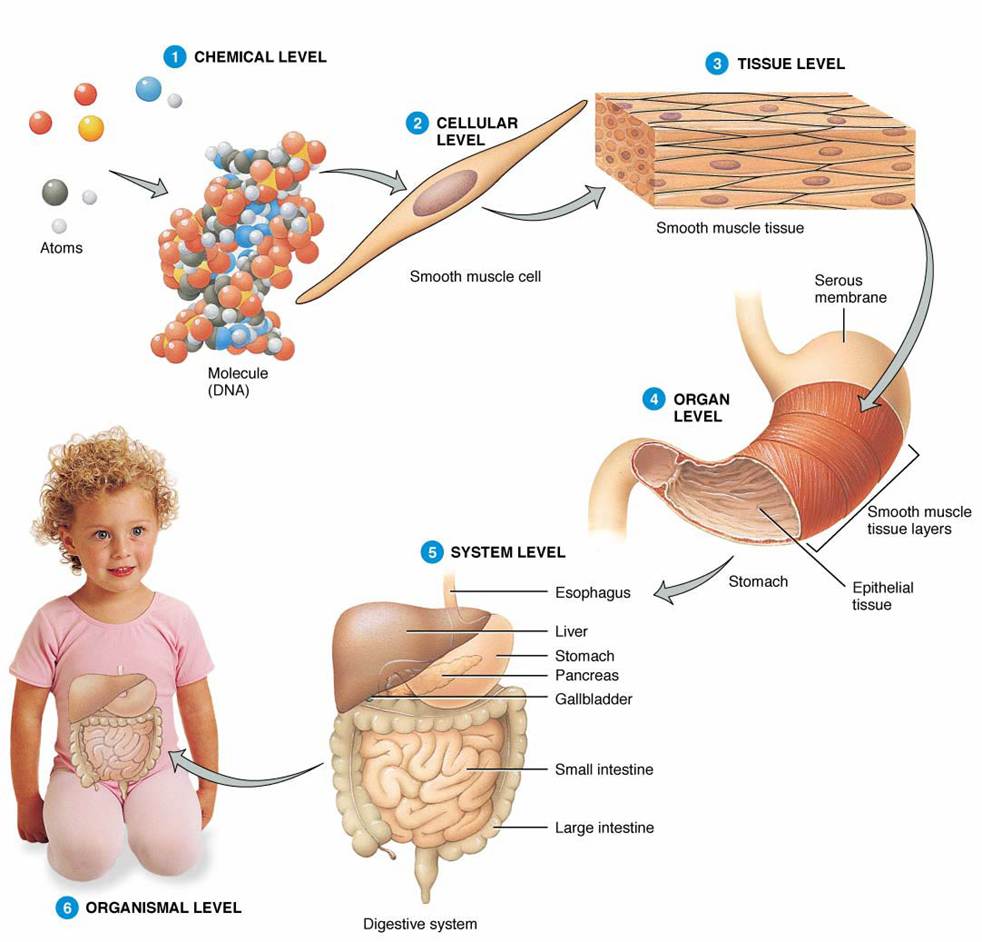
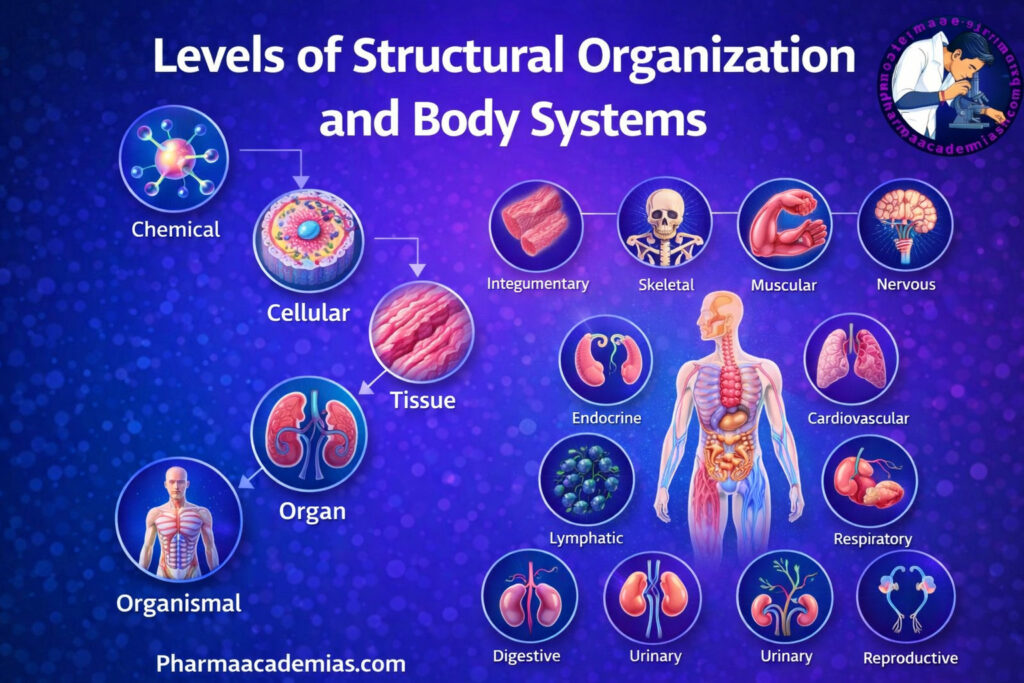
Levels of Structural Organization
The human body is organized into six major structural levels:
- Chemical Level
- Cellular Level
- Tissue Level
- Organ Level
- Organ System Level
- Organism Level
Each level is structurally and functionally integrated with the others.
1. Chemical Level of Organization
The chemical level is the simplest and most fundamental level of body organization. It includes atoms, molecules, and chemical compounds that form the structural and functional basis of all living matter.
Everything in the human body is ultimately composed of chemicals. Proper chemical interactions are essential for life processes such as metabolism, respiration, digestion, nerve conduction, and muscle contraction.
Atoms
Atoms are the smallest units of matter that retain the properties of an element.
Major elements in the human body include:
- Oxygen
- Carbon
- Hydrogen
- Nitrogen
- Calcium
- Phosphorus
- Potassium
- Sodium
These elements combine to form biological molecules.
Molecules
When atoms combine chemically, they form molecules.
Important biological molecules include:
- Water
- Glucose
- Proteins
- Lipids
- Carbohydrates
- Nucleic acids
These molecules are necessary for:
- Energy production
- Growth
- Repair
- Cellular communication
Macromolecules
Large complex molecules called macromolecules are vital for life.
Types of Macromolecules
1. Proteins
Functions:
- Structural support
- Enzyme activity
- Hormone formation
- Transport
2. Carbohydrates
Functions:
- Source of energy
- Energy storage
3. Lipids
Functions:
- Energy reserve
- Insulation
- Cell membrane formation
4. Nucleic Acids
Examples:
- DNA
- RNA
Functions:
- Genetic information storage
- Protein synthesis
Importance of Chemical Level
The chemical level is important because:
- It forms the foundation of life.
- Chemical reactions maintain metabolism.
- Disturbance in chemicals may cause disease.
For example:
- Low calcium weakens bones.
- Reduced glucose affects energy production.
2. Cellular Level of Organization
Cells are the basic structural and functional units of life. At the cellular level, molecules combine to form cells capable of independent activity.
The human body contains trillions of cells, each specialized for specific functions.
Structure of Cells
A typical cell contains:
- Cell membrane
- Cytoplasm
- Nucleus
Inside the cytoplasm are organelles such as:
- Mitochondria
- Ribosomes
- Golgi apparatus
- Endoplasmic reticulum
Each organelle performs specialized activities.
Functions of Cells
Cells perform several essential functions:
- Respiration
- Nutrition
- Excretion
- Growth
- Reproduction
- Movement
- Communication
Types of Cells
Epithelial Cells: Provide covering and protection.
Muscle Cells: Specialized for contraction and movement.
Nerve Cells: Transmit electrical impulses.
Blood Cells: Transport gases and defend the body.
Importance of Cellular Level
The cellular level is important because:
- Cells carry out all life activities.
- Healthy cells maintain healthy tissues and organs.
- Cellular damage can lead to disease.
For example:
- Cancer results from uncontrolled cell division.
- Nerve cell damage affects coordination.
3. Tissue Level of Organization
A tissue is a group of similar cells working together to perform a common function.
At this level, cells combine to form specialized tissues that perform specific activities.
Four Basic Types of Tissues
1. Epithelial Tissue: Epithelial tissue is a primary animal tissue forming continuous, tightly packed sheets that cover external body surfaces, line internal cavities and organs, and constitute glandular tissue. It acts as a protective barrier while facilitating absorption, secretion, and filtration.
Functions:
- Protection
- Absorption
- Secretion
Found in:
- Skin
- Lining of organs
2. Connective Tissue: Connective tissue is one of the four primary tissue types in the body, serving to support, connect, bind, and protect organs and tissues. It consists of cells, fibers, and a ground substance matrix. Major types include connective tissue proper (loose and dense), cartilage, bone, adipose (fat), and blood.
Functions:
- Support
- Binding
- Protection
Examples:
- Bone
- Cartilage
- Blood
- Adipose tissue
3. Muscle Tissue: Muscle tissue is a specialized animal tissue composed of contractile cells (muscle fibers) that shorten to produce movement, maintain posture, and generate heat. It is categorized into three distinct types: skeletal (voluntary, striated), cardiac (involuntary, heart), and smooth (involuntary, organs). These tissues contain actin and myosin proteins that interact for contraction.
Functions:
- Movement
- Heat production
Types:
- Skeletal muscle
- Cardiac muscle
- Smooth muscle
4. Nervous Tissue: Nervous tissue, or neural tissue, is the primary component of the nervous system (brain, spinal cord, and nerves), responsible for coordinating body functions, processing information, and enabling communication via electrical impulses. It consists of neurons (nerve cells) that transmit signals and neuroglia (glial cells) that provide essential support, insulation, and nutrients.
Functions:
- Conduct nerve impulses
- Coordination
Components:
- Neurons
- Neuroglia
Importance of Tissue Level
Tissues are important because they:
- Perform specialized functions efficiently.
- Form organs and body structures.
- Help maintain body integrity.
Damage to tissues may impair organ function.
4. Organ Level of Organization
An organ is a structure composed of two or more tissues working together to perform specific functions.
Each organ has a definite shape, structure, and role.
Examples of Organs
| Organ | Function |
| Heart | Pumps blood |
| Lungs | Gas exchange |
| Liver | Metabolism and detoxification |
| Kidneys | Filtration and urine formation |
| Brain | Control and coordination |
Tissue Composition of Organs
Most organs contain all four tissue types.
Example: Heart
- Muscle tissue for contraction
- Connective tissue for support
- Nervous tissue for control
- Epithelial tissue for lining
Importance of Organ Level
Organs perform complex specialized activities essential for survival.
Failure of an organ can seriously affect health.
Examples:
- Kidney failure
- Heart attack
- Liver disease
5. Organ System Level of Organization
An organ system consists of multiple organs working together to perform major body functions.
The human body contains several organ systems that coordinate to maintain life.
Major Organ Systems of Human Body
1. Integumentary System
Components
- Skin
- Hair
- Nails
- Sweat glands
Functions
- Protection
- Temperature regulation
- Sensation
2. Skeletal System
Components
- Bones
- Cartilage
- Ligaments
Functions
- Support
- Protection
- Blood cell formation
- Movement assistance
3. Muscular System
Components
- Skeletal muscles
Functions
- Body movement
- Posture maintenance
- Heat production
4. Nervous System
Components
- Brain
- Spinal cord
- Nerves
Functions
- Rapid communication
- Coordination
- Sensory perception
5. Endocrine System
Components
- Pituitary gland
- Thyroid gland
- Adrenal glands
- Pancreas
Functions
- Hormone secretion
- Regulation of growth and metabolism
6. Cardiovascular System
Components
- Heart
- Blood vessels
- Blood
Functions
- Transport of oxygen and nutrients
- Waste removal
7. Lymphatic and Immune System
Components
- Lymph nodes
- Spleen
- Thymus
Functions
- Defense against infection
- Fluid balance
8. Respiratory System
Components
- Nose
- Trachea
- Lungs
Functions
- Oxygen intake
- Carbon dioxide removal
9. Digestive System
Components
- Mouth
- Stomach
- Intestines
- Liver
- Pancreas
Functions
- Digestion
- Nutrient absorption
10. Urinary System
Components
- Kidneys
- Ureters
- Urinary bladder
- Urethra
Functions
- Waste removal
- Fluid and electrolyte balance
11. Reproductive System
Male Components
- Testes
- Penis
Female Components
- Ovaries
- Uterus
Functions
- Reproduction
- Hormone production
Interaction Among Body Systems
No body system works independently. All systems cooperate to maintain homeostasis and survival.
Examples
- Respiratory and cardiovascular systems work together to deliver oxygen.
- Digestive and circulatory systems transport nutrients.
- Nervous and endocrine systems coordinate body functions.
6. Organism Level of Organization
The organism level is the highest level of organization.
At this level, all organ systems work together to form a complete living human being capable of independent life.
Characteristics of Organism Level
The human organism can:
- Grow
- Reproduce
- Respond to stimuli
- Maintain homeostasis
- Adapt to environmental changes
Homeostasis and Structural Organization
One of the most important functions of body organization is maintaining homeostasis, which refers to the maintenance of a stable internal environment.
Examples include regulation of:
- Body temperature
- Blood glucose
- Blood pressure
- pH balance
All structural levels contribute to maintaining homeostasis.
Importance of Studying Structural Organization
Understanding structural organization is important because it:
- Explains body complexity
- Helps understand disease processes
- Assists in medical diagnosis
- Supports clinical treatment
- Forms the basis of anatomy and physiology
Healthcare professionals use this knowledge to:
- Understand body functions
- Diagnose diseases
- Plan treatments
- Interpret symptoms
Relationship Between Structure and Function
A fundamental principle in biology is:
“Structure determines function.”
The way a body part is structured directly influences its function.
Examples
- Thin alveolar walls allow rapid gas exchange.
- Long muscle fibers enable contraction.
- Branched neurons facilitate communication.
Thus, proper structure is essential for normal function.
Clinical Significance
Disturbances at any organizational level may cause disease.
| Level | Example of Disorder |
| Chemical | Electrolyte imbalance |
| Cellular | Cancer |
| Tissue | Muscle degeneration |
| Organ | Kidney failure |
| Organ System | Respiratory disease |
Understanding these levels helps healthcare workers identify and manage diseases effectively.
Conclusion
The human body is organized into a highly integrated hierarchy ranging from simple chemical substances to the complete organism. The six levels of structural organization—chemical, cellular, tissue, organ, organ system, and organism—work together to maintain life and health.
Body systems are groups of organs that cooperate to perform major physiological functions such as respiration, circulation, digestion, movement, and reproduction. Proper interaction among these systems ensures homeostasis and survival.
A clear understanding of structural organization and body systems provides the foundation for studying anatomy, physiology, pathology, pharmacology, and clinical medicine. It is essential for students and professionals in healthcare and life sciences because it helps explain how the human body functions in both normal and diseased conditions.