Active Pharmaceutical Ingredients: A pharmaceutical product is not just a drug—it is a carefully engineered system designed to deliver a therapeutic effect safely and effectively. Every dosage form, whether a tablet, capsule, injection, or cream, is composed of two fundamental components:
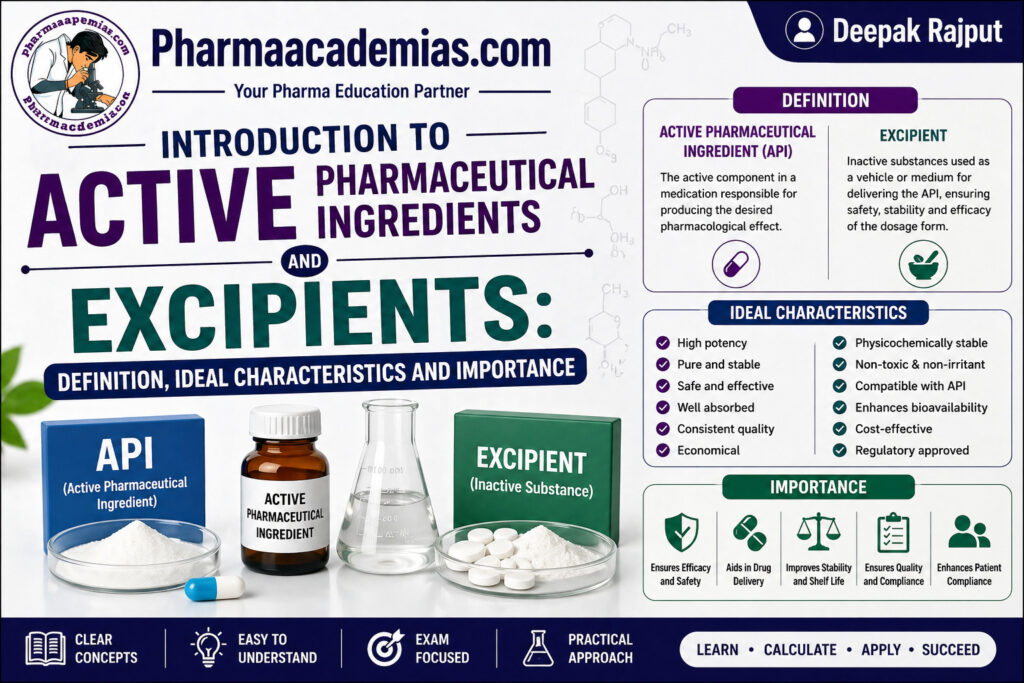
- the Active Pharmaceutical Ingredient (API), which produces the desired pharmacological effect, and
- the excipients, which support, protect, and deliver the API.
This distinction is central to pharmaceutics because the success of a drug therapy depends not only on the API but also on how it is formulated. A poorly formulated drug, even with a highly potent API, may fail due to instability, poor absorption, or lack of patient acceptability.
Active Pharmaceutical Ingredient (API)
An Active Pharmaceutical Ingredient (API) is the chemically or biologically active substance in a drug product that is responsible for its therapeutic effect. It interacts with biological systems to produce a pharmacological response, such as reducing pain, killing bacteria, or regulating physiological functions.
For example, in a paracetamol tablet, the API is Paracetamol, which produces the analgesic and antipyretic effect.
Physicochemical and Biological Characteristics of API
The performance of an API depends heavily on its inherent properties. These properties determine how the drug behaves during formulation, storage, and after administration.
An ideal API should exhibit:
- Chemical stability, meaning it should not degrade due to heat, light, oxygen, or moisture during storage and use.
- Adequate solubility and dissolution rate, since drug absorption depends on its ability to dissolve in biological fluids.
- Appropriate molecular size and lipophilicity, which influence its ability to cross biological membranes.
- High potency, so that a small amount produces the desired effect, making dosage forms practical.
- Reproducible bioavailability, ensuring consistent therapeutic response.
In addition to these, the API must have a well-established safety profile, with minimal toxicity at therapeutic doses.
Biopharmaceutical Considerations
The API is also evaluated based on its classification in systems such as the Biopharmaceutics Classification System (BCS), which categorizes drugs based on solubility and permeability. These properties influence:
- rate and extent of absorption,
- onset of action,
- and formulation strategy.
Thus, APIs are not just chemical substances; they are biopharmaceutical entities whose behavior determines therapeutic success.
Importance of API in Drug Development
The API forms the core of drug action, and its properties dictate:
- the dose required to achieve therapeutic levels,
- the route of administration (oral, injectable, topical),
- the frequency of dosing,
- and the overall clinical efficacy.
Any variation in API quality—such as impurities, degradation, or polymorphic changes—can significantly affect drug performance. Therefore, APIs are subject to strict regulatory standards in pharmacopoeias.
Excipients
Excipients are pharmacologically inactive substances that are combined with the API to produce a final dosage form. Although they do not have therapeutic effects, they are essential for ensuring that the drug is stable, deliverable, manufacturable, and acceptable to the patient.
Functional Role of Excipients
Excipients are not merely “inactive fillers”; they perform highly specific and critical roles in formulation. Depending on the dosage form, they may:
- enhance stability by protecting the API from degradation,
- improve solubility and bioavailability,
- assist in manufacturing processes such as compression and flow,
- and improve patient acceptability by modifying taste, color, and texture.
Thus, excipients are integral to the performance of the dosage form, even though they do not contribute directly to therapeutic action.
Ideal Characteristics of Excipients
An ideal excipient should possess several important properties:
- It must be non-toxic, non-irritant, and pharmacologically inert, ensuring patient safety.
- It should be chemically compatible with the API, without causing degradation or interaction.
- It must exhibit physical and chemical stability over the shelf life of the product.
- It should be economical, easily available, and reproducible in quality.
- It should not interfere with drug absorption, bioavailability, or analytical testing.
These characteristics ensure that excipients support the drug without compromising its quality.
Classification of Excipients (Functional Perspective)
Excipients are classified based on the function they perform in a formulation. While the list is extensive, a few important categories include:
- Diluents (Fillers): Increase bulk for accurate dosing (e.g., lactose)
- Binders: Promote cohesion in tablets (e.g., starch, PVP)
- Disintegrants: Help tablets break apart after administration
- Lubricants and Glidants: Improve powder flow and reduce friction during manufacturing
- Preservatives: Prevent microbial contamination
- Flavoring and Coloring Agents: Enhance patient compliance
Each excipient is selected based on its compatibility with the API and the desired characteristics of the final dosage form.
Importance of Excipients in Drug Formulation
Excipients play a decisive role in transforming a raw API into a usable medicine. Their importance can be appreciated in multiple dimensions.
They contribute to drug stability by protecting the API from environmental factors such as light, moisture, and oxidation. They also improve bioavailability, particularly for poorly soluble drugs, by enhancing dissolution and absorption.
Equally important is their role in patient compliance. A bitter drug may become acceptable through the addition of flavoring agents, while a poorly compressible powder can be converted into a convenient tablet through binders and lubricants.
In modern pharmaceutics, excipients are also used in advanced drug delivery systems, such as controlled-release formulations, where they regulate the rate and site of drug release.
API–Excipient Interaction
The interaction between API and excipients is a critical aspect of formulation development. Even though excipients are considered inert, they can sometimes interact with the API, leading to:
- chemical degradation,
- reduced potency,
- or altered bioavailability.
Therefore, compatibility studies are conducted during formulation development to ensure that the selected excipients do not adversely affect the API.
A successful formulation is one in which:
- the API remains stable and effective,
- excipients perform their intended roles,
- and the final product meets all quality standards.
Conclusion
Active Pharmaceutical Ingredients and excipients together form the foundation of pharmaceutical formulations. The API provides the therapeutic effect, while excipients ensure that the drug is stable, manufacturable, and patient-friendly. Neither component alone is sufficient; it is their careful selection, optimization, and interaction that determine the success of a drug product.
A deep understanding of APIs and excipients is therefore essential for pharmacists and formulation scientists, as it directly impacts drug efficacy, safety, quality, and patient outcomes.