Dusting powders are finely divided medicinal or non-medicinal powders intended for external application to the skin. They are one of the most commonly used topical pharmaceutical preparations and are designed to protect the skin, reduce friction, absorb moisture, and deliver therapeutic agents locally. Dusting powders are widely used in dermatology, wound care, cosmetic preparations, and fungal or bacterial skin infections.
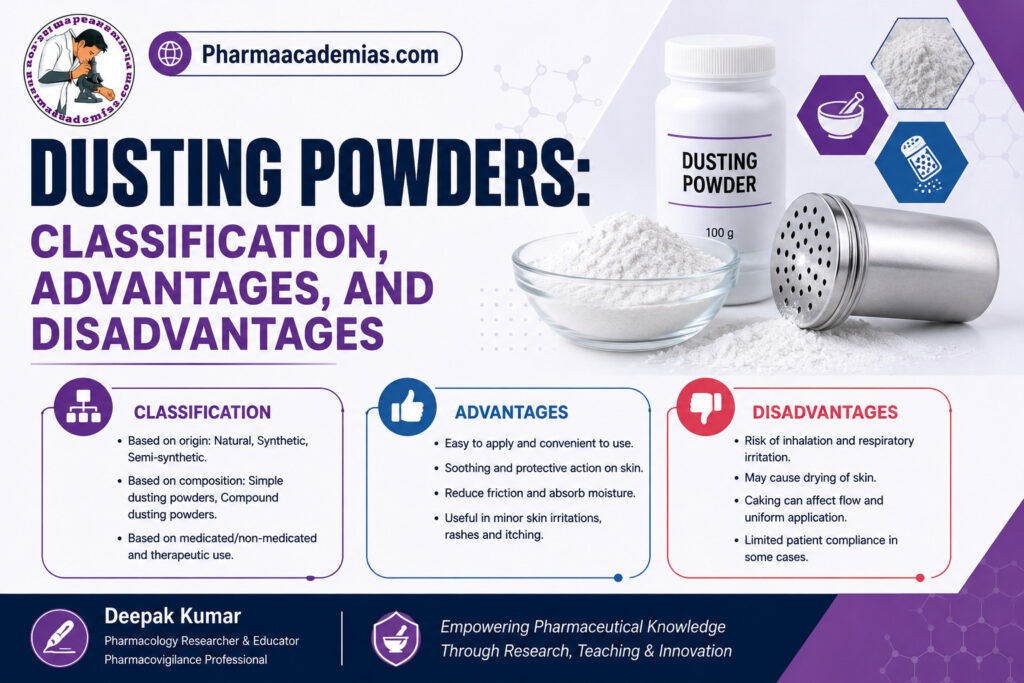
The effectiveness of dusting powders depends largely on their particle size, flow properties, absorbency, adhesiveness, and ability to spread uniformly over the skin surface. An ideal dusting powder should be free from irritation, possess good covering properties, remain stable during storage, and provide comfort to the patient after application.
Dusting powders are especially beneficial in conditions where the skin remains moist due to sweating, exudation, or friction. They help maintain dryness and reduce microbial growth, thereby preventing infections and skin irritation. These powders may be medicated or non-medicated depending on their intended therapeutic use.
Definition of Dusting Powders
Dusting powders are finely divided powders intended for external application to the skin to produce local effects such as protection, lubrication, cooling, drying, or medication.
According to pharmaceutics, dusting powders are topical preparations consisting of powders that are free-flowing, non-irritating, and capable of easy application to the skin.
Objectives of Dusting Powders
The main objectives of using dusting powders include:
- Protecting the skin from irritation
- Reducing friction between skin surfaces
- Absorbing moisture and sweat
- Delivering medicaments locally
- Preventing microbial growth
- Producing a cooling and soothing effect
- Promoting comfort in skin disorders
Characteristics of an Ideal Dusting Powder
An ideal dusting powder should possess the following characteristics:
1. Fine Particle Size: The powder should be finely divided so that it spreads uniformly over the skin and does not produce irritation.
2. Free Flowing Nature: Dusting powders should flow easily from the container and distribute uniformly during application.
3. Good Adhesion: The powder should adhere to the skin for a sufficient period to produce the desired therapeutic effect.
4. Non-Irritating: It should not cause redness, itching, or irritation to damaged or sensitive skin.
5. Good Absorbent Property: The powder should absorb moisture, sweat, and secretions effectively.
6. Chemically and Physically Stable: The preparation should remain stable during storage without discoloration, clumping, or degradation.
7. Sterility (When Required): Dusting powders used on wounds, burns, or surgical areas must be sterile.
Classification of Dusting Powders
Dusting powders are broadly classified into two main categories:
1. Medical Dusting Powders
Medical dusting powders are applied to intact skin for therapeutic or protective purposes.
Features
- Usually non-sterile
- Used externally on unbroken skin
- May contain active medicinal agents
Uses
- Treatment of fungal infections
- Relief from itching
- Protection against irritation
- Absorption of sweat
Examples
- Talcum powder
- Clotrimazole dusting powder
- Zinc oxide powder
2. Surgical Dusting Powders
Surgical dusting powders are sterile preparations used on wounds, burns, and surgical areas.
Features
- Must be sterile
- Free from pathogenic microorganisms
- Prepared under aseptic conditions
Uses
- Application on wounds
- Burns and ulcers
- Surgical dressings
Important Note
Starch is generally avoided in surgical dusting powders because it may promote bacterial growth and wound irritation.
Composition of Dusting Powders
Dusting powders generally contain the following components:
1. Base Substances
These form the major portion of the powder and provide absorbent and protective properties.
Common Bases
- Talc
- Starch
- Kaolin
- Zinc oxide
Functions
- Absorb moisture
- Reduce friction
- Improve spreadability
2. Medicinal Agents
These are added to provide therapeutic action.
Examples
- Antifungal agents (Clotrimazole, Miconazole)
- Antibacterial agents
- Antiseptics
- Local anesthetics
Functions
- Treat infections
- Relieve itching and pain
- Prevent microbial growth
3. Perfumes and Cooling Agents
Added to improve patient acceptability and provide cooling sensation.
Examples
- Menthol
- Camphor
- Perfumes
Ingredients Commonly Used in Dusting Powders
| Ingredient | Function |
| Talc | Lubricant and absorbent |
| Zinc oxide | Protective and mild antiseptic |
| Starch | Absorbent |
| Kaolin | Absorbent and soothing |
| Clotrimazole | Antifungal agent |
| Menthol | Cooling effect |
| Boric acid | Mild antiseptic |
Advantages of Dusting Powders
Dusting powders possess several advantages that make them valuable topical preparations.
1. Absorb Moisture Effectively: They absorb sweat and moisture from the skin, helping to keep the area dry and comfortable.
2. Reduce Friction: Dusting powders decrease friction between skin surfaces and clothing, preventing irritation and rashes.
3. Provide Cooling and Soothing Effect: Many dusting powders produce a cooling sensation that relieves discomfort and itching.
4. Easy Application: They can be easily applied over large areas of the body.
5. Useful in Fungal Infections: Antifungal dusting powders help control fungal growth in moist body areas.
6. Protective Action: They form a protective layer over the skin and reduce exposure to irritant
7. Non-Greasy Preparation:Unlike ointments and creams, dusting powders do not leave a greasy residue.
Disadvantage of Dusting Powders
Despite their benefits, dusting powders also have certain disadvantages.
1. Poor Adhesion to Skin: Some powders do not remain on the skin for a long time and may require repeated application.
2. Risk of Inhalation: Fine powder particles may be inhaled accidentally, especially in infants and children, causing respiratory irritation.
3. Caking in Humid Conditions: Exposure to moisture may cause clumping or caking of powders.
4. Difficulty in Sterilization:Maintaining sterility in surgical dusting powders can be challenging
5. Limited Penetration: Dusting powders mainly act superficially and have poor penetration through the skin.
6. Possible Skin Dryness:Excessive use may cause over-drying of the skin.
Uses of Dusting Powders
Dusting powders are widely used in medicine and cosmetics.
Medical Uses
- Fungal infections
- Diaper rash
- Prickly heat
- Skin irritation
- Excess sweating
Cosmetic Uses
- Body powders
- Face powders
- Deodorizing powders
Examples of Dusting Powders
| Preparation | Use |
| Clotrimazole Dusting Powder | Antifungal |
| Talcum Powder | Moisture absorption |
| Zinc Oxide Powder | Skin protection |
| Nystatin Dusting Powder | Fungal infections |
| Menthol Dusting Powder | Cooling effect |
Difference Between Medical and Surgical Dusting Powders
| Feature | Medical Dusting Powder | Surgical Dusting Powder |
| Sterility | Not necessary | Essential |
| Application | Intact skin | Wounds and surgical areas |
| Composition | May contain starch | Starch avoided |
| Preparation | Simple | Aseptic conditions required |
Conclusion
Dusting powders are important topical pharmaceutical preparations used for protective, absorbent, soothing, and therapeutic purposes. They are finely divided powders applied externally to maintain skin dryness, reduce friction, and provide relief from irritation and infections. Dusting powders are classified into medical and surgical types based on their use and sterility requirements.
These preparations offer several advantages such as ease of application, moisture absorption, cooling effect, and usefulness in fungal infections. However, they also possess limitations including poor adhesion, risk of inhalation, and possible caking under humid conditions.
Proper formulation, particle size control, packaging, and storage are essential to ensure the effectiveness, safety, and stability of dusting powders. Due to their simplicity, versatility, and wide therapeutic applications, dusting powders continue to occupy an important place in pharmaceutical and dermatological practice.