Hygroscopic powders are pharmaceutical substances that have the ability to absorb moisture from the atmosphere when exposed to air. This property is known as hygroscopicity. In pharmaceutics, hygroscopic substances are very important because their moisture-absorbing nature can significantly affect the stability, flow properties, appearance, handling, and therapeutic effectiveness of powder formulations.
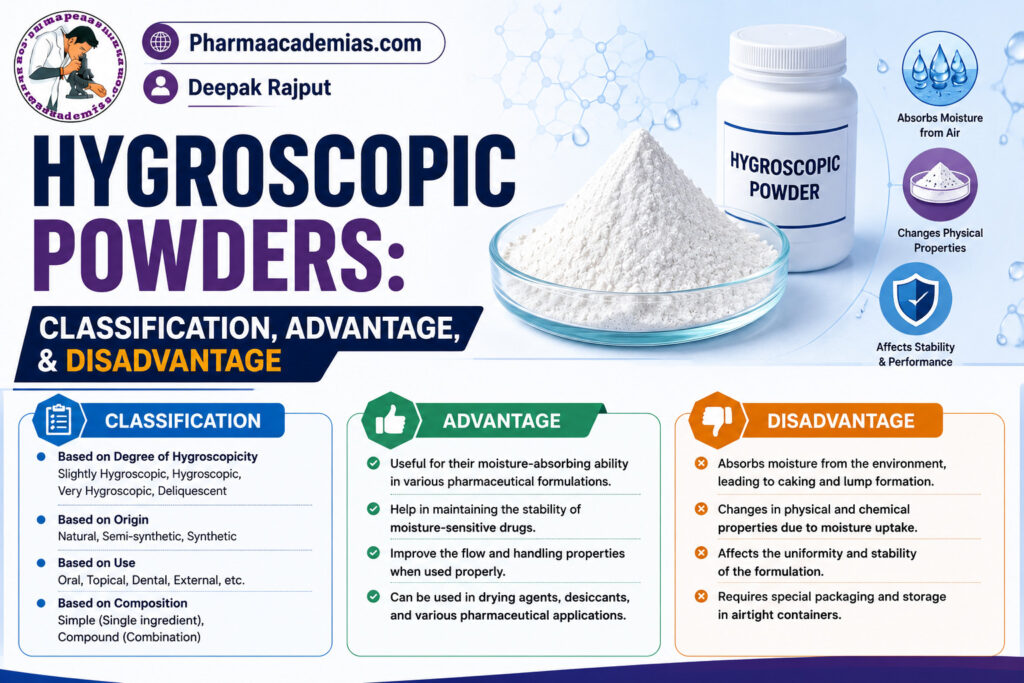
Many pharmaceutical drugs and excipients possess hygroscopic characteristics. When exposed to humid conditions, these powders absorb water vapor from the atmosphere, leading to dampness, clumping, caking, and sometimes chemical degradation. Excessive moisture absorption may also interfere with dose uniformity and patient acceptability.
Hygroscopic powders require special precautions during manufacturing, storage, dispensing, and packaging. Pharmacists often use airtight containers, moisture-resistant packaging, desiccants, and absorbent diluents to maintain stability and quality.
Understanding hygroscopicity is essential in pharmaceutical formulation because moisture can alter the physical and chemical properties of powders and may reduce shelf life and therapeutic efficacy.
Definition of Hygroscopic Powders
Hygroscopic powders are pharmaceutical powders that absorb moisture from the atmosphere without dissolving completely.
The phenomenon of absorbing atmospheric moisture is known as hygroscopicity.
Mechanism of Hygroscopicity
Hygroscopic substances attract water molecules from the surrounding environment due to their affinity for moisture.
The process involves:
- Exposure of powder to humid air
- Attraction of water vapor molecules
- Adsorption or absorption of moisture
- Formation of damp or sticky powder mass
Unlike deliquescent substances, hygroscopic powders absorb limited moisture and usually do not liquefy completely.
Characteristics of Hygroscopic Powders
Hygroscopic powders exhibit several characteristic properties.
1. Moisture Absorption: They absorb water vapor from the atmosphere.
2. Dampness Formation: The powder may become moist or sticky after exposure.
3. Caking Tendency: Particles stick together and form lumps.
4. Reduced Flow Properties: Moisture interferes with free flow of powders.
5. Stability Problems: Moisture absorption may accelerate chemical degradation.
Examples of Hygroscopic Substances
| Substance | Nature |
| Sodium bromide | Hygroscopic |
| Potassium hydroxide | Hygroscopic |
| Calcium chloride | Highly hygroscopic |
| Glycerol powder preparations | Moisture absorbing |
| Dry plant extracts | Hygroscopic |
| Gelatin powder | Hygroscopic |
Causes of Hygroscopicity
Several factors contribute to hygroscopic behavior.
1. High Atmospheric Humidity: Moist air increases moisture absorption.
2. Chemical Nature of Substance: Certain chemicals possess strong affinity for water.
3. Fine Particle Size: Smaller particles expose greater surface area for moisture absorption.
4. Improper Storage: Exposure to open air promotes moisture uptake.
Effects of Hygroscopicity on Powders
Hygroscopicity can produce several undesirable effects.
1. Caking and Clumping: Powder particles stick together due to absorbed moisture.
2. Reduced Stability: Water may promote hydrolysis and degradation of drugs.
3. Difficulty in Handling: Sticky powders are difficult to weigh, mix, and package.
4. Alteration in Dose Uniformity: Non-uniform mixing may occur due to moisture accumulation.
5. Reduced Shelf Life: Moisture exposure decreases product stability.
6. Microbial Growth: Excess moisture may support microbial contamination.
Prevention of Hygroscopicity
Several methods are used to protect hygroscopic powders.
1. Use of Airtight Containers: Tightly closed containers prevent moisture entry.
2. Addition of Absorbent Materials
Absorbents help retain excess moisture.
Examples
- Talc
- Kaolin
- Starch
- Magnesium oxid
3. Use of Desiccants
Desiccants absorb moisture within the container.
Examples
- Silica gel
- Calcium oxide
4. Moisture-Resistant Packaging: Special packaging materials protect against humidity.
5. Storage in Dry Conditions: Controlled humidity storage improves stability.
6. Granulation: Granules possess less exposed surface area than fine powders.
Packaging of Hygroscopic Powders
Suitable packaging is essential.
Common Packaging Materials
- Airtight glass containers
- Aluminum foil sachets
- Plastic moisture-resistant containers
Packaging Requirements
- Moisture protection
- Tight sealing
- Minimal air exposure
Advantages of Hygroscopic Powders
Although hygroscopicity is generally undesirable, some advantages may exis
1. Rapid Dissolution: Some hygroscopic substances dissolve quickly due to affinity for water.
2. Improved Solubility: Moisture interaction may enhance dissolution properties.
Disadvantages of Hygroscopic Powders
Hygroscopic powders present several pharmaceutical problems.
1. Moisture Sensitivity: They readily absorb atmospheric moisture.
2. Caking: Powders lose free-flowing nature.
3. Stability Issues:Chemical degradation may occur.
4. Special Storage Requirements: Controlled storage is necessary.
5. Reduced Elegance:Appearance and texture deteriorate.
Difference Between Hygroscopic and Deliquescent Powders
| Feature | Hygroscopic Powders | Deliquescent Powders |
| Moisture Absorption | Moderate | Very high |
| Physical Change | Become moist | Liquefy completely |
| Example | Sodium bromide | Calcium chloride |
Difference Between Hygroscopic and Efflorescent Powders
| Feature | Hygroscopic Powders | Efflorescent Powders |
| Moisture Behavior | Absorb moisture | Lose water |
| Atmospheric Effect | Become damp | Become dry or release water |
| Water Source | Atmosphere | Water of crystallization |
Conclusion
Hygroscopic powders are pharmaceutical substances that absorb moisture from the atmosphere and become damp or sticky. Their moisture-sensitive nature can affect stability, flow properties, appearance, and therapeutic effectiveness. Proper handling, airtight packaging, controlled storage conditions, and use of absorbents are essential to maintain their quality and stability.
Knowledge of hygroscopicity is extremely important in pharmaceutical formulation and dispensing because it helps pharmacists prevent instability and ensure safe, effective, and elegant pharmaceutical preparations.