
Basic Anatomical Terminologies: Anatomy is the branch of science concerned with the structure of the human body and the relationship among its parts. To study anatomy effectively, healthcare professionals and students use a standardized set of terms known as anatomical terminologies. These terms provide a universal language that allows scientists, doctors, nurses, pharmacists, physiotherapists, and other healthcare workers to communicate accurately and clearly about the human body.
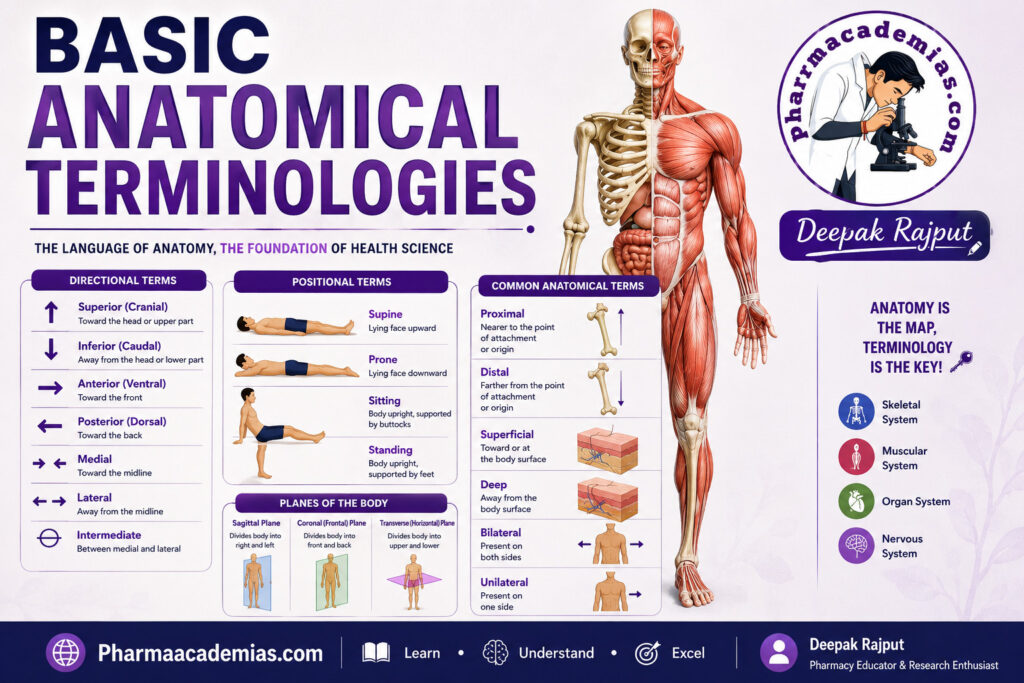
Without standardized anatomical terminology, describing body structures, positions, movements, and relationships would become confusing and inconsistent. Basic anatomical terminologies help in understanding the exact location of organs, directions within the body, body movements, and relationships between different structures.
Anatomical terminology forms the foundation of anatomy, physiology, pathology, radiology, surgery, nursing, and clinical medicine.
Definition of Basic Anatomical Terminologies
Anatomical terminology refers to the standardized scientific terms used to describe:
- Body structures
- Body positions
- Directions
- Regions
- Planes
- Cavities
- Movements
- Relationships between body parts
These terms ensure uniformity and precision in medical communication worldwide.
Importance of Basic Anatomical Terminologies
Basic anatomical terminology is important because it:
- Provides clear communication among healthcare professionals
- Prevents misunderstanding during diagnosis and treatment
- Helps describe body structures accurately
- Assists in surgery and clinical examination
- Facilitates learning of anatomy and physiology
- Helps interpret radiological images and medical reports
For example, instead of saying:
- “The pain is above the stomach and toward the middle,”
A healthcare professional may say:
- “Pain is present in the epigastric region.”
Thus, anatomical terminology improves accuracy and efficiency.
Anatomical Position
The anatomical position is the standard reference position used to describe body parts and directional terms.
All anatomical descriptions are based on this position regardless of the actual posture of the body.
Features of Anatomical Position
In anatomical position:
- The body stands erect
- Head faces forward
- Eyes look straight ahead
- Arms hang by the sides
- Palms face forward
- Legs are together or slightly apart
- Feet point forward
This position serves as the universal reference point for anatomical descriptions
Importance of Anatomical Position
Anatomical position helps:
- Standardize body descriptions
- Eliminate confusion
- Describe locations accurately
For example:
- The thumb is lateral to the little finger in anatomical position.
Anatomical Directions
Directional terms describe the location of one body part relative to another.
1. Superior (Cranial)
Indicates a position higher or above another structure. For example, the head is superior to the neck.
Example
- The head is superior to the neck.
- The chest is superior to the abdomen.
2. Inferior (Caudal)
Indicates a position lower or below another structure. For example, the feet are inferior to the knees.
Example
- The stomach is inferior to the heart.
- The knee is inferior to the hip.
3. Anterior (Ventral)
Refers to the front or the direction toward the front of the body. For example, the chest is anterior to the spine.
Example
- The sternum is anterior to the heart.
- The nose is anterior to the ears.
4. Posterior (Dorsal)
Refers to the back of the direction toward the back of the body. For example, the spine is posterior to the chest.
Example
- The vertebral column is posterior to the stomach.
- The heart is posterior to the sternum.
5. Medial
Refers to a position closer to the midline or center of the body. For example, the nose is medial to the eyes.
Example
- The nose is medial to the eyes.
- The heart is medial to the lungs.
6. Lateral
Refers to a position farther away from the midline or toward the sides of the body. For example, the ears are lateral to the nose.
Example
- The arms are lateral to the chest.
- The ears are lateral to the eyes.
7. Intermediate
Between two structures.
Example
- The clavicle is intermediate between the sternum and shoulder.
8. Proximal
Closer to the origin or attachment point.
Usually used for limbs.
Example
- The elbow is proximal to the wrist.
- The knee is proximal to the ankle.
9. Distal
Indicates a position farther away from the point of attachment or origin. For example, the fingers are distal to the wrist.
Example
- The fingers are distal to the wrist.
- The ankle is distal to the knee.
10. Superficial
Refers to structures closer to the body’s surface. For example, the skin is superficial to the muscles.
Example
- The skin is superficial to muscles.
11. Deep
Away from the body surface.
Example
- Bones are deep to muscles.
- The lungs are deep to the ribs.
12. Ipsilateral
On the same side of the body.
Example
- The right arm and right leg are ipsilateral.
13. Contralateral
On opposite sides of the body.
Example
- The right arm and left leg are contralateral.
Body Planes
Body planes are imaginary flat surfaces that divide the body into sections.
They help in:
- Anatomical study
- Surgical procedures
- Radiological imaging
1. Sagittal Plane
A vertical plane dividing the body into right and left portions.
Types
Median (Midsagittal) Plane: Divides body into equal right and left halves.
Parasagittal Plane: Divides body into unequal portions.
2. Frontal Plane (Coronal Plane)
Divides the body into anterior and posterior portions.
Example: Separates front and back of the body.
3. Transverse Plane (Horizontal Plane)
Divides the body into superior and inferior portions.
Example: Separates upper and lower body parts.
4. Oblique Plane
Cuts the body at an angle.
Importance of Body Planes
Body planes are important in:
- CT scans
- MRI imaging
- Surgical anatomy
- Movement analysi
Body Cavities
Body cavities are spaces within the body that contain and protect internal organs.
Major Body Cavities
The body has two major cavities:
- Dorsal body cavity
- Ventral body cavity
1. Dorsal Body Cavity
Located toward the back of the body.
Components
A. Cranial Cavity
Contains: Brain
B. Vertebral (Spinal) Cavity
Contains: Spinal cord
Functions: Protection of central nervous system structures
2. Ventral Body Cavity
Located toward the front of the body.
Divided by the diaphragm into:
- Thoracic cavity
- Abdominopelvic cavity
Thoracic Cavity
Contains:
- Heart
- Lungs
- Trachea
- Esophagus
Subdivisions
Pleural Cavities: Contain lungs.
Mediastinum
Contains:
- Heart
- Great vessels
- Trachea
Abdominopelvic Cavity
Divided into:
- Abdominal cavity
- Pelvic cavit
Abdominal Cavity
Contains:
- Stomach
- Liver
- Intestines
- Pancreas
- Spleen
Pelvic Cavity
Contains:
- Urinary bladder
- Reproductive organs
- Rectum
Functions of Body Cavities
Body cavities:
- Protect organs
- Allow organ movement
- Reduce friction
- Support organ function
Abdominopelvic Regions
The abdomen is divided into nine regions for clinical examination.
Nine Abdominal Regions
| Upper Row | Middle Row | Lower Row |
| Right hypochondriac | Epigastric | Left hypochondriac |
| Right lumbar | Umbilical | Left lumbar |
| Right iliac | Hypogastric | Left iliac |
Clinical Importance
These regions help locate:
- Pain
- Swelling
- Organ enlargement
- Disease conditions
Example:
- Appendicitis commonly causes pain in right iliac region.
Quadrants of Abdomen
The abdomen may also be divided into four quadrants:
- Right upper quadrant (RUQ)
- Left upper quadrant (LUQ)
- Right lower quadrant (RLQ)
- Left lower quadrant (LLQ
Anatomical Terms Related to Movement
Movement terminology describes actions of body parts.
1. Flexion
Decreases angle between body parts.
Example: Bending elbow.
2. Extension
Increases angle between body parts.
Example: Straightening knee.
3. Abduction
Movement away from midline.
Example: Raising arm sideways.
4. Adduction
Movement toward midline.
Example: Lowering arm to body.
5. Rotation
Movement around an axis.
Example: Turning head side to side.
6. Circumduction
Circular movement of a limb.
7. Supination
Turning palm upward.
8. Pronation
Turning palm downward.
9. Dorsiflexion
Upward movement of foot.
10. Plantar Flexion
Downward movement of foot.
Regional Terms of Human Body
Different body areas have specific names.
Head and Neck
| Region | Description |
| Cephalic | Head |
| Cranial | Skull |
| Facial | Face |
| Cervical | Neck |
Upper Limb
| Region | Description |
| Acromial | Shoulder |
| Brachial | Arm |
| Antebrachial | Forearm |
| Carpal | Wrist |
| Digital | Fingers |
Lower Limb
| Region | Description |
| Femoral | Thigh |
| Patellar | Knee |
| Crural | Leg |
| Tarsal | Ankle |
Posterior Body Regions
| Region | Description |
| Scapular | Shoulder blade |
| Vertebral | Spine |
| Lumbar | Lower back |
| Gluteal | Buttock |
Medical Imaging and Anatomical Terminology
Anatomical terminology is essential in:
- X-rays
- CT scans
- MRI
- Ultrasound
Radiologists use anatomical directions and planes to describe findings accurately.
Clinical Importance of Anatomical Terminology
Healthcare professionals use anatomical terminology in:
- Diagnosis
- Surgery
- Nursing care
- Physical examination
- Prescription interpretation
- Emergency medicine
Examples:
- “Pain in lower right quadrant”
- “Fracture distal to elbow”
- “Tumor located posterior to stomach”
Anatomical Position in Clinical Practice
The anatomical position helps:
- Describe injuries
- Interpret scans
- Perform physical examinations
- Plan surgical procedures
Without standardized terminology, medical errors could occur.
Relationship Between Anatomy and Physiology
Anatomical terminology supports understanding of:
- Organ structure
- Functional relationships
- Disease processes
Proper anatomical knowledge is essential for studying physiology and pathology.
Conclusion
Basic anatomical terminologies provide a universal language for describing the structure, position, direction, and movement of body parts. These standardized terms include anatomical position, directional terms, body planes, body cavities, regional terms, and movement terminology.
A clear understanding of anatomical terminology is essential in anatomy, physiology, medicine, nursing, pharmacy, surgery, radiology, and all healthcare sciences because it ensures accurate communication, proper diagnosis, effective treatment, and safe clinical practice.
Editorial Note
This article has been carefully researched and written by Deepak Rajput with a focus on accuracy, clarity, and evidence-based healthcare information. Pharmaacademias.com