
What are Homeostasis? Homeostasis is one of the most fundamental concepts in anatomy and physiology. The survival of the human body depends upon its ability to maintain a stable internal environment despite continuous changes occurring both inside and outside the body. Every organ system works together to preserve this balance and ensure optimal conditions for cellular function.
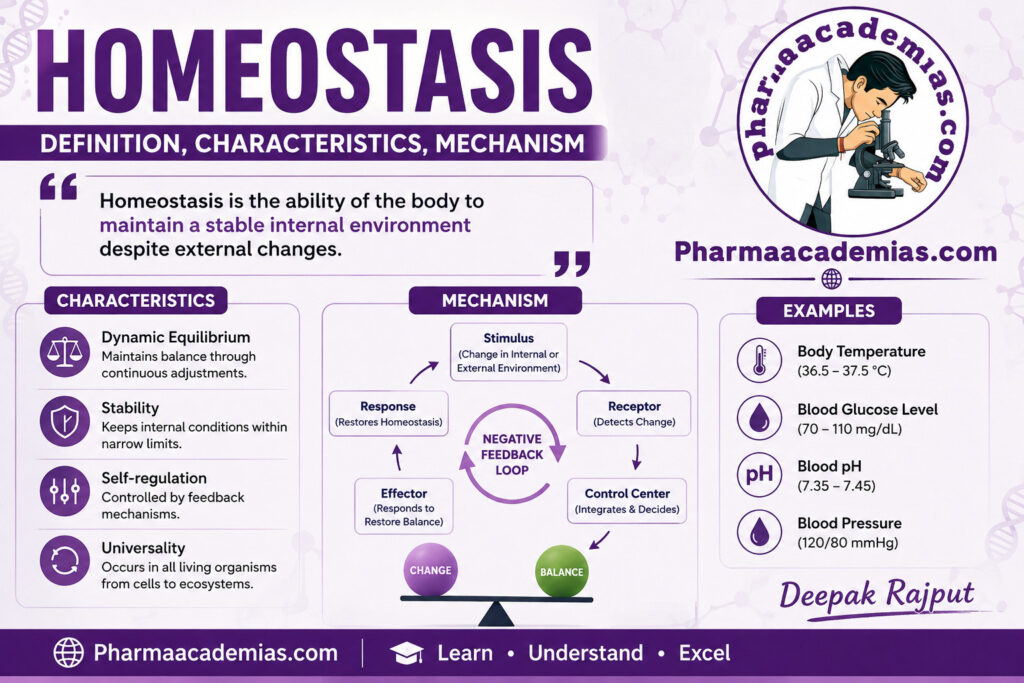
The human body is constantly exposed to changing environmental conditions such as variations in temperature, oxygen levels, water availability, food intake, stress, and infections. Even though the external environment changes continuously, the internal environment of the body must remain relatively constant for cells to survive and function properly. This maintenance of internal stability is known as homeostasis.
Homeostasis is essential because cells can function efficiently only within a narrow range of conditions. Disturbances in homeostasis may lead to disease, organ dysfunction, or even death if the imbalance becomes severe.
What are Homeostasis
The term Homeostasis is derived from two Greek words:
- Homeo = similar or constant
- Stasis = standing still
Homeostasis may be defined as:
“The ability of the body to maintain a relatively stable internal environment despite changes in the external or internal conditions.”
The concept of homeostasis was introduced by the physiologist Walter Cannon, who explained how the body maintains internal equilibrium through coordinated physiological mechanisms.
Internal Environment of the Body
The internal environment mainly refers to the fluid surrounding body cells, known as the extracellular fluid (ECF).
Cells require a stable environment for:
- Nutrient supply
- Waste removal
- Enzyme activity
- Proper metabolism
The body continuously regulates the composition of this internal fluid.
Characteristics of Homeostasis
Homeostasis has several important features:
- Dynamic equilibrium
- Continuous monitoring
- Self-regulating mechanisms
- Coordination among organ systems
- Maintenance within normal limits
Homeostasis does not mean that conditions remain absolutely constant. Instead, variables fluctuate within a narrow physiological range.
Importance of Homeostasis
Homeostasis is vital for survival because it:
- Maintains optimal conditions for cells
- Supports enzyme activity
- Regulates body temperature
- Controls fluid and electrolyte balance
- Maintains blood pressure
- Stabilizes blood glucose levels
- Preserves acid-base balance
- Ensures proper organ functioning
Without homeostasis, normal physiological processes cannot occur efficiently.
Homeostatic Variables
Several important body conditions are regulated through homeostasis.
1. Body Temperature
Normal body temperature is approximately: 37°C (98.6°F)
The body maintains temperature balance through:
- Sweating
- Shivering
- Vasodilation
- Vasoconstriction
2. Blood Glucose Level
Normal blood glucose levels are regulated mainly by:
- Insulin
- Glucagon
Maintaining glucose balance is essential for energy production.
3. Blood Pressure
Blood pressure is regulated through:
- Heart activity
- Blood vessel diameter
- Kidney function
- Hormonal control
4. Water and Electrolyte Balance
The body carefully regulates:
- Sodium
- Potassium
- Calcium
- Water levels
This balance is maintained primarily by the kidneys and hormones.
5. Oxygen and Carbon Dioxide Levels
The respiratory and cardiovascular systems regulate gas exchange to maintain proper oxygen supply and carbon dioxide removal
6. pH Balance
Normal blood pH is maintained between: 7.35 – 7.45
Even slight changes in pH can affect enzyme activity and cellular function.
Components of Homeostatic Control Mechanism
Homeostasis is maintained through a control system consisting of three major components:
- Receptor
- Control center
- Effector
1. Receptor
A receptor detects changes in the internal or external environment.
Function:
- Monitors conditions
- Sends information to the control center
Examples:
- Temperature receptors in skin
- Blood pressure receptors in arteries
2. Control Center
The control center receives information from receptors and determines the appropriate response.
Functions:
- Compares conditions with normal values
- Processes information
- Sends commands to effectors
Examples:
- Brain
- Hypothalamus
- Endocrine glands
3. Effector
The effector carries out the response to restore balance.
Examples:
- Muscles
- Glands
- Blood vessels
Mechanism of Homeostasis
Homeostasis operates mainly through feedback mechanisms.
A feedback mechanism is a cycle in which the body responds to changes and attempts to restore normal conditions.
There are two main types of feedback mechanisms:
- Negative feedback
- Positive feedback
Negative Feedback Mechanism
Negative feedback is a mechanism in which the body reverses a change to maintain stability.
It is the most common and important homeostatic mechanism.
Features of Negative Feedback
- Opposes changes
- Restores normal conditions
- Maintains stability
- Prevents excessive fluctuations
Examples of Negative Feedback
1. Regulation of Body Temperature
When body temperature rises:
- Sweat glands produce sweat
- Blood vessels dilate
- Heat loss increases
When body temperature falls:
- Shivering occurs
- Blood vessels constrict
- Heat production increases
Thus, temperature returns to normal.
2. Blood Glucose Regulation
When blood glucose increases:
- Pancreas secretes insulin
- Cells absorb glucose
- Blood glucose decreases
When blood glucose decreases:
- Pancreas secretes glucagon
- Liver releases glucose
- Blood glucose increases
3. Blood Pressure Regulation
Changes in blood pressure are detected by receptors, and corrective adjustments are made through heart rate and blood vessel diameter changes.
Importance of Negative Feedback
Negative feedback:
- Stabilizes body functions
- Prevents harmful extremes
- Maintains homeostasis efficiently
Positive Feedback Mechanism
Positive feedback is a mechanism in which the response enhances or amplifies the original change.
Unlike negative feedback, it does not restore stability immediately.
Features of Positive Feedback
- Intensifies change
- Continues until a specific event occurs
- Usually temporary
Examples of Positive Feedback
1. Childbirth
During labor:
- Uterine contractions push the baby toward the cervix
- Stretching of cervix stimulates oxytocin release
- Oxytocin increases contractions
This cycle continues until childbirth is complete.
2. Blood Clotting
When bleeding occurs:
- Platelets gather at injury site
- More platelets are attracted
- Clot formation increases rapidly
The process stops once the clot is formed.
3. Lactation
Suckling stimulates hormone release that increases milk production.
Comparison Between Negative and Positive Feedback
| Feature | Negative Feedback | Positive Feedback |
| Effect on Change | Reverses change | Enhances change |
| Goal | Maintain stability | Complete a process |
| Commonality | Very common | Less common |
| Example | Temperature control | Childbirth |
Role of Organ Systems in Homeostasis
Multiple organ systems cooperate to maintain homeostasis.
Nervous System
- Rapid control and coordination
- Detects stimuli
- Sends nerve impulses
Endocrine System
- Hormonal regulation
- Long-term control
Examples:
- Insulin
- Thyroxine
- ADH
Respiratory System
- Maintains oxygen and carbon dioxide balance
- Regulates blood pH
Cardiovascular System
- Transports nutrients and gases
- Maintains blood pressure
Urinary System
- Regulates water and electrolyte balance
- Removes waste products
Digestive System
- Provides nutrients and water
Integumentary System
- Regulates temperature through sweating
Homeostasis at Cellular Level
Cells require stable conditions for survival.
Homeostasis maintains:
- Nutrient supply
- Oxygen availability
- Proper temperature
- Waste removal
Cellular dysfunction occurs if homeostasis is disrupted.
Factors Affecting Homeostasis
Several factors can disturb homeostasis:
- Infection
- Injury
- Dehydration
- Malnutrition
- Stress
- Environmental extremes
- Disease conditions
Disorders Related to Homeostatic Imbalance
Failure of homeostasis may result in disease
Diabetes Mellitus: Failure of glucose regulation due to insulin problems.
Hypertension: Persistent elevation of blood pressure.
Dehydration: Loss of fluid and electrolyte balance
Acidosis and Alkalosis: Abnormal blood pH conditions.
Fever: Disruption of temperature regulation.
Shock: Severe failure of circulatory homeostasis.
Homeostasis and Health
Good health depends on efficient homeostatic mechanisms.
Healthcare professionals monitor homeostasis through:
- Blood pressure measurement
- Blood glucose testing
- Temperature monitoring
- Laboratory investigations
Medical treatment often aims to restore homeostasis.
Clinical Significance of Homeostasis
Understanding homeostasis is important in medicine and healthcare because it helps explain:
- Disease mechanisms
- Drug actions
- Physiological regulation
- Emergency conditions
- Organ system interactions
Examples:
- IV fluids restore fluid balance.
- Insulin therapy regulates glucose levels.
- Oxygen therapy improves gas balance.
Relationship Between Homeostasis and Life Processes
All life processes contribute to maintaining homeostasis.
Examples
- Respiration regulates oxygen.
- Circulation transports nutrients.
- Excretion removes waste.
- Digestion supplies energy.
Thus, the body functions as an integrated system.
Homeostatic Regulation by Hypothalamus
The hypothalamus is a major control center for homeostasis.
It regulates:
- Temperature
- Hunger
- Thirst
- Sleep
- Hormone secretion
It acts as a link between the nervous and endocrine systems.
Aging and Homeostasis
As age increases:
- Homeostatic efficiency decreases
- Recovery becomes slower
- Disease susceptibility increases
Elderly individuals may have reduced ability to maintain:
- Temperature balance
- Fluid balance
- Blood pressure stability
Conclusion
Homeostasis is the process by which the human body maintains a stable internal environment necessary for normal cellular function and survival. It involves continuous monitoring and regulation of physiological variables such as temperature, blood glucose, blood pressure, fluid balance, gas exchange, and pH.
Homeostasis is maintained through coordinated actions of receptors, control centers, and effectors, mainly using negative and positive feedback mechanisms. Multiple organ systems work together to preserve internal stability despite external and internal changes.
A thorough understanding of homeostasis is essential in anatomy, physiology, medicine, nursing, pharmacy, and all healthcare sciences because disturbances in homeostasis form the basis of many diseases and clinical disorders.
Editorial Note
This article has been carefully researched and written by Deepak Rajput with a focus on accuracy, clarity, and evidence-based healthcare information. Pharmaacademias.com


