Basic Life Processes: Basic life processes are the essential activities performed by living organisms to maintain life and ensure survival. These processes include nutrition, respiration, movement, growth, excretion, reproduction, and digestion. They help organisms obtain energy, grow, remove wastes, respond to the environment, and continue their species. In simple words, basic life processes are the necessary functions that keep living organisms alive and healthy.
These processes occur at all levels of organization, from individual cells to the entire organism.
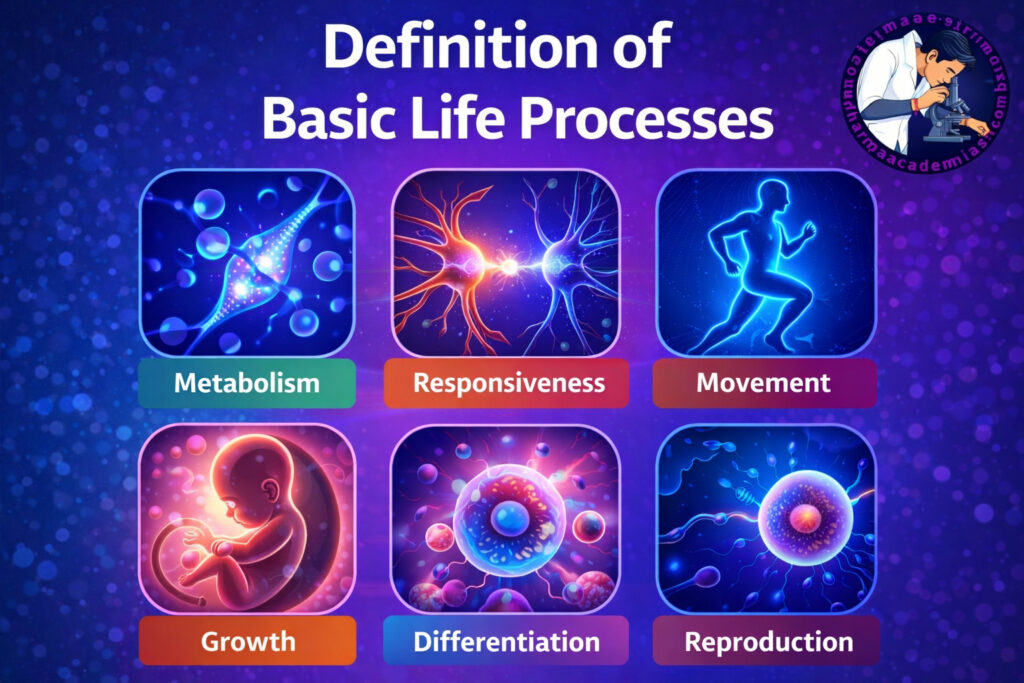
Characteristics of Basic Life Processes
Living organisms show several important characteristics that distinguish them from non-living things. These characteristics are expressed through basic life processes.
The major life processes include:
- Metabolism
- Respiration
- Nutrition
- Movement
- Growth
- Reproduction
- Excretion
- Responsiveness (Irritability)
- Digestion
- Circulation
- Homeostasis
Each process contributes to the maintenance of life and proper functioning of the body.
1. Metabolism
Metabolism is the process by which the body changes food and drinks into energy and useful substances needed for growth, repair, and normal body functions. It includes all the chemical reactions that occur inside living cells to keep the body alive and working properly. Through metabolism, nutrients such as carbohydrates, proteins, and fats are broken down to produce energy, while other substances are built up to form tissues, hormones, and enzymes. In simple words, metabolism is the body’s way of converting food into energy and materials needed for life.
It includes two main processes:
catabolism (breaking down compounds to release energy) and anabolism (using energy to build components like muscles and proteins).
These reactions are necessary for:
- Energy production
- Growth
- Repair
- Maintenance of body functions
Metabolism occurs continuously in every cell of the body.
Types of Metabolism
Metabolism is divided into two major categories:
A. Anabolism: Anabolism is the constructive phase of metabolism.It involves building complex substances from simpler ones.
Examples
- Protein synthesis
- Formation of glycogen from glucose
- Tissue growth and repair
Characteristics
- Requires energy
- Promotes growth
- Stores energy
B. Catabolism: Catabolism is the destructive phase of metabolism.It involves breakdown of complex substances into simpler ones.
Examples
- Digestion of food
- Breakdown of glucose for energy
- Fat metabolism
Characteristics
- Releases energy
- Produces waste products
Importance of Metabolism
Metabolism is essential because it:
- Produces energy
- Maintains body temperature
- Supports growth and repair
- Enables cellular activities
Disturbances in metabolism may lead to diseases such as:
- Diabetes mellitus
- Obesity
- Thyroid disorders
2. Respiration
Respiration is the biological process by which living organisms take in oxygen and use it to break down food to release energy. During this process, carbon dioxide and water are produced as waste products. The energy released is used by the body for growth, movement, repair, and other life activities. In simple words, respiration is the process of releasing energy from food inside the cells of the body.
It also involves removal of carbon dioxide produced during metabolism.
Types of Respiration
A. External Respiration
Exchange of gases between lungs and blood.
Oxygen: Moves from lungs into blood.
Carbon dioxide: Moves from blood into lungs.
B. Internal Respiration
Exchange of gases between blood and body tissues.
C. Cellular Respiration
Occurs inside cells where oxygen is used to produce ATP (energy).
Importance of Respiration
Respiration is necessary for:
- Energy production
- Cellular function
- Maintenance of life
Without oxygen, cells cannot survive for long.
Respiratory Organs
The respiratory system includes:
- Nose
- Pharynx
- Larynx
- Trachea
- Bronchi
- Lungs
3. Nutrition
Nutrition is the process by which living organisms obtain and use food for growth, energy, repair, and maintenance of the body. It involves taking in nutrients such as carbohydrates, proteins, fats, vitamins, minerals, and water, which are necessary for proper body functions and good health. In simple words, nutrition is the way the body gets and uses food to stay healthy and active.
Food provides nutrients essential for body functioning.
Types of Nutrients
Macronutrients: Required in large amounts.
Includes:
- Carbohydrates
- Proteins
- Fats
Micronutrients: Required in small amounts.
Includes:
- Vitamins
- Minerals
Functions of Nutrition
Nutrition helps in:
- Energy production
- Tissue repair
- Growth
- Immunity
- Regulation of body processes
Digestive System in Nutrition
The digestive system processes food through:
- Ingestion
- Digestion
- Absorption
- Assimilation
- Elimination
4. Movement
Movement is the ability of a living organism or its body parts to change position. It may involve moving from one place to another or the movement of internal body parts such as muscles, heart, or lungs. Movement helps organisms perform important activities like walking, breathing, feeding, and responding to their environment. In simple words, movement is any change in the position of the body or its parts.
Movement occurs at different levels:
- Whole body movement
- Organ movement
- Cellular movement
Types of Movement
A. Voluntary Movement: Voluntary movement is the movement of body parts that occurs under a person’s conscious control and decision. These movements are controlled by the brain and skeletal muscles, such as walking, writing, speaking, and lifting objects. In simple words, voluntary movement is any movement that we do intentionally according to our wishes.
Examples
- Walking
- Writing
B. Involuntary Movement: Involuntary movement is the movement of body parts that occurs automatically without conscious control. These movements are regulated by the nervous system and happen naturally to maintain body functions, such as heartbeat, digestion, breathing, and blinking of the eyes. In simple words, involuntary movement is any movement that happens on its own without our direct control.
Examples
- Heartbeat
- Peristalsis
- Breathing
Importance of Movement
Movement helps in:
- Locomotion
- Circulation
- Digestion
- Respiration
- Communication
Organs Responsible for Movement
Movement mainly involves:
- Skeletal muscles
- Bones
- Joints
- Nervous system
5. Growth
Growth is the process of increase in the size, weight, and number of cells in a living organism over time. It is an important characteristic of living beings and occurs due to proper nutrition and cell division. Growth helps organisms develop and mature. In simple words, growth is the increase in the size and development of the body.
Mechanisms of Growth
Growth occurs through:
- Cell division
- Increase in cell size
- Formation of new tissues
Factors Affecting Growth
- Nutrition
- Hormones
- Genetics
- Environment
- Health status
Importance of Growth
Growth is necessary for:
- Development
- Tissue repair
- Organ maturation
Abnormal growth may cause developmental disorders.
6. Reproduction
Reproduction is the biological process by which living organisms produce new individuals of their own kind. It helps in the continuation and survival of a species from one generation to the next. Reproduction can occur sexually or asexually depending on the organism. In simple words, reproduction is the process of producing offspring or young ones similar to their parents.
It ensures continuity of life.
Types of Reproduction
A. Sexual Reproduction: Involves fusion of male and female gametes.
Male gamete: Sperm
Female gamete: Ovum
B. Cellular Reproduction: Production of new cells through cell division.
Types:
- Mitosis
- Meiosis
Importance of Reproduction
Reproduction is essential for:
- Continuation of species
- Growth and tissue repair
- Genetic inheritance
Reproductive Organs
Male System
- Testes
- Penis
- Prostate gland
Female System
- Ovaries
- Uterus
- Fallopian tubes
7. Excretion
Excretion is the biological process by which the body removes waste products and harmful substances produced during metabolism. These waste materials include carbon dioxide, urine, sweat, and other toxic substances. Excretion helps maintain the balance and proper functioning of the body. In simple words, excretion is the process of removing waste materials from the body.
Major Waste Products
- Carbon dioxide
- Urea
- Excess salts
- Water
Organs of Excretion
Kidneys: Remove nitrogenous waste through urine.
Lungs: Remove carbon dioxide.
Skin: Removes sweat.
Liver: Detoxifies harmful substances.
Importance of Excretion
Excretion helps maintain:
- Fluid balance
- Electrolyte balance
- Acid-base balance
- Internal cleanliness
Failure of excretion can cause toxic accumulation.
8. Responsiveness (Irritability)
Responsiveness is the ability of the body to detect and respond to changes in the internal or external environment.
These changes are called stimuli.
Examples of Stimuli
- Heat
- Light
- Pain
- Sound
- Pressure
Examples of Responses
- Withdrawal from pain
- Sweating during heat
- Pupil constriction in bright light
Nervous System and Responsiveness
The nervous system coordinates responses through:
- Receptors
- Nerves
- Brain
- Spinal cord
Importance of Responsiveness
Responsiveness helps:
- Protection from danger
- Adaptation to environment
- Maintenance of homeostasis
9. Digestion
Digestion is the process by which food is broken down into simpler substances that can be absorbed and used by the body for energy, growth, and repair. It involves both mechanical and chemical processes carried out in the digestive system. In simple words, digestion is the process of converting food into a form that the body can easily absorb and use.
Types of Digestion
Mechanical Digestion: Physical breakdown of food.
Example: Chewing
Chemical Digestion
Enzymatic breakdown of food.
Digestive Organs
- Mouth
- Esophagus
- Stomach
- Small intestine
- Large intestine
- Liver
- Pancreas
Importance of Digestion
Digestion enables:
- Nutrient absorption
- Energy production
- Growth and repair
10. Circulation
Circulation is the movement of blood and body fluids throughout the body.
Functions of Circulation
- Transport oxygen
- Deliver nutrients
- Remove waste
- Distribute hormones
- Maintain temperature
Components of Circulatory System
- Heart
- Blood
- Blood vessels
Types of Blood Vessels
Arteries: Carry blood away from heart.
Veins: Carry blood toward heart.
Capillaries: Exchange substances with tissues.
Importance of Circulation: Circulation ensures survival of tissues and organs.
11. Homeostasis
Homeostasis is the maintenance of a stable internal environment despite external changes.
It is one of the most important life processes.
Examples of Homeostasis
- Temperature regulation
- Blood glucose regulation
- Water balance
- Blood pressure control
Mechanism of Homeostasis
Homeostasis is maintained mainly through:
- Nervous system
- Endocrine system
- Feedback mechanisms
Types of Feedback
Negative Feedback: Reverses changes to maintain stability.
Example: Body temperature regulation
Positive Feedback: Enhances changes until a process is complete.
Example: Childbirth contractions
Importance of Basic Life Processes
Basic life processes are essential because they:
- Maintain survival
- Support growth and development
- Provide energy
- Protect the body
- Maintain internal balance
- Ensure continuation of species
Disturbance in any process may lead to disease or death.
Integration of Life Processes
All life processes are interconnected.
Example
- Nutrition provides nutrients.
- Digestion breaks down food.
- Respiration releases energy.
- Circulation transports nutrients and oxygen.
- Excretion removes waste.
Thus, the body functions as an integrated unit.
Clinical Significance
Understanding life processes is important in healthcare because many diseases result from disturbances in these processes.
| Life Process | Disorder Example |
| Respiration | Asthma |
| Metabolism | Diabetes |
| Excretion | Kidney failure |
| Circulation | Hypertension |
| Growth | Dwarfism |
| Reproduction | Infertility |
Healthcare professionals use this knowledge for:
- Diagnosis
- Treatment
- Disease prevention
- Patient care
Conclusion
Basic life processes are essential biological activities that sustain life and maintain health in the human body. These processes include metabolism, respiration, nutrition, movement, growth, reproduction, excretion, responsiveness, digestion, circulation, and homeostasis. Each process is interdependent and contributes to the proper functioning of cells, tissues, organs, and organ systems.
A thorough understanding of these life processes forms the basis of anatomy, physiology, pathology, medicine, nursing, and pharmacy. Knowledge of these processes helps healthcare professionals understand normal body functioning and recognize abnormalities associated with disease conditions.
Editorial Note
This article has been carefully researched and written by Deepak Rajput with a focus on accuracy, clarity, and evidence-based healthcare information. Pharmaacademias.com