
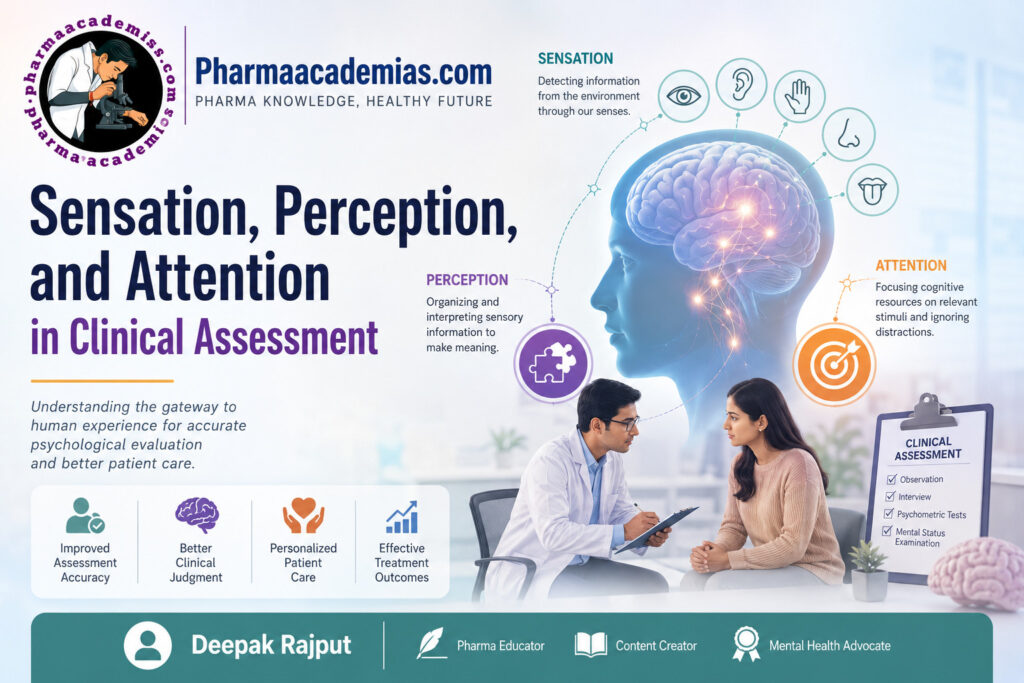
Sensation perception and attention are important psychological processes that help individuals receive, interpret, and respond to information from the environment. These processes are essential for normal functioning of the human body and mind. In healthcare and clinical practice, understanding sensation, perception, and attention helps healthcare professionals assess a patient’s mental status, neurological condition, emotional state, and cognitive functioning.
Abnormalities in these processes may indicate psychological disorders, neurological diseases, brain injuries, intoxication, or psychiatric conditions. Therefore, they are important components of clinical assessment in medicine, nursing, pharmacy, psychiatry, and psychology.
Sensation Perception and Attention
1. Sensation
Sensation is the process by which sensory organs receive stimuli from the environment and transmit them to the brain through sensory nerves.
It is the first step in gaining information about the surroundings.
In simple words:
Sensation is the detection of physical stimuli such as light, sound, smell, taste, touch, pain, and temperature.
Sensory Receptors
Sensory receptors are specialized cells that detect stimuli.
Types of Sensory Receptors
| Receptor Type | Function |
| Photoreceptors | Detect light |
| Mechanoreceptors | Detect pressure and sound |
| Thermoreceptors | Detect temperature |
| Chemoreceptors | Detect taste and smell |
| Nociceptors | Detect pain |
Process of Sensation
The process of sensation involves:
- Stimulus occurs
- Sensory receptor detects the stimulus
- Conversion into nerve impulse
- Transmission to brain
- Brain receives sensory information
Example:
When a patient touches a hot object, thermoreceptors detect heat and send signals to the brain.
Characteristics of Sensation
- It is the basic process of awareness.
- It depends on functioning sensory organs.
- It provides raw information to the brain.
- It occurs before perception.
Clinical Importance of Sensation
Assessment of sensation is important in healthcare because sensory abnormalities may indicate neurological or psychological disorders.
Clinical Relevance
Healthcare professionals assess:
- Pain sensation
- Touch sensation
- Temperature sensation
- Vision and hearing
- Smell and taste abnormalities
Disorders of Sensation
1. Anesthesia: Complete loss of sensation.
2. Paresthesia: Abnormal sensation such as tingling or numbness.
3. Hyperesthesia: Increased sensitivity to stimuli.
4. Hypoesthesia: Reduced sensitivity to stimuli.
Importance in Clinical Assessment
Sensory assessment helps diagnose:
- Nerve damage
- Stroke
- Diabetes-related neuropathy
- Brain injury
- Spinal cord disorders
For example: A diabetic patient may experience numbness due to peripheral neuropathy.
2. Perception
Perception is the process of organizing, interpreting, and giving meaning to sensory information.
While sensation only detects stimuli, perception helps individuals understand what those stimuli mean.
Perception is the interpretation of sensory experiences.
Example:
The eyes may sense light and shape, but perception allows a person to recognize a familiar face.
Process of Perception
The process includes:
- Receiving sensory input
- Organizing information
- Interpreting meaning
- Responding appropriately
Factors Affecting Perception
Several factors influence perception:
1. Past Experience: Previous experiences affect interpretation.
2. Motivation and Needs: Hungry individuals may perceive food-related stimuli more easily.
3. Emotions: Fear and anxiety may distort perception.
4. Attention: Focused attention improves perception.
5. Culture and Beliefs: Cultural background influences interpretation.
Types of Perception
1. Visual Perception: Interpretation of visual stimuli.
2. Auditory Perception: Interpretation of sounds.
3. Tactile Perception: Interpretation of touch sensations.
4. Spatial Perception: Understanding distance and space.
Perceptual Disorders
Abnormal perception is often seen in psychiatric and neurological disorders.
1. Illusion: An illusion is the misinterpretation of a real external stimulus.
Example:
Mistaking a rope for a snake in dim light.
Illusions commonly occur during:
- Fatigue
- Anxiety
- Fear
- Poor lighting
2. Hallucination: A hallucination is a false perception occurring without any external stimulus.
Types include:
- Auditory hallucinations
- Visual hallucinations
- Olfactory hallucinations
- Tactile hallucinations
Hallucinations are commonly seen in:
- Schizophrenia
- Drug intoxication
- Severe mental illness
3. Delusion: A delusion is a false fixed belief not based on reality.
Example:
A patient believes others are trying to harm them.
Importance of Perception in Clinical Assessment
Assessment of perception helps healthcare professionals identify:
- Psychiatric disorders
- Cognitive impairment
- Brain dysfunction
- Drug-induced psychosis
- Delirium
Clinical Relevance
In Psychiatry: Perceptual disturbances help diagnose schizophrenia and psychosis.
In Neurology: Visual perception problems may indicate brain injury or stroke.
In Elderly Patients: Perceptual changes may occur in dementia and delirium.
In Drug Abuse: Hallucinations may occur with alcohol or substance intoxication.
3. Attention
Attention is the process of concentrating mental activity on a particular stimulus while ignoring other stimuli.
It allows individuals to focus selectively on important information.
Attention is the ability to focus consciousness on a specific object or activity.
Characteristics of Attention
- Selective in nature
- Limited in capacity
- Essential for learning and memory
- Influenced by interest and motivation
Types of Attention
1. Voluntary Attention: Attention given intentionally.
Example: A student concentrating during a lecture.
2. Involuntary Attention: Attention automatically drawn by strong stimuli.
Example: Turning toward a loud sound.
3. Sustained Attention: Ability to maintain focus over time.
Example: Monitoring patients during surgery.
4. Divided Attention: Focusing on more than one activity at the same time.
Example: A nurse listening to a patient while recording notes.
Factors Affecting Attention
Attention is influenced by:
- Interest
- Fatigue
- Emotional state
- Motivation
- Stress
- Physical illness
- Drugs and alcohol
Attention Disorders
1. Distractibility: Difficulty maintaining focus.
2. Attention Deficit: Reduced ability to concentrate.
3. Hypervigilance: Excessive alertness.
4. Inattention: Failure to respond appropriately to stimuli.
Clinical Importance of Attention
Assessment of attention is essential in evaluating mental and neurological functioning.
Clinical Relevance
1. Mental Status Examination: Attention is assessed during psychiatric evaluation.
2. Dementia Assessment: Poor attention may indicate cognitive decline.
3. Delirium: Patients with delirium show impaired attention.
4. ADHD: Attention deficits are major symptoms in Attention Deficit Hyperactivity Disorder.
5. Brain Injury: Reduced attention may occur after trauma or stroke.
Methods of Assessing Attention
Healthcare professionals assess attention using:
- Serial subtraction tests
- Digit span tests
- Observation during conversation
- Memory and concentration tasks
Example: A patient may be asked to count backward from 100 by 7s.
Relationship Between Sensation, Perception, and Attention
These three processes are interconnected.
Sensation: Receives information from the environment.
Attention: Selects important information.
Perception: Interprets and gives meaning to information.
Example: A patient hears a sound (sensation), focuses on it (attention), and recognizes it as a doctor’s voice (perception).
Role in Clinical Assessment
Sensation, perception, and attention are important components of clinical and psychological evaluation.
Healthcare professionals assess these functions to:
- Identify neurological disorders
- Detect psychiatric illnesses
- Evaluate cognitive impairment
- Assess consciousness and mental status
- Monitor effects of drugs or toxins
Abnormal findings may indicate:
- Brain injury
- Stroke
- Dementia
- Psychosis
- Delirium
- Anxiety disorders
Importance for B.Pharm Students
For B.Pharm students, understanding these psychological processes is important because:
- Many drugs affect sensation, perception, and attention.
- CNS drugs may alter consciousness and cognition.
- Pharmacists counsel patients with neurological and psychiatric disorders.
- Drug side effects may include hallucinations, drowsiness, or impaired attention.
Knowledge of these concepts helps pharmacists monitor adverse effects and improve patient care.
Conclusion
Sensation, perception, and attention are fundamental psychological processes that play a major role in human behavior and clinical functioning. Sensation helps detect stimuli, perception interprets sensory information, and attention allows selective focus on important stimuli.
In clinical assessment, evaluation of these processes is essential for diagnosing neurological, psychiatric, and cognitive disorders. Abnormalities in sensation, perception, or attention may indicate serious health problems such as psychosis, dementia, stroke, or brain injury.
For healthcare professionals and B.Pharm students, understanding these concepts improves patient assessment, communication, diagnosis, and therapeutic care.
Editorial Note
This article has been carefully researched and written by Deepak Rajput with a focus on accuracy, clarity, and evidence-based healthcare information. Pharmaacademias.com