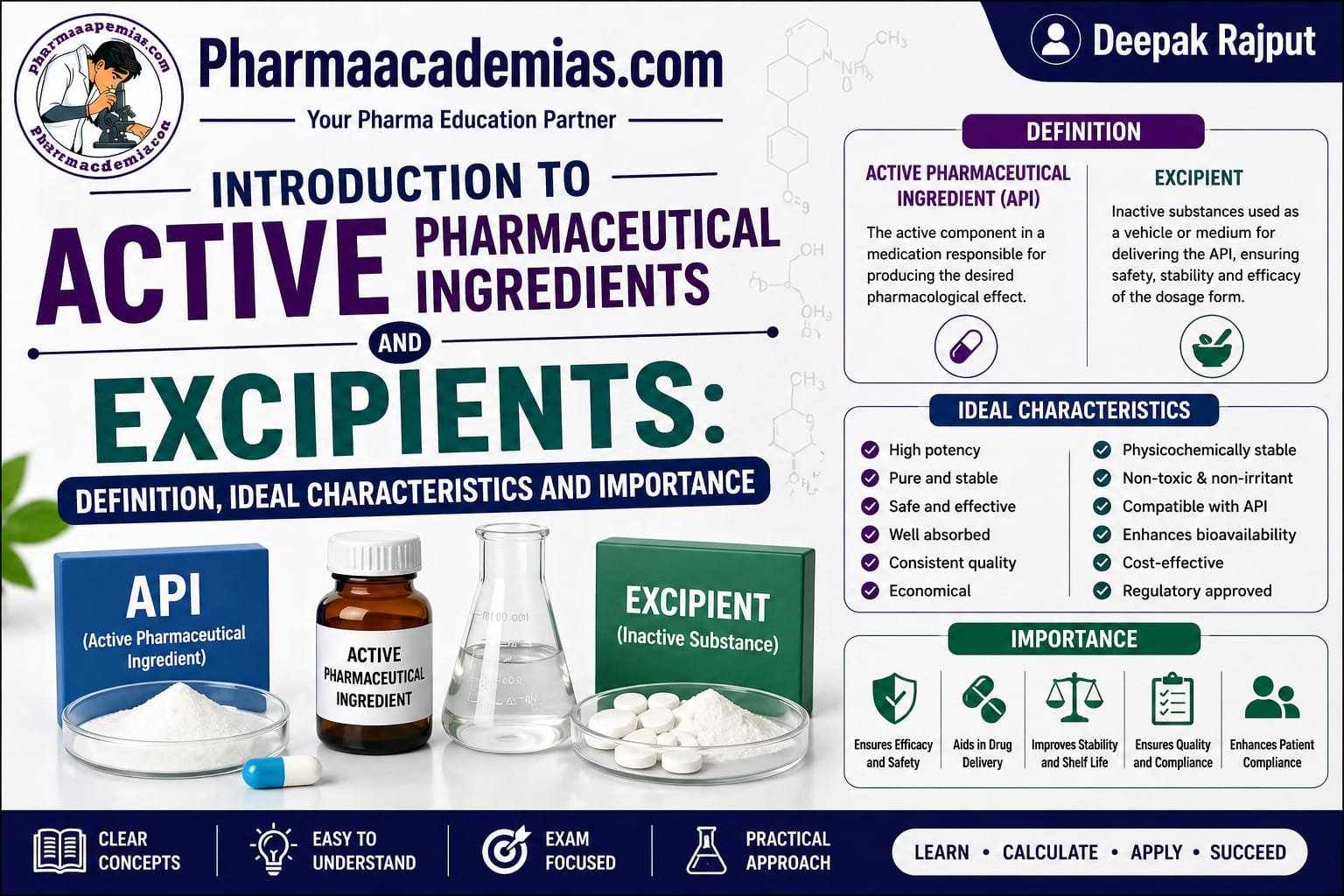
What are Excipients: Excipients are pharmacologically inactive substances that are formulated along with the active pharmaceutical ingredient (API) in a dosage form. Although excipients do not produce therapeutic effects directly, they play a vital role in the formulation, manufacturing, stability, appearance, bioavailability, and patient acceptability of pharmaceutical products.
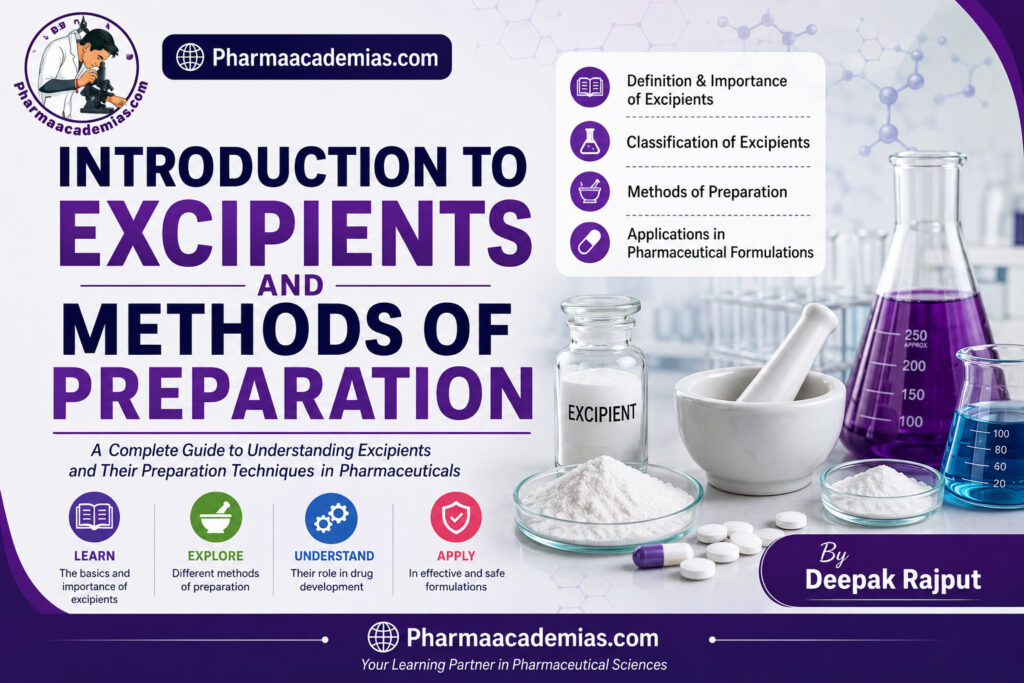
In modern pharmaceutics, excipients are considered essential components of drug formulations because very few drugs can be administered alone in pure chemical form. Active drugs often possess poor flow properties, unpleasant taste, instability, low compressibility, or poor dissolution characteristics. Excipients help overcome these limitations and ensure that the dosage form performs effectively and safely.
Excipients are used in almost all pharmaceutical dosage forms including tablets, capsules, powders, suspensions, emulsions, ointments, injections, and controlled-release systems. They may function as fillers, binders, lubricants, preservatives, sweeteners, colorants, stabilizers, coating agents, and disintegrants.
The selection of suitable excipients is one of the most important steps in pharmaceutical formulation because inappropriate excipients may affect drug stability, bioavailability, and therapeutic efficacy.
Definition of Excipients
Excipients are inert substances included in pharmaceutical formulations along with the active drug to aid manufacturing, protect the drug, improve stability, enhance patient acceptability, and facilitate administration.
They are also known as:
- Pharmaceutical additives
- Inactive ingredients
- Pharmaceutical aids
Importance of Excipients in Pharmaceutical Formulation
Excipients perform several essential functions in dosage forms.
1. Improve Drug Stability: Certain drugs are unstable in the presence of moisture, oxygen, or light. Excipients help protect the drug from degradation.
2. Enhance Patient Acceptability: Flavoring agents, sweeteners, and colorants improve the taste and appearance of medicines.
3. Aid Manufacturing Process: Excipients improve powder flow, compressibility, lubrication, and handling during manufacturing.
4. Improve Bioavailability: Some excipients enhance dissolution and absorption of drugs.
5. Control Drug Release: Special excipients are used in sustained-release and controlled-release formulations.
6. Increase Bulk Volume: Potent drugs are often present in very small amounts; fillers increase dosage form size for accurate handling.
Characteristics of an Ideal Excipient
An ideal pharmaceutical excipient should possess the following properties:
- Non-toxic
- Pharmacologically inert
- Chemically stable
- Compatible with the drug
- Economical
- Easily available
- Non-irritating
- Free from microbial contamination
- Physically stable
- Acceptable in taste and odor
Classification of Excipients
Excipients are classified according to their functions in pharmaceutical formulations.
1. Diluents or Fillers
These substances increase the bulk of formulations containing small quantities of active drug.
Examples
- Lactose
- Microcrystalline cellulose
- Starch
- Dicalcium phosphate
Functions
- Increase tablet size
- Improve compressibility
- Facilitate handling
2. Binders or Adhesives
Binders hold powder particles together and improve granule formation.
Examples
- Starch paste
- Gelatin
- Polyvinylpyrrolidone (PVP)
- Acacia
Functions
- Promote cohesion
- Improve tablet hardness
3. Disintegrants
Disintegrants help tablets break apart after administration.
Examples
- Sodium starch glycolate
- Cross-linked PVP
- Starch
Functions
- Enhance drug release
- Improve dissolution
4. Lubricants
Lubricants reduce friction during tablet compression.
Examples
- Magnesium stearate
- Talc
- Stearic acid
Functions
- Prevent sticking
- Improve powder flow
5. Glidants
Glidants improve flow properties of powders.
Examples
- Colloidal silicon dioxide
- Talc
6. Preservatives
Prevent microbial growth in formulations.
Examples
- Methyl paraben
- Propyl paraben
- Benzalkonium chloride
7. Sweetening Agents
Improve taste and palatability.
Examples
- Sucrose
- Aspartame
- Saccharin sodium
8. Flavoring Agents
Mask unpleasant drug taste.
Examples
- Peppermint oil
- Orange flavor
- Vanilla
9. Coloring Agents
Provide attractive appearance and product identification.
Examples
- Tartrazine
- Iron oxide colors
10. Coating Agents
Used to coat tablets and capsules.
Examples
- Hydroxypropyl methylcellulose (HPMC)
- Shellac
11. Surfactants and Wetting Agents
Improve wetting and dissolution.
Examples
- Sodium lauryl sulfate
- Polysorbates
Sources of Excipients
Excipients may originate from natural, semi-synthetic, or synthetic sources.
1. Natural Excipients
Obtained from plants, animals, or minerals.
Examples
- Starch
- Gelatin
- Acacia
- Alginate
2. Semi-Synthetic Excipients
Prepared by chemical modification of natural substances.
Examples
- Sodium carboxymethyl cellulose
- HPMC
3. Synthetic Excipients
Prepared entirely by chemical synthesis.
Examples
- PVP
- Polyethylene glycol
- Polysorbates
Methods of Preparation of Excipients
The preparation method depends on the type and source of excipient. Various physical, chemical, and mechanical processes are used.
1. Extraction Method
Natural excipients are commonly prepared by extraction from plant or animal sources.
Process
- Raw material collection
- Cleaning and drying
- Solvent extraction
- Filtration
- Concentration
- Drying and pulverization
Examples
- Acacia
- Pectin
- Gelatin
2. Chemical Synthesis Method
Synthetic excipients are prepared through chemical reactions under controlled conditions.
Steps
- Selection of raw chemicals
- Chemical reaction
- Purification
- Crystallization
- Drying
Examples
- Polyethylene glycol
- PVP
3. Fermentation Method
Some excipients are produced by microbial fermentation.
Process
- Preparation of culture medium
- Microbial inoculation
- Fermentation
- Product recovery
- Purification
Examples
- Xanthan gum
- Dextran
4. Polymerization Method
Polymeric excipients are prepared by polymerization reactions.
Process
- Monomer selection
- Initiation of polymerization
- Chain propagation
- Polymer formation
- Drying and purification
Examples
- Polyvinylpyrrolidone
- Acrylic polymers
5. Milling and Pulverization
Used to obtain suitable particle size for excipients.
Objectives
- Improve flow properties
- Enhance mixing
- Increase surface area
Equipment Used
- Ball mill
- Hammer mill
- Fluid energy mill
6. Granulation Method
Granulation improves compressibility and flow properties.
Types
A. Wet Granulation
Uses binding solution to form granules.
B. Dry Granulation
Uses pressure without liquid.
7. Spray Drying
A liquid feed is converted into dry powder by spraying into hot air.
Advantages
- Uniform particle size
- Rapid drying
- Improved flowability
Examples
- Lactose powders
- Flavoring agents
8. Crystallization
Used to purify excipients and obtain uniform crystals.
Steps
- Dissolution
- Cooling or evaporation
- Crystal formation
- Filtration
- Drying
Evaluation of Excipients
Excipients are evaluated for quality and compatibility.
1. Particle Size: Affects flow and compressibility.
2. Moisture Content: Excess moisture may reduce stability.
3. Flow Properties: Determines ease of manufacturing.
4. Compatibility Studies: Ensures no interaction with active drug.
5. Microbial Limit Test: Checks microbial contamination.
Applications of Excipients
Excipients are used in:
- Tablets
- Capsules
- Powders
- Syrups
- Suspensions
- Ointments
- Injectable preparations
- Controlled-release systems
Advantages of Excipients
1. Improve Stability: Protect drugs from degradation.
2. Enhance Drug Release: Improve dissolution and absorption.
3. Improve Product Appearance: Provide color, gloss, and elegance.
4. Facilitate Manufacturing: Improve compressibility and handling.
5. Improve Patient Compliance: Enhance taste and ease of administration.
Disadvantages of Excipients
1. Possibility of Drug Interaction: Some excipients may interact chemically with drugs.
2. Allergic Reactions: Certain excipients may cause hypersensitivity.
3. Increased Formulation Cost: Specialized excipients may be expensive.
4. Stability Problems: Improper excipient selection may reduce product stability.
Conclusion
Excipients are indispensable components of pharmaceutical formulations that perform numerous functions including improving stability, enhancing patient acceptability, aiding manufacturing, and controlling drug release. Although pharmacologically inactive, they significantly influence the quality, effectiveness, safety, and performance of dosage forms.
Excipients are classified according to their functions such as diluents, binders, lubricants, preservatives, sweeteners, and disintegrants. They may be obtained from natural, semi-synthetic, or synthetic sources and prepared by methods such as extraction, synthesis, fermentation, polymerization, crystallization, granulation, and spray drying.
Proper selection and preparation of excipients are essential in pharmaceutical development because they ensure stability, compatibility, manufacturability, and therapeutic efficiency of pharmaceutical products. Thus, excipients remain fundamental to modern pharmaceutics and drug delivery systems.
Editorial Note
This article has been carefully researched and written by Deepak Rajput with a focus on accuracy, clarity, and evidence-based healthcare information. Pharmaacademias.com