
Efflorescent powders are pharmaceutical powders that contain substances capable of losing water of crystallization when exposed to air or dry environmental conditions. This phenomenon is known as efflorescence. In pharmaceutical science, efflorescence is an important consideration during the preparation, storage, and dispensing of powders because the release of water can affect the stability, appearance, flow properties, and therapeutic effectiveness of the formulation.
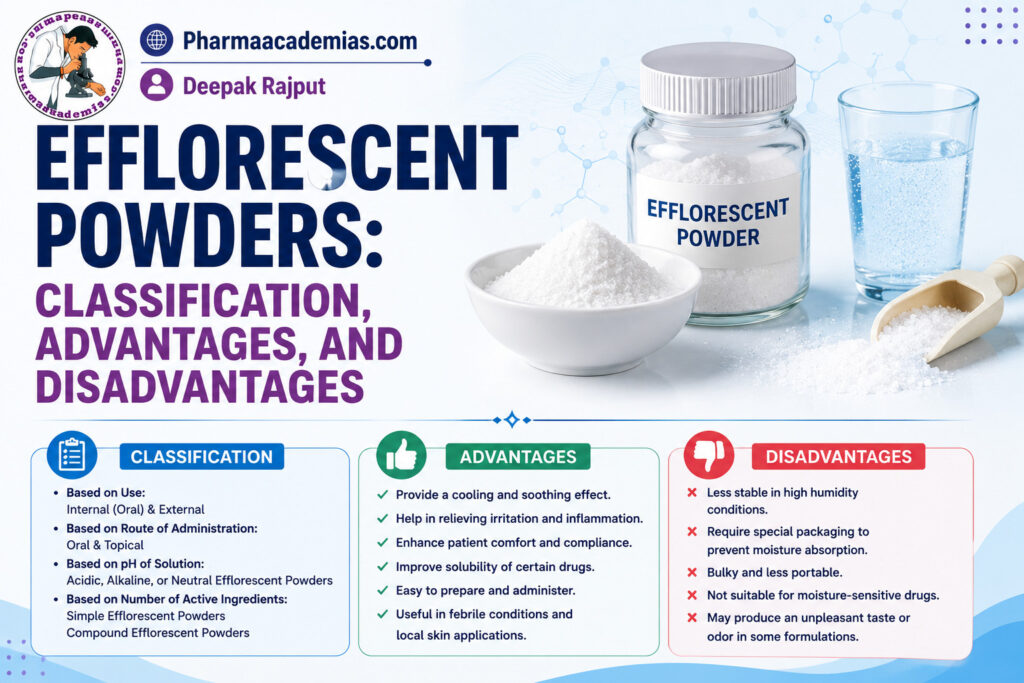
Certain crystalline substances naturally contain water molecules incorporated within their crystal structure. When these substances are exposed to air, especially in low humidity conditions, they may release part or all of this water. The liberated moisture may cause powders to become damp, sticky, or partially liquefied, thereby affecting their quality and handling properties.
Efflorescent powders require special precautions during formulation and packaging to prevent deterioration. Pharmacists often mix them with absorbent materials or use suitable packaging methods to maintain stability and free-flowing characteristics.
Definition of Efflorescent powders
Efflorescent powders are powders containing crystalline substances that lose water of crystallization upon exposure to air, resulting in partial or complete dehydration of the substance.
The process by which these substances lose water is called efflorescence.
Concept of Water of Crystallization
Many crystalline pharmaceutical substances contain a definite quantity of water molecules within their crystal lattice. These water molecules are known as water of crystallization.
When exposed to air:
- The water may evaporate
- The crystal structure changes
- The powder may become soft, damp, or unstable
This loss of water is responsible for efflorescence.
Mechanism of Efflorescent powders
Efflorescence occurs when the vapor pressure of the water present within the crystal is greater than the partial pressure of water vapor in the surrounding atmosphere.
As a result:
- Water escapes from the crystal lattice
- The substance becomes dehydrated
- Moisture appears on the powder surface
- Powder properties change
The released water may dissolve part of the powder, producing a sticky or pasty mass.
Examples of Efflorescent Substances
Several pharmaceutical substances exhibit efflorescence.
| Substance | Water of Crystallization |
| Sodium carbonate | Contains crystalline water |
| Ferrous sulfate | Hydrated salt |
| Magnesium sulfate | Hydrated crystals |
| Zinc sulfate | Crystalline hydrate |
| Alum | Contains water molecules |
| Citric acid monohydrate | May lose water on exposure |
Characteristics of Efflorescent Powders
Efflorescent powders possess several distinguishing characteristics.
1. Presence of Water of Crystallization: These powders contain chemically bound water within their crystalline structure.
2. Loss of Water on Exposure to Air: The substances lose water when kept in dry atmospheric conditions.
3. Change in Physical Appearance
Efflorescence may lead to:
- Powder softening
- Dampness
- Caking
- Change in texture
4. Reduced Stability: Loss of crystalline water may alter physical and chemical stability.
5. Difficulty in Handling: The released moisture can interfere with mixing and packaging operations.
Causes of Efflorescence
Several factors promote efflorescence in pharmaceutical powders.
1. Low Atmospheric Humidity: Dry air encourages the escape of water from hydrated crystals.
2. High Temperature: Increased temperature accelerates evaporation of water molecules.
3. Improper Storage: Exposure to open air and poor packaging can increase efflorescence.
4. Large Surface Area: Finely powdered substances lose water more rapidly because of increased surface exposure
Effects of Efflorescence on Pharmaceutical Powders
Efflorescence can significantly affect the quality and effectiveness of powders.
1. Powder Becomes Damp: The released water may moisten the powder mixture.
2. Caking and Agglomeration: Moisture causes powder particles to stick together and form lumps.
3. Difficulty in Dispensing: Sticky powders are difficult to handle, weigh, and package accurately.
4. Alteration in Drug Stability:Loss of water may change the chemical stability of certain drugs.
5. Inaccurate Dosage: Changes in physical properties may affect dose uniformity.
6. Reduced Elegance:The appearance and texture of the powder become less acceptable
Advantages of Efflorescent Powders
Although efflorescence is generally considered undesirable, these powders may still possess some advantages.
1. Ease of Dissolution: Hydrated crystals often dissolve rapidly in water.
2. Better Compressibility: Some hydrated substances possess good compression properties.
3. Improved Stability in Crystalline Form: Certain substances remain more stable in hydrated crystalline state before exposure
Disadvantages of Efflorescent Powders
Efflorescent powders have several disadvantages that create formulation challenges.
1. Moisture Release: Loss of water affects physical stability.
2. Caking and Stickiness:The powder may become damp and difficult to handle.
3. Poor Appearance: Efflorescence reduces the elegance of the preparation.
4. Difficult Storage Conditions:Special packaging and storage are required.
5. Reduced Shelf Life: Improper storage may shorten product stability.
6. Incompatibility Problems: Released moisture may react with other ingredients
Pharmaceutical Importance of Efflorescence
Understanding efflorescence is essential in pharmaceutics because it influences:
- Powder formulation
- Packaging design
- Storage conditions
- Stability studies
- Drug compatibility
Pharmacists must carefully evaluate efflorescent properties during compounding and industrial manufacturing.
Difference Between Efflorescent and Hygroscopic Powders
| Feature | Efflorescent Powders | Hygroscopic Powders |
| Moisture Behavior | Lose water | Absorb water |
| Source of Water | Water of crystallization | Atmospheric moisture |
| Result | Become dry or damp due to released water | Become moist by absorbing humidity |
| Example | Sodium carbonate | Calcium chloride |
Difference Between Efflorescent and Deliquescent Powders
| Feature | Efflorescent Powders | Deliquescent Powders |
| Water Movement | Lose water | Absorb large amount of water |
| Physical Change | Become powdery or damp | Liquefy completely |
| Cause | Loss of crystal water | Absorption of atmospheric moisture |
Applications of Efflorescent Powders
Efflorescent substances are used in:
- Pharmaceutical formulations
- Analytical chemistry
- Chemical preparations
- Industrial pharmaceutical manufacturing
Precautions During Dispensing
Pharmacists should:
- Use absorbent diluents
- Avoid prolonged air exposure
- Package immediately
- Label properly for storage
Conclusion
Efflorescent powders are pharmaceutical preparations containing substances that lose water of crystallization when exposed to air. This process, known as efflorescence, can significantly affect the physical stability, appearance, flow properties, and handling characteristics of powders. Common efflorescent substances include sodium carbonate, magnesium sulfate, ferrous sulfate, and other hydrated salts.
Efflorescence may lead to dampness, caking, stickiness, and reduced product elegance, making proper formulation and packaging essential. Pharmaceutical scientists use various preventive measures such as absorbent materials, airtight containers, anhydrous forms, and controlled storage conditions to minimize these problems.
Understanding the behavior of efflorescent powders is extremely important in pharmaceutical compounding and industrial manufacturing because it ensures the stability, effectiveness, and quality of pharmaceutical preparations.
Editorial Note
This article has been carefully researched and written by Deepak Rajput with a focus on accuracy, clarity, and evidence-based healthcare information. Pharmaacademias.com