Posology is a vital branch of pharmacology that deals with the determination of appropriate drug dosage required to produce the desired therapeutic effect without causing toxicity. The concept is central to clinical practice because the same drug cannot be administered in identical doses to all individuals. Variability in physiological and pathological conditions necessitates careful dose individualization.
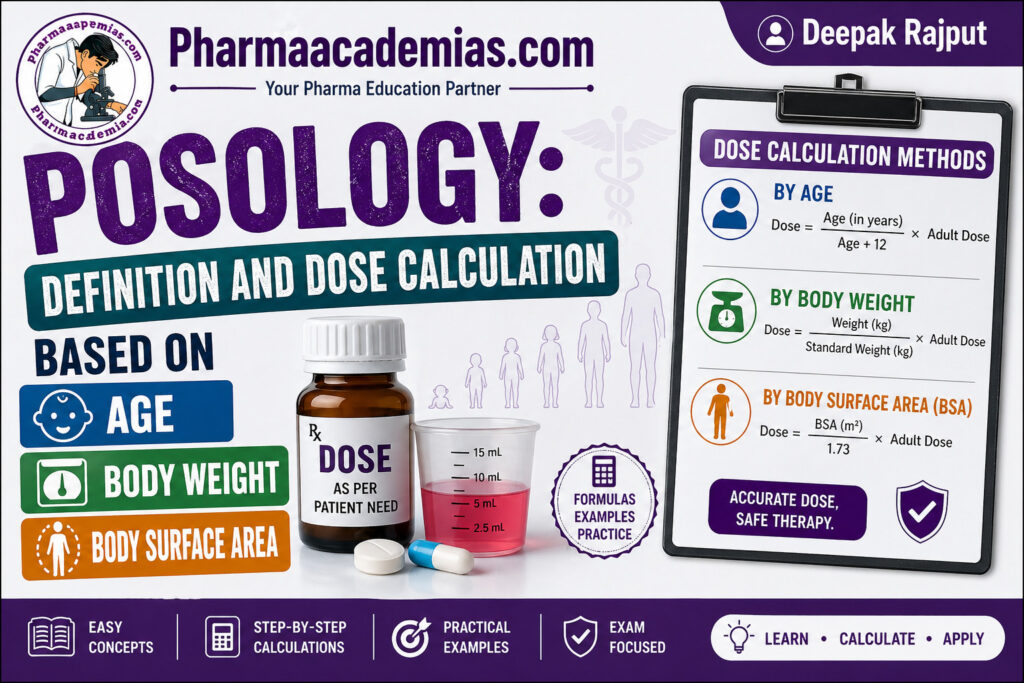
In pharmaceutical sciences, accurate dose calculation is particularly important in pediatrics, geriatrics, oncology, and critical care, where even slight deviations may lead to therapeutic failure or adverse drug reactions. Among the various methods available, dose calculation based on age, body weight, and body surface area (BSA) are the most commonly used and widely accepted approaches.
Definition and Scope of Posology
Posology can be defined as the science concerned with:
- the study of drug dosage,
- the frequency and timing of administration,
- and the various factors that influence dose selection.
It integrates principles from pharmacokinetics and pharmacodynamics to ensure that the administered drug reaches an optimal concentration at the site of action.
The determination of dose is influenced not only by measurable parameters like age and weight but also by factors such as genetic variability, organ function (especially liver and kidney), route of administration, and disease conditions. However, for standardized calculations, age, body weight, and BSA remain the most practical and widely used criteria.
Dose Calculation Based on Age
Age-based dosing is one of the earliest and simplest methods used in clinical practice. It is particularly useful when body weight or other patient-specific data are not available. However, it is important to understand that age alone does not fully reflect physiological maturity, especially in children.
In pediatric patients, organ systems such as the liver and kidneys are not fully developed, which affects drug metabolism and excretion. Therefore, age-based formulas provide only an approximate estimation of dose.
Several empirical formulas are used:
Young’s Formula

This formula is generally applied to children between 1 and 12 years of age. It assumes a gradual increase in metabolic capacity with age.
Dilling’s Formula

Dilling’s formula is simpler but less precise, as it assumes a linear relationship between age and dose.
Fried’s Formula (for infants)

This formula is specifically designed for infants under one year of age, where dosing requires extra caution due to immature physiological systems.
Despite their simplicity, these formulas have limitations because they do not account for individual variations in body composition, enzyme activity, and organ function. Hence, they are gradually being replaced by more accurate methods.
Dose Calculation Based on Body Weight
Body weight-based dosing is one of the most widely accepted methods in modern pharmacotherapy. It provides a more individualized approach compared to age-based calculations because it directly correlates with body mass, which influences drug distribution and elimination.
The general formula used is:
Dose = mg/kg \times Body\ Weight\ (kg)
This method is especially useful in pediatric and hospital settings, where precise dosing is critical.
For example, if a drug is prescribed at 10 mg/kg for a child weighing 20 kg, the calculated dose would be 200 mg. This method ensures that the administered dose is proportional to the patient’s body size.
However, certain precautions must be considered. In obese patients, dosing based on total body weight may lead to overdosing, while in underweight patients, it may result in subtherapeutic dosing. In such cases, adjustments using ideal body weight or adjusted body weight may be necessary.
Weight-based dosing is commonly used for:
- antibiotics,
- analgesics and antipyretics,
- anticancer drugs,
- and emergency medications.
Dose Calculation Based on Body Surface Area (BSA)
Body surface area is considered the most accurate method for dose calculation, particularly for drugs with a narrow therapeutic index, such as anticancer agents. Unlike body weight, BSA better reflects physiological parameters like metabolic rate, blood volume, and organ function.
The most commonly used formula for calculating BSA is:
Mosteller Formula
Once BSA is calculated, the pediatric dose can be determined using:

Here, 1.73 m² represents the average adult body surface area.
For instance, if a child has a BSA of 0.86 m² and the adult dose is 500 mg, the calculated dose would be approximately 248 mg. This method provides a more precise estimate because it accounts for both height and weight, thereby reflecting overall body physiology.
BSA-based dosing is particularly important in:
- oncology (chemotherapy dosing),
- pediatric critical care,
- and drugs requiring precise therapeutic monitoring.
Comparative Understanding
Each method of dose calculation has its own advantages and limitations. Age-based methods are simple but less accurate, weight-based methods offer better individualization, and BSA-based methods provide the highest precision.
A balanced understanding of these approaches allows healthcare professionals to select the most appropriate method based on clinical context.
Clinical Importance of Posology
The importance of posology extends beyond simple calculations. It plays a crucial role in ensuring:
- optimal therapeutic outcomes,
- prevention of adverse drug reactions,
- and rational use of medicines.
Incorrect dosing can lead to serious consequences, including toxicity, drug resistance (in case of antibiotics), or complete therapeutic failure. Therefore, posology is not merely a mathematical exercise but a critical component of patient safety and evidence-based medicine.
Conclusion
Posology serves as the scientific foundation for determining appropriate drug dosage in clinical practice. While age-based methods provide a quick estimate, weight-based calculations offer better accuracy, and body surface area-based dosing remains the gold standard for precise therapy, especially in critical conditions. A thorough understanding of these methods is essential for pharmacists and healthcare professionals to ensure safe, effective, and individualized drug therapy.
Editorial Note
This article has been carefully researched and written by Deepak Rajput with a focus on accuracy, clarity, and evidence-based healthcare information. Pharmaacademias.com