
In pharmaceutical sciences, monophasic liquids are defined as homogeneous liquid systems in which all components are uniformly distributed within a single phase. These liquids are distinguished by their consistent physicochemical properties, clarity, and stability, making them essential in both clinical therapeutics and pharmaceutical formulation development.
Unlike biphasic or multiphasic systems, such as emulsions or suspensions where multiple immiscible phases coexist, monophasic liquids maintain thermodynamic stability, ensuring that the active pharmaceutical ingredient (API) remains evenly distributed throughout the solution. This uniformity is critical because any inconsistency in drug concentration can lead to therapeutic failure or toxicity.
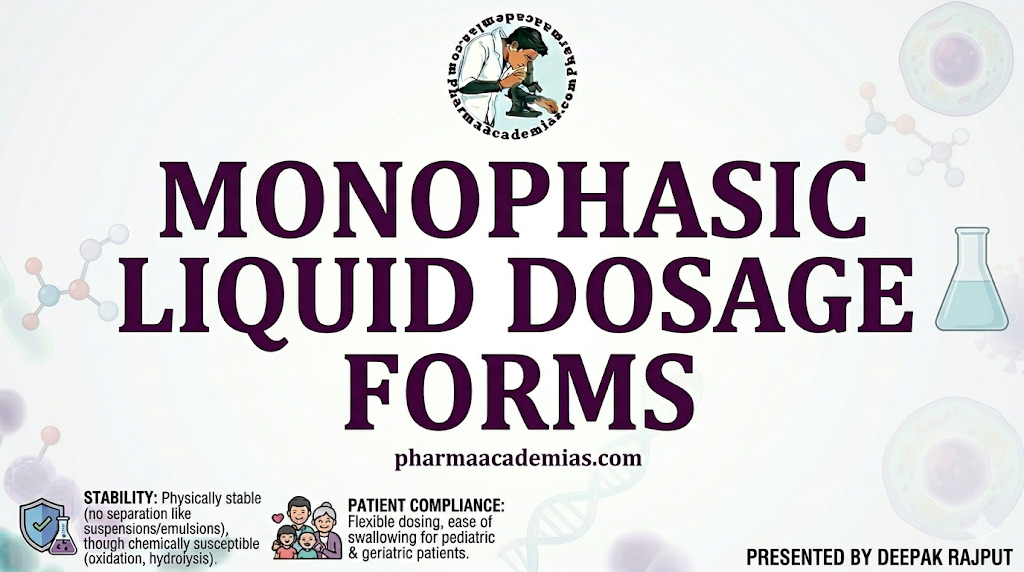
Pharmacy professionals, including formulation scientists and pharmacists, rely on monophasic liquids for accurate dosing, predictable bioavailability, and patient-friendly administration, especially in populations such as children, the elderly, or patients with swallowing difficulties.
Definition of Monophasic Liquids
A monophasic liquid is a pharmaceutical preparation in which all constituents, including active drugs, solvents, and excipients, exist in a single continuous phase, without any visible separation or sedimentation. In practical terms, this means that the liquid appears clear or uniformly colored and retains homogeneity over its shelf life. The absence of phase separation ensures that every administered dose contains the same amount of active ingredient, a crucial factor for both efficacy and safety.
Classification of Monophasic Liquids
Monophasic liquids can be categorized according to their composition, solvent system, or pharmaceutical function. The most commonly recognized types in pharmacy include simple solutions, hydroalcoholic preparations like elixirs and tinctures, and aromatic waters or spirits.
Simple solutions consist of a drug or chemical completely dissolved in a single solvent, typically water, producing a clear, homogeneous liquid. These are widely used in oral formulations, such as saline solutions, sugar syrups, and aqueous solutions of electrolytes, providing both therapeutic and supportive care.
Elixirs are hydroalcoholic solutions that often contain sweeteners, flavors, and one or more active drugs. These solutions are specifically designed to mask unpleasant tastes, improving patient compliance, while maintaining monophasic uniformity to ensure accurate dosing. An example is a dextromethorphan cough syrup, where the active component remains completely dissolved and evenly distributed.
Tinctures are alcoholic or hydroalcoholic solutions prepared from plant extracts or chemical substances. The monophasic nature of tinctures ensures that the drug content is consistent and reliable, facilitating both topical and oral applications. A common example is iodine tincture, where iodine is uniformly dissolved in alcohol for antiseptic use.
Spirits and aromatic waters are also monophasic liquids, typically used for flavoring, therapeutic, or preservative purposes. They differ mainly in alcohol content and the type of active or aromatic compounds dissolved. Despite these differences, the key characteristic remains a single, homogeneous phase.
Characteristics of Monophasic Liquids
Monophasic liquids are distinguished by several physicochemical and pharmaceutical characteristics. Homogeneity ensures that the liquid is consistent throughout, without any phase separation, sediment, or cloudiness. Clarity or uniform coloration is often indicative of proper solubilization, which is essential for both aesthetic appeal and drug stability.
Thermodynamic stability is another hallmark of monophasic liquids, making them suitable for long-term storage under specified conditions. In addition, these liquids provide predictable pharmacokinetics because the drug molecules are already in solution and readily available for absorption, which is particularly important for oral and parenteral administration.
Furthermore, monophasic liquids are generally easy to administer, requiring minimal preparation or manipulation by the patient. This feature is especially advantageous for populations with swallowing difficulties, pediatric patients, or those requiring accurate liquid dosing.
Preparation of Monophasic Liquids
The preparation of monophasic liquids in pharmacy involves ensuring that all solutes are completely dissolved in the solvent system and that the final solution remains homogeneous and stable. The simplest method is direct dissolution, where the active ingredient is dissolved under constant stirring to promote uniformity.
For drugs that are poorly soluble in water, co-solvents such as alcohol, glycerin, or propylene glycol are often employed. These co-solvents enhance solubility and allow for the preparation of a single-phase solution even with complex or multi-component drugs.
The pH of the medium may also be adjusted to favor the ionized or unionized form of the drug, enhancing solubility and ensuring monophasic behavior. In addition, filtration techniques are frequently applied to remove any undissolved particles, ensuring clarity and stability of the final product. Proper storage, protection from light, and temperature control are critical in preventing degradation or precipitation, which could compromise the monophasic nature of the solution.
Pharmaceutical Applications
Monophasic liquids have broad applications in pharmacy, spanning oral, topical, and parenteral dosage forms.
Orally administered monophasic liquids, such as syrups and elixirs, allow for accurate dosing and rapid absorption. These formulations are particularly advantageous for patients unable to swallow tablets or capsules, including children and elderly patients.
Topical monophasic solutions, including antiseptics and medicated waters, ensure uniform drug distribution, which is critical for achieving consistent therapeutic effects across the applied area.
Parenteral solutions, such as saline injections or vitamin infusions, must be monophasic to prevent precipitation, embolism, or tissue irritation, ensuring both safety and efficacy during administration.
In addition to therapeutic applications, monophasic liquids are used in analytical and laboratory settings as reference standards or calibration solutions. Their uniformity and stability make them ideal for dissolution testing, assay validation, and quality control studies.
Advantages and Limitations
Monophasic liquids offer numerous advantages in pharmaceutical practice. They allow for uniform dosage delivery, predictable pharmacokinetics, and rapid drug availability, while also being thermodynamically stable and aesthetically acceptable. These systems are generally easy to sterilize, package, and store, making them ideal for both clinical use and large-scale pharmaceutical manufacturing.
However, monophasic liquids are not without limitations. Some drugs are poorly soluble in a single solvent, necessitating the use of co-solvents, pH adjustments, or solubilizing agents. They are also generally unsuitable for sustained-release formulations, as the drug is already in solution and can be absorbed rapidly. Furthermore, exposure to light, heat, or oxygen can lead to degradation or discoloration, potentially affecting stability and efficacy.
Conclusion
Monophasic liquids are a cornerstone of pharmaceutical liquid dosage forms, combining simplicity, homogeneity, and stability. Their single-phase nature ensures accurate dosing, predictable drug delivery, and enhanced patient compliance, making them indispensable in oral, topical, and parenteral formulations. A thorough understanding of the preparation methods, physicochemical properties, and applications of monophasic liquids is essential for pharmacy students, formulation scientists, and practicing pharmacists alike.
Key Study Concepts
- Homogeneous single-phase liquid systems
- Solubility enhancement using co-solvents and pH adjustment
- Applications in oral, topical, and parenteral dosage forms
- Stability, clarity, and uniform drug distribution
References
- Allen, L.V., Popovich, N.G., Ansel, H.C. Ansel’s Pharmaceutical Dosage Forms and Drug Delivery Systems, 10th Edition, 2014.
- Lachman, L., Lieberman, H.A., Kanig, J.L. The Theory and Practice of Industrial Pharmacy, 3rd Edition, 1987.
- Beckett, A.H., Stenlake, J.B. Practical Pharmaceutical Chemistry, 5th Edition, CBS Publishers, 2002.
- Rowe, R.C., Sheskey, P.J., Quinn, M.E. Handbook of Pharmaceutical Excipients, 6th Edition, 2009.