General Principles of Cell Communication: Cell communication, also known as cell signaling, is a fundamental biological process through which cells detect, interpret, and respond to signals from their internal and external environments. In multicellular organisms, billions of cells must coordinate their activities to maintain growth, development, metabolism, immunity, tissue repair, and homeostasis. Without proper communication among cells, the body would lose the ability to function as a unified system. Cell communication ensures that cells can exchange information efficiently and adapt their behavior according to physiological needs and environmental changes.
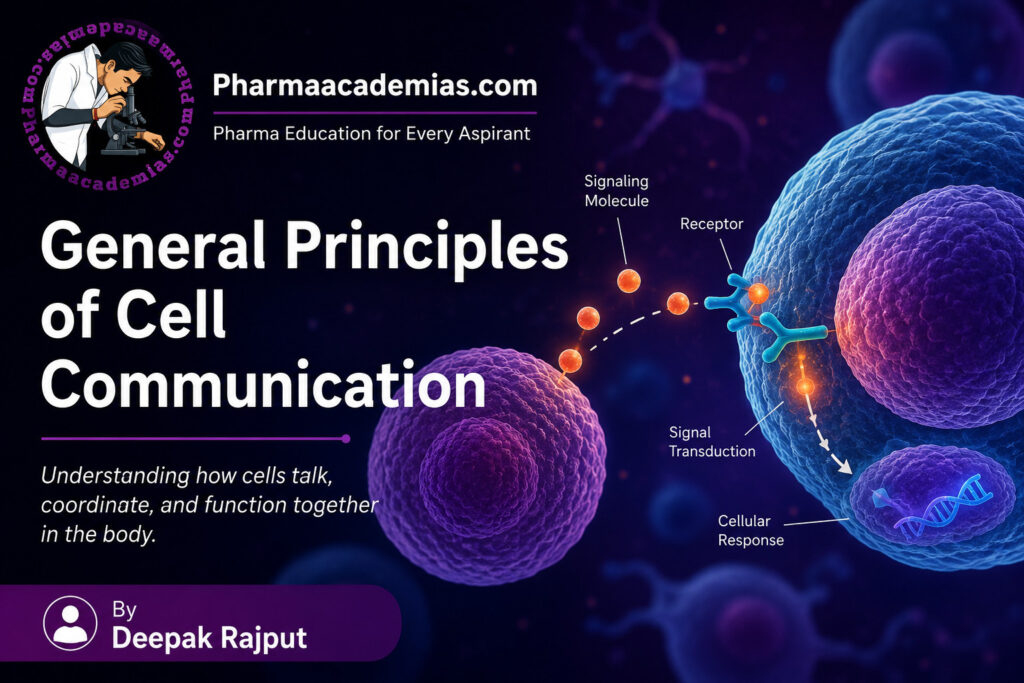
The process of cell communication involves the transmission of signals from one cell to another through specialized signaling molecules and receptor systems. These signaling events regulate numerous biological activities such as cell proliferation, differentiation, migration, apoptosis, neurotransmission, hormone secretion, immune responses, and embryonic development. Defects in cell communication pathways are associated with various diseases including cancer, diabetes, autoimmune disorders, cardiovascular diseases, and neurological disorders.
Introduction to Cell Communication
Every living cell continuously receives and processes information. This information may originate from neighboring cells, distant organs, microorganisms, or environmental stimuli such as temperature, light, pressure, or nutrients. Cells interpret these signals and generate appropriate responses that help maintain survival and normal physiological functioning.
Cell communication is especially important in multicellular organisms because different groups of cells perform specialized functions. For example, nerve cells transmit electrical impulses, endocrine cells secrete hormones, immune cells coordinate defense mechanisms, and muscle cells respond to neural stimulation. Despite these differences, all cells rely on communication systems that follow common principles.
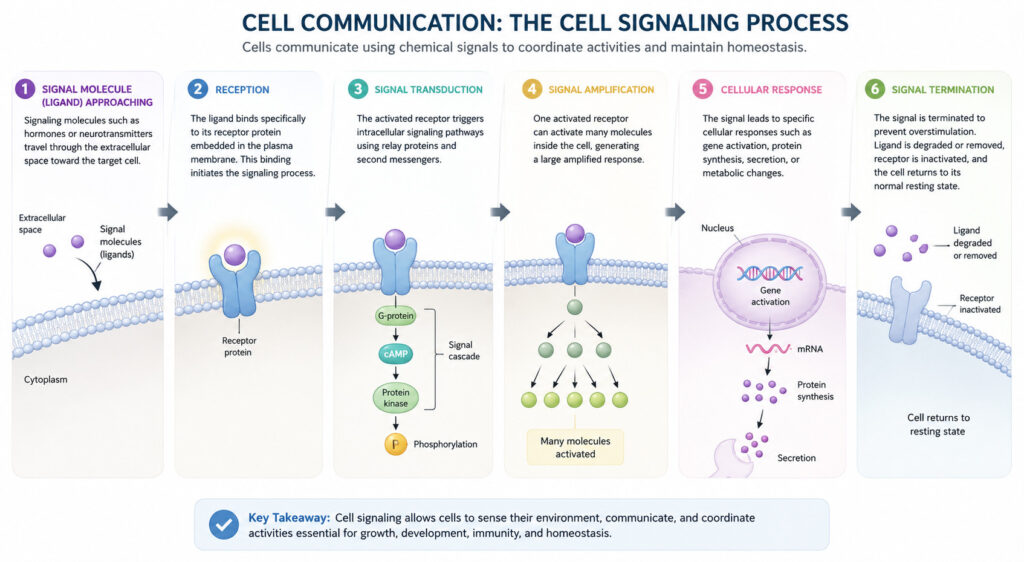
The general process of cell communication can be divided into three major stages:
- Signal Reception
- Signal Transduction
- Cellular Response
These stages together form a signaling pathway.
Components of Cell Communication
1. Signaling Molecules (Ligands)
Signaling molecules are chemical messengers released by cells to communicate with target cells. These molecules are often called ligands because they bind specifically to receptors on target cells.
Different types of signaling molecules include:
- Hormones
- Neurotransmitters
- Growth factors
- Cytokines
- Chemokines
- Lipid mediators
- Gases such as nitric oxide
- Peptides and proteins
The nature of the ligand determines the type and range of communication. Some ligands travel long distances through blood circulation, whereas others act only on nearby cells.
Characteristics of Signaling Molecules
- High specificity toward receptors
- Active at very low concentrations
- Capable of inducing precise cellular responses
- Rapid synthesis and degradation in many cases
- Regulated secretion mechanisms
2. Receptors
Receptors are specialized proteins that recognize and bind signaling molecules. Only cells possessing the appropriate receptor can respond to a specific signal. Therefore, receptor expression determines target cell specificity.
Receptors are broadly classified into:
A. Cell Surface Receptors
These receptors are located on the plasma membrane and bind hydrophilic molecules that cannot cross the lipid bilayer.
Examples include:
- G-protein coupled receptors (GPCRs)
- Receptor tyrosine kinases (RTKs)
- Ion channel receptors
- Cytokine receptors
B. Intracellular Receptors
These receptors are present in the cytoplasm or nucleus and bind lipid-soluble molecules that can diffuse through the membrane.
Examples include:
- Steroid hormone receptors
- Thyroid hormone receptors
- Vitamin D receptors
Receptor-ligand interaction initiates intracellular signaling cascades that alter cellular activity.
Stages of Cell Communication
1. Signal Reception
Signal reception is the first step in cell communication. During this stage, a signaling molecule binds to its specific receptor on or within the target cell.
The binding is highly selective and depends on:
- Molecular shape
- Charge interactions
- Chemical compatibility
This interaction causes conformational changes in the receptor, activating downstream signaling mechanisms.
Importance of Signal Reception
- Ensures specificity of response
- Prevents unnecessary cellular activation
- Allows cells to discriminate among multiple signals
For example, insulin affects muscle and liver cells because they possess insulin receptors, whereas red blood cells do not respond significantly due to lack of appropriate receptors.
2. Signal Transduction
Signal transduction refers to the conversion of an extracellular signal into intracellular biochemical events. After receptor activation, signaling pathways transmit and amplify the signal inside the cell.
This stage often involves:
- Protein phosphorylation
- Activation of enzymes
- Generation of second messengers
- Opening of ion channels
- Activation of transcription factors
Signal transduction pathways allow a small external signal to produce a large cellular response through amplification mechanisms.
Second Messengers
Second messengers are intracellular molecules that relay signals from receptors to target proteins.
Major second messengers include:
- Cyclic AMP (cAMP)
- Cyclic GMP (cGMP)
- Calcium ions (Ca²⁺)
- Inositol triphosphate (IP₃)
- Diacylglycerol (DAG)
Functions of Second Messengers
- Rapid signal amplification
- Activation of protein kinases
- Regulation of gene expression
- Modulation of ion transport
- Control of metabolic pathways
For example, activation of adenylate cyclase increases cAMP production, which activates protein kinase A and alters cellular metabolism.
3. Cellular Response
The final stage of cell communication is the cellular response. The activated signaling pathway ultimately changes cellular activity.
Possible cellular responses include:
- Altered gene expression
- Protein synthesis
- Enzyme activation or inhibition
- Cell division
- Cell differentiation
- Secretion
- Muscle contraction
- Apoptosis
Responses may occur rapidly or slowly depending on the signaling mechanism.
Rapid Responses
Examples:
- Opening ion channels
- Neurotransmitter release
- Muscle contraction
Slow Responses
Examples:
- Gene transcription
- Cell growth
- Differentiation
Types of Cell Communication
Cells communicate through several mechanisms depending on the distance between signaling and target cells.
1. Autocrine Signaling
In autocrine signaling, cells release signals that act on the same cell that produced them.
Characteristics
- Self-regulation mechanism
- Common in immune cells and cancer cells
- Important in cell growth and differentiation
Example
Activated T-lymphocytes secrete interleukin-2 (IL-2), which stimulates their own proliferation.
2. Paracrine Signaling
In paracrine signaling, signaling molecules act on nearby cells.
Characteristics
- Short-distance communication
- Rapid local responses
- Signal molecules are quickly degraded
Examples
- Neurotransmitters at synapses
- Histamine release during inflammation
- Growth factor signaling
3. Endocrine Signaling
Endocrine signaling involves hormones secreted into the bloodstream that travel long distances to target organs.
Characteristics
- Long-distance communication
- Slower onset but prolonged effects
- Highly regulated
Examples
- Insulin
- Thyroxine
- Cortisol
- Estrogen
4. Synaptic Signaling
Synaptic signaling occurs in the nervous system where neurons communicate with target cells through synapses.
Characteristics
- Very rapid communication
- Highly specific
- Electrical and chemical components
Process
- Electrical impulse travels along neuron
- Neurotransmitter released into synaptic cleft
- Neurotransmitter binds receptors on target cell
- Response generated
Examples
- Acetylcholine
- Dopamine
- Serotonin
- GABA
5. Juxtacrine Signaling (Contact-Dependent Signaling)
In juxtacrine signaling, cells communicate through direct physical contact.
Characteristics
- Requires membrane-bound molecules
- Important in embryonic development and immune responses
Examples
- Notch signaling pathway
- Immune cell interactions
Gap Junction Communication
Gap junctions are specialized intercellular channels connecting adjacent cells. They allow direct passage of ions and small molecules.
Functions
- Electrical coupling
- Coordination of cellular activity
- Rapid signal transmission
Examples
- Cardiac muscle cells
- Smooth muscle tissue
In plants, similar structures are called plasmodesmata.
Signal Amplification
One of the most important principles of cell communication is signal amplification. A single ligand-receptor interaction can activate many intracellular molecules, resulting in a large response.
Mechanism
- One receptor activates many G proteins
- One enzyme generates thousands of second messengers
- Kinase cascades amplify signaling
Importance
- Increased sensitivity
- Efficient cellular response
- Rapid adaptation
Signal Specificity
Despite numerous simultaneous signals, cells respond specifically due to:
- Receptor specificity
- Distinct intracellular proteins
- Spatial organization
- Temporal regulation
The same signaling molecule may produce different effects in different cells depending on receptor type and intracellular machinery.
Example
Epinephrine:
- In heart cells increases contraction rate
- In liver cells stimulates glycogen breakdown
Regulation and Termination of Signaling
Cell signaling must be tightly controlled to prevent excessive or prolonged responses.
Mechanisms of Signal Termination
1. Ligand Degradation: Signaling molecules are enzymatically degraded.
2. Receptor Inactivation: Receptors may become desensitized or internalized.
3. Dephosphorylation: Protein phosphatases remove phosphate groups.
4. Second Messenger Removal: Enzymes degrade second messengers.
5. Feedback Inhibition: Downstream products inhibit upstream signaling.Proper termination maintains cellular homeostasis.
Cross-Talk Between Signaling Pathways
Cells often receive multiple signals simultaneously. Different signaling pathways can interact with each other, a phenomenon called cross-talk.
Importance
- Integration of information
- Coordinated cellular responses
- Fine-tuning of signaling
Cross-talk allows cells to adapt to complex physiological conditions.
Cell Communication in Development
Cell communication plays a central role during embryonic development.
Functions
- Cell differentiation
- Tissue organization
- Organ formation
- Pattern development
Morphogens and developmental signaling pathways guide proper tissue formation.
Major developmental pathways include:
- Wnt signaling
- Hedgehog signaling
- Notch signaling
- TGF-β signaling
Cell Communication in the Immune System
Immune cells rely heavily on communication for coordinated defense responses.
Cytokines
Immune signaling molecules called cytokines regulate:
- Inflammation
- Immune cell activation
- Antibody production
- Pathogen elimination
Examples
- Interleukins
- Interferons
- Tumor necrosis factor (TNF)
Defective immune communication can lead to autoimmune diseases or immunodeficiency.
Cell Communication and Cancer
Abnormal signaling pathways contribute significantly to cancer development.
Mechanisms
- Overactive growth factor receptors
- Mutated signaling proteins
- Loss of apoptosis signaling
- Uncontrolled proliferation
Cancer cells often exploit autocrine signaling to sustain their own growth.
Targeted anticancer therapies frequently focus on signaling pathways.
Examples
- EGFR inhibitors
- HER2 inhibitors
- Tyrosine kinase inhibitors
Importance of Cell Communication
Cell communication is essential for:
- Maintenance of homeostasis
- Growth and development
- Coordination of organ systems
- Immune defense
- Nervous system function
- Tissue repair
- Adaptation to environmental changes
Without communication, multicellular life could not exist in an organized manner.
Conclusion
The general principles of cell communication form the foundation of cellular organization and physiological regulation in living organisms. Through complex signaling networks involving ligands, receptors, second messengers, and intracellular pathways, cells continuously exchange information and coordinate their activities. These communication systems ensure proper growth, metabolism, immunity, development, and survival.
Cell signaling is highly specific, tightly regulated, and capable of enormous amplification. Different modes of signaling such as autocrine, paracrine, endocrine, synaptic, and contact-dependent communication enable cells to respond effectively to local and distant signals. Understanding these principles is essential for comprehending normal physiology as well as the pathogenesis of diseases such as cancer, diabetes, immune disorders, and neurological conditions.
Advances in molecular biology and pharmacology continue to reveal new aspects of cell communication, leading to innovative therapeutic strategies targeting signaling pathways. Thus, the study of cell communication remains one of the most important and rapidly evolving fields in modern biological and pharmaceutical sciences.
Editorial Note
This article has been carefully researched and written by Deepak Rajput with a focus on accuracy, clarity, and evidence-based healthcare information. Pharmaacademias.com