In pharmacology, the interaction between a drug and its receptor is one of the most fundamental concepts for understanding how medicines produce their therapeutic as well as adverse effects. Among all receptor interactions, the terms agonists and antagonists are especially important because they explain whether a drug activates a receptor or blocks it.
A receptor is usually a protein molecule present on the cell membrane, cytoplasm, or nucleus, and when a drug binds to it, a chain of biochemical events is triggered. Depending on the nature of this interaction, the drug may either stimulate the receptor and generate a biological response or prevent the normal ligand from acting on it.
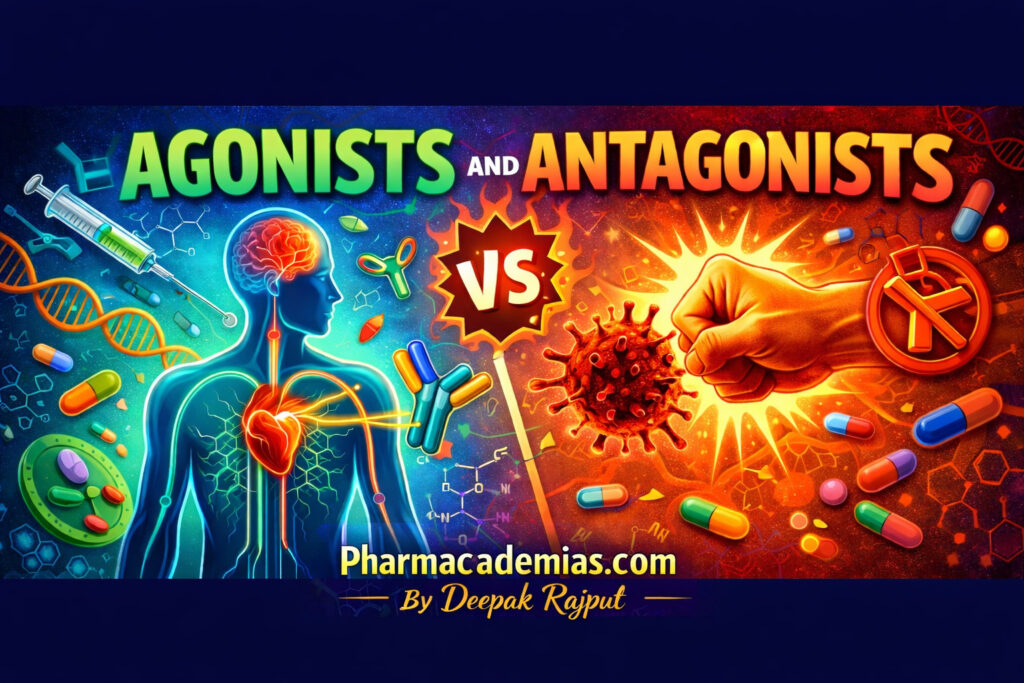
Drugs that bind to receptors and activate them are known as agonists, while drugs that bind without activating and block receptor function are called antagonists. These concepts form the basis of many important therapies, including pain management, antihypertensive therapy, bronchodilation, psychiatric treatment, and emergency antidote use.
Because receptor pharmacology is central to modern therapeutics, understanding agonists and antagonists is essential for B.Pharm, D.Pharm, MBBS, nursing, GPAT, NIPER, and pharmacology competitive exams.
Agonists and Antagonists
Definition of Agonists
An agonist is a drug or endogenous substance that has both affinity and intrinsic activity (efficacy). Affinity means the ability of the drug to bind to the receptor, while intrinsic activity refers to its ability to activate the receptor after binding.
When an agonist binds to its receptor, it produces a conformational change in the receptor protein, which initiates intracellular signaling pathways and leads to a measurable physiological response such as muscle contraction, secretion, neurotransmission, vasodilation, or analgesia.
A simple example is morphine, which acts as an agonist at opioid receptors and produces pain relief.
Mechanism of Action of Agonists
The mechanism of agonist action begins when the drug binds to a specific receptor site with high affinity. This binding stabilizes the receptor in its active state, allowing it to interact with downstream effectors such as:
- G-proteins
- ion channels
- enzymes
- second messengers
- transcription factors
This results in amplification of the signal and production of the desired biological response. As the concentration of agonist increases, receptor occupancy rises, and the response also increases until a maximum effect (Emax) is reached.
In some receptor systems, a full response can occur even before all receptors are occupied due to the presence of spare receptors.
Types of Agonists
Full Agonist
A full agonist binds to the receptor and produces the maximum possible biological response, even if only a fraction of receptors are occupied in systems with spare receptors.
These drugs have high efficacy and are capable of producing the same maximal effect as the endogenous ligand.
A classical example is morphine, which fully activates µ-opioid receptors and produces strong analgesia.
Partial Agonist
A partial agonist also binds to the receptor but produces only a submaximal response, even when all receptors are occupied.
This occurs because its intrinsic activity is lower than that of a full agonist. An important clinical feature is that in the presence of a full agonist, a partial agonist may behave like a competitive antagonist by occupying receptors and reducing the overall effect.
A well-known example is buprenorphine, which partially activates opioid receptors and produces a ceiling effect on respiratory depression.
Inverse Agonist
An inverse agonist binds to the same receptor as an agonist but stabilizes it in the inactive state, thereby reducing its constitutive or basal activity.
Instead of simply blocking the receptor, it actively produces an effect opposite to that of the agonist. This is possible only in receptors that show some degree of constitutive activity in the absence of ligand.
A classic example includes beta-carbolines at GABA-A receptors, which can promote anxiety and convulsions.
Super Agonist
A super agonist is a drug that produces a response greater than the endogenous natural ligand.
Its efficacy exceeds the normal physiological agonist, resulting in an exaggerated response. These agents are more commonly discussed in advanced receptor pharmacology and peptide therapeutics.
Synthetic peptide hormones are common examples where receptor activation exceeds the endogenous hormone response.
Biased Agonist
A biased agonist is a modern pharmacological concept where the drug selectively activates one signaling pathway over another through the same receptor.
This selective signaling improves therapeutic benefits while reducing side effects. It is extremely important in drug design and precision pharmacology.
A good example is oliceridine, an opioid biased agonist that preferentially activates G-protein pathways associated with analgesia while reducing β-arrestin-mediated respiratory depression.
Definition of Antagonists
An antagonist is a drug that has affinity but no intrinsic activity.
This means it can bind to the receptor but cannot activate it. Instead, it blocks the receptor and prevents agonists or endogenous ligands from binding and producing their effect.
Antagonists are extremely useful clinically because they can reverse overdoses, block harmful endogenous mediators, and prevent excessive receptor stimulation.
For example, naloxone reverses opioid overdose by blocking opioid receptors.
Mechanism of Action of Antagonists
The mechanism of antagonists depends on whether they block the receptor at the same binding site or at a different site.
Some antagonists directly compete with agonists for the same receptor site, while others alter receptor shape or function through allosteric binding, reducing responsiveness even when the agonist is present.
The net result is reduced or absent receptor activation and suppression of the biological response.
Types of Antagonists
Competitive Antagonists
Competitive antagonists bind reversibly to the same receptor site as the agonist.
Because binding is reversible, increasing the concentration of agonist can overcome the blockade. This is called surmountable antagonism. Pharmacologically, it causes a parallel rightward shift in the dose-response curve without reducing maximum efficacy.
A classic example is flumazenil, which competitively blocks the benzodiazepine site on the GABA-A receptor and reverses sedation.
Other important examples include:
- atropine against acetylcholine
- naloxone against morphine
Noncompetitive Antagonists
Noncompetitive antagonists bind either irreversibly to the same receptor site or bind to a different allosteric site.
This alters receptor function in such a way that even high concentrations of agonist cannot restore the maximum response. This is called insurmountable antagonism, and it reduces the Emax of the agonist.
A classic example is phenoxybenzamine, which irreversibly blocks alpha-adrenergic receptors and is used in pheochromocytoma.
Clinical Importance
The concepts of agonists and antagonists are highly important in therapeutics.
Agonists are used when stimulation of a receptor is required, such as:
- salbutamol in asthma
- morphine in pain
- dopamine in shock
Antagonists are used when blocking receptor activity is beneficial, such as:
- antihistamines in allergy
- beta blockers in hypertension
- naloxone in opioid poisoning
- atropine in organophosphate poisoning
This receptor-based classification forms the basis of rational drug design and personalized medicine.
Conclusion
Agonists and antagonists are the foundation of receptor pharmacology. Agonists activate receptors and produce biological responses, while antagonists block receptor activation and inhibit the effects of agonists.
Agonists may be full, partial, inverse, super, or biased, whereas antagonists are mainly competitive and noncompetitive. Understanding their mechanism, receptor affinity, efficacy, and clinical applications is essential for mastering pharmacology and drug action.
This topic is extremely important for semester exams, viva, GPAT, pharmacology interviews, and clinical therapeutics.