
PMOS: For years, millions of women around the world have known the condition as PCOS — short for Polycystic Ovary Syndrome. Doctors, patients, hospitals, and health websites have used this term for decades. But now, a major international discussion is changing the future of this condition.
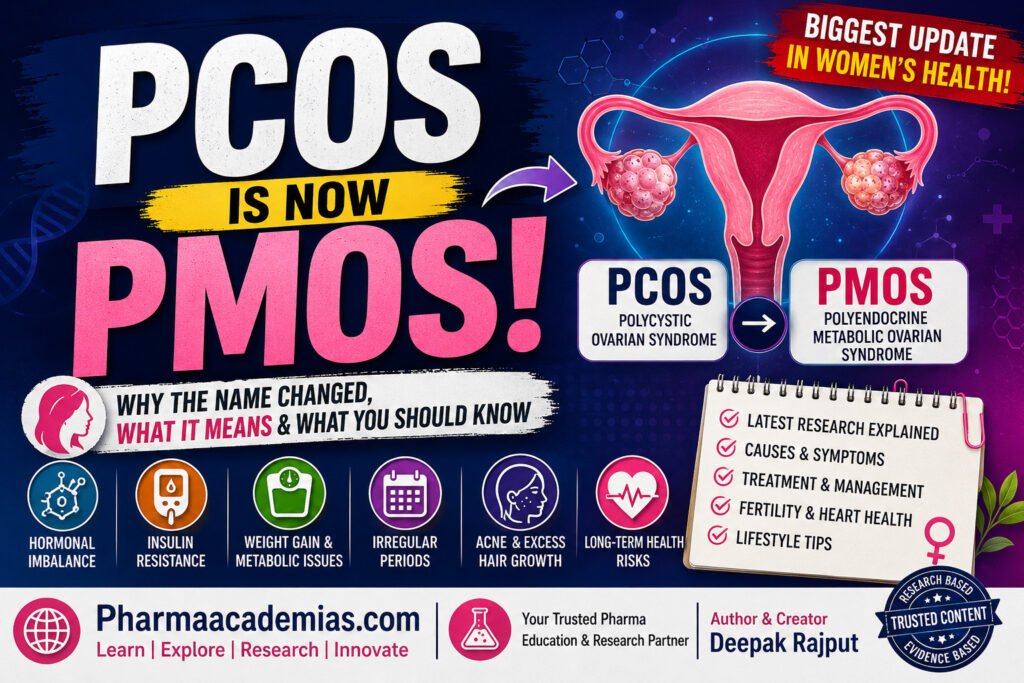
According to recent global research and expert discussions, many scientists and healthcare professionals believe the name “PCOS” no longer properly describes the condition. Because of this, experts have proposed a new name:
PMOS — Polyendocrine Metabolic Ovarian Syndrome
This proposed name change is becoming one of the biggest discussions in women’s health.
But why are experts trying to change the name?
Is PCOS not related to ovarian cysts?
What does PMOS actually mean?
And most importantly — will this change help patients?
In this article, we’ll explain everything in simple and easy language so anyone can understand the science behind this global movement.
What Is PCOS?
Polycystic Ovary Syndrome (PCOS) is a common hormonal condition that affects women during their reproductive years.
Researchers estimate that more than 170 million women worldwide may have this condition.
PCOS can affect many parts of the body, including:
- Hormones
- Metabolism
- Menstrual cycles
- Fertility
- Skin and hair
- Mental health
- Weight management
- Heart health
For many years, people believed PCOS was mainly an ovarian disorder. However, newer research shows the condition is much more complicated than doctors previously thought.
Today, experts say PCOS is actually a whole-body hormonal and metabolic disorder.
Why Are Experts Changing the Name? PCOS to PMOS
The biggest reason is simple:
The old name is scientifically misleading.
The word “polycystic” makes people think women with PCOS have dangerous ovarian cysts.
But according to researchers:
- Most women with PCOS do not have true ovarian cysts
- The small structures seen in ultrasounds are immature follicles, not harmful cysts
- The condition affects much more than just the ovaries
Because of this, many patients feel the current name creates confusion.
Researchers also found that the name contributes to:
- Delayed diagnosis
- Poor awareness
- Misunderstanding among doctors and patients
- Frustration among women living with the condition
- Incomplete treatment approaches
Experts now believe the name should reflect the real science behind the disorder.
What Does PMOS Mean?
The proposed new name is:
Polyendocrine Metabolic Ovarian Syndrome
Let’s understand each word in simple language.
1. Polyendocrine
“Poly” means multiple.
“Endocrine” refers to hormones and hormone-producing systems.
This word was included because PMOS affects multiple hormone systems in the body — not just one.
Researchers found problems involving:
- Insulin
- Androgens
- Brain hormones
- Ovarian hormones
- Metabolic hormones
This is why experts felt “polyendocrine” better explains the condition.
2. Metabolic
This word highlights the strong connection between the condition and metabolism.
Many women with PMOS experience:
- Insulin resistance
- Weight gain
- Prediabetes
- Type 2 diabetes
- High cholesterol
- Fatty liver disease
- High blood pressure
Researchers now consider metabolic dysfunction one of the central features of the disorder.
3. Ovarian
Although the condition affects the whole body, ovarian dysfunction still remains an important part of the disease.
Women with PMOS may experience:
- Irregular ovulation
- Irregular periods
- Fertility problems
- Hormonal imbalance
The term “ovarian” helps keep the reproductive aspect of the condition represented without incorrectly focusing on cysts.
Why PCOS Is More Than an Ovary Disorder
One of the biggest discoveries in recent years is that PCOS is not simply a gynecological condition.
Researchers now know the disorder involves several body systems working abnormally together.
Hormonal Problems
Women with PMOS often have higher androgen levels.
Androgens are sometimes called “male hormones,” although women naturally produce small amounts too.
High androgen levels can cause:
- Acne
- Excess facial hair
- Body hair growth
- Hair thinning
- Scalp hair loss
Researchers also discovered changes in brain hormone signaling that stimulate the ovaries to produce too many androgens.
Insulin Resistance
One of the most important features of PMOS is insulin resistance.
This happens when the body stops responding properly to insulin.
As a result:
- Blood sugar control becomes difficult
- Insulin levels rise
- Weight gain becomes easier
- Hormonal imbalance worsens
Studies show insulin resistance affects most women with PMOS.
Even women who are slim or have normal weight can still develop insulin resistance.
Metabolic Dysfunction
Researchers now strongly connect PMOS with metabolic disease.
Women with PMOS are more likely to develop:
- Prediabetes
- Type 2 diabetes
- High blood pressure
- Heart disease
- Stroke risk
- Fatty liver disease
This is one major reason why experts insisted the word “metabolic” must be included in the new name.
Common Symptoms of PMOS
Symptoms can vary from person to person.
Some women experience only mild symptoms, while others may struggle with severe hormonal and metabolic problems.
Common symptoms include:
Menstrual Problems
- Irregular periods
- Missed periods
- Heavy bleeding
- Ovulation problems
Fertility Problems
- Difficulty getting pregnant
- Irregular ovulation
- Reduced fertility
Skin and Hair Changes
- Acne
- Facial hair growth
- Body hair growth
- Hair loss
- Oily skin
Weight and Metabolism Issues
- Weight gain
- Difficulty losing weight
- Belly fat accumulation
- Cravings
- Insulin resistance
Emotional and Mental Health Symptoms
- Anxiety
- Depression
- Low confidence
- Stress
- Poor body image
Many researchers now believe mental health symptoms are an important but often overlooked part of the condition.
How Doctors Diagnose PMOS
Currently, doctors still officially use PCOS diagnostic guidelines.
In adults, diagnosis usually requires at least two of the following:
- Irregular ovulation
- High androgen levels
- Multiple small ovarian follicles on ultrasound
Teenagers are diagnosed slightly differently because irregular periods can be common during adolescence.
Researchers also use:
- Hormone tests
- Ultrasound scans
- Anti-Müllerian Hormone (AMH) levels
- Blood sugar testing
- Insulin testing
Experts hope future guidelines will eventually transition from PCOS terminology to PMOS terminology.
Why So Many Women Remain Undiagnosed
One shocking finding from global research is that many women with PCOS may never receive a diagnosis.
Some studies estimate that up to 70% of affected individuals remain undiagnosed.
Reasons include:
- Poor awareness
- Confusing symptoms
- Lack of education
- Social stigma
- Misleading name
- Limited healthcare access
Many women struggle with symptoms for years before finally learning they have the condition.
Experts believe a clearer and more accurate name could help improve awareness and earlier diagnosis.
The Global Movement Behind the Name Change
The push to rename PCOS did not happen suddenly.
Researchers, doctors, and patient organizations have debated this issue for many years.
In 2012, even the US National Institutes of Health (NIH) officially recognized that the name “PCOS” may be inaccurate and misleading.
After this, global organizations and patient advocacy groups began pushing for change.
Major organizations involved included:
- Monash University
- The Androgen Excess and PCOS Society
- Verity UK
- International patient support groups
Thousands of people worldwide participated in:
- Surveys
- Workshops
- International discussions
- Online voting
- Research collaborations
The goal was to create a name that:
- Better reflects the science
- Reduces confusion
- Avoids stigma
- Improves awareness
- Helps patients receive better care
How the Research Was Conducted
Researchers organized one of the largest international consensus projects ever conducted for a women’s health condition.
The process included:
- More than 14,000 survey responses
- Healthcare professionals from multiple disciplines
- Women living with PCOS
- Experts from different countries
- Patient advocacy organizations
Participants discussed:
- What the new name should include
- Which words were scientifically accurate
- Which terms were easiest to understand
- Cultural concerns related to naming
- Potential stigma in different countries
Researchers also tested different acronyms and possible names.
Some names were rejected because:
- They sounded confusing
- The acronyms already existed
- They had negative social meanings
- They created cultural concerns
Eventually, experts reached strong global support for:
Polyendocrine Metabolic Ovarian Syndrome (PMOS)
Why Experts Rejected Some Other Names
During the workshops, researchers tested many possible names.
For example:
- Metabolic Endocrine Reproductive Syndrome
- Endocrine Metabolic Ovulatory Syndrome
- Other hormone-related combinations
However, some names were rejected because their acronyms overlapped with:
- Existing diseases
- Internet subcultures
- Social meanings
- Potentially stigmatizing interpretations
Researchers wanted a name that would:
- Be medically accurate
- Sound professional
- Be easy to communicate globally
- Avoid cultural problems
PMOS eventually became the strongest option.
Why the Word “Ovarian” Was Kept
Some people wondered why experts still kept the word “ovarian” in the new name.
Researchers explained that ovarian dysfunction remains a major part of the condition.
Women with PMOS often experience:
- Irregular follicle development
- Ovulation problems
- Hormonal imbalance
- Fertility challenges
However, experts intentionally avoided using the word “polycystic” because it creates confusion.
The new name keeps ovarian involvement visible while removing the inaccurate cyst-related focus.
The Link Between PMOS and Weight Gain
Weight gain is one of the most frustrating symptoms for many women with PMOS.
Researchers found that obesity — especially belly fat — can worsen symptoms.
Extra weight may increase:
- Insulin resistance
- Hormonal imbalance
- Inflammation
- Fertility problems
- Cardiovascular risks
However, experts also emphasize an important point:
Not every woman with PMOS is overweight.
Many women with normal body weight can still develop:
- hormonal imbalance
- insulin resistance
- irregular menstrual cycles
- fertility problems
- acne and excess hair growth
This is one reason why doctors now say PMOS should never be treated as only a “weight-related condition.”
However, researchers found that obesity — especially belly fat — can make symptoms much worse. Excess weight may increase:
- inflammation
- hormone imbalance
- insulin resistance
- cardiovascular risks
Studies also suggest that weight gain and PMOS may influence each other in a cycle. PMOS can make weight loss difficult, while extra body fat can further worsen symptoms.
Because of this, lifestyle management has become one of the most important parts of treatment.
How Lifestyle Changes Help in PMOS
Doctors often recommend lifestyle improvements as the first step in managing PMOS symptoms.
These may include:
- regular exercise
- balanced nutrition
- stress management
- proper sleep
- reducing processed foods and excess sugar
Research shows that even small weight loss in overweight individuals can improve:
- menstrual regularity
- ovulation
- insulin sensitivity
- fertility outcomes
- energy levels
For some people, doctors may also recommend medications or medical weight-management treatments depending on symptom severity.
PMOS and Heart Health
One of the biggest concerns researchers identified is the long-term effect of PMOS on heart and metabolic health.
Women with PMOS may have a higher risk of:
- high blood pressure
- high cholesterol
- blood vessel dysfunction
- Type 2 diabetes
- heart disease
- stroke
Some studies even found increased risks of heart attack and cardiovascular disease in women with PMOS compared to women without the condition.
This is why many experts now believe PMOS should be managed as a long-term metabolic and hormonal health condition — not just a fertility disorder.
Why Early Diagnosis Matters
Researchers say early diagnosis can make a major difference.
When PMOS is diagnosed early, patients may have a better chance to:
- manage symptoms sooner
- reduce long-term complications
- improve fertility outcomes
- maintain healthier metabolism
- protect heart health
Unfortunately, many women remain undiagnosed for years because symptoms are often misunderstood or ignored.
Some women may only discover they have PMOS after:
- fertility struggles
- major weight gain
- severe acne
- diabetes diagnosis
- irregular periods for many years
Experts hope the new name PMOS may encourage better awareness and faster recognition of symptoms in the future.
Editorial Note
This article has been carefully researched and written by Deepak Rajput with a focus on accuracy, clarity, and evidence-based healthcare information. Pharmaacademias.com