
Definition and Scope of Anatomy Physiology: The study of the human body is one of the most important branches of biological and medical sciences. Understanding the structure of the body, the functions performed by different organs, and the changes that occur during disease conditions forms the basis of healthcare education. Three major disciplines that provide this understanding are Anatomy, Physiology, and Pathophysiology. These subjects are closely interconnected and together help healthcare professionals understand how the body works in health and disease.
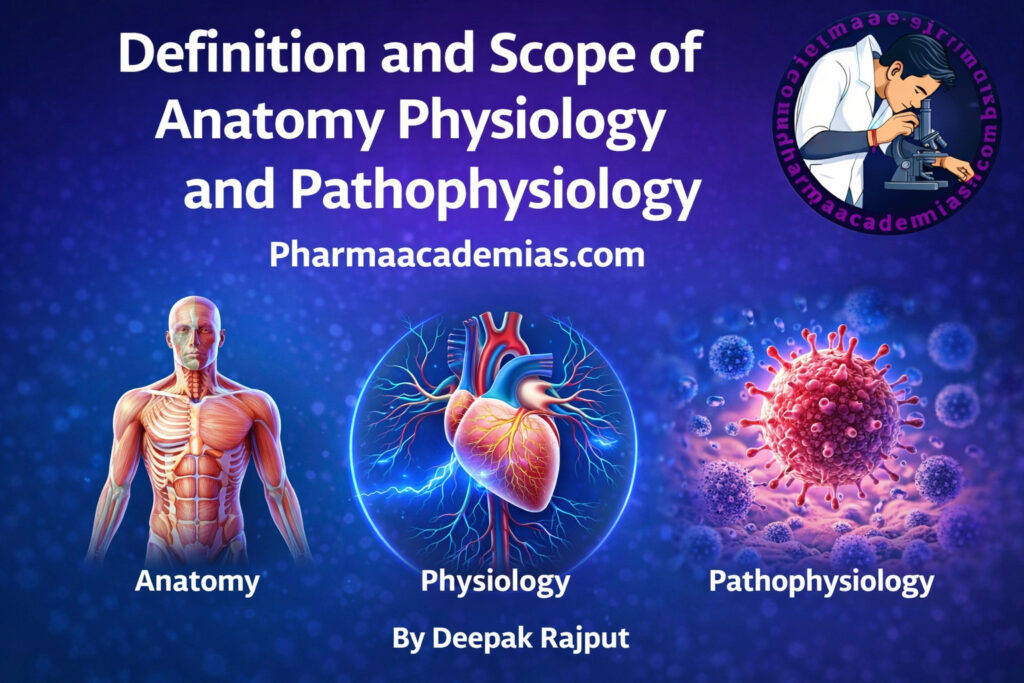
Anatomy explains the structure of the body, physiology explains how the body functions, and pathophysiology describes how normal functions are altered during disease. A thorough knowledge of these sciences is essential in medicine, pharmacy, nursing, physiotherapy, biotechnology, and all allied health sciences.
Anatomy
The term Anatomy is derived from the Greek words:
- Ana = apart
- Tomy = cutting
Thus, anatomy literally means “cutting apart” or studying the structure of an organism by separating its parts.
Anatomy is the branch of science that deals with the study of the structure, organization, shape, size, location, and relationship of different parts of the human body.
It helps in understanding how body parts are arranged and how they are connected with one another. Anatomy mainly focuses on the physical and structural aspects of living organisms.
Importance of Anatomy
The study of anatomy is fundamental because:
- It provides knowledge of body structure.
- It helps identify organs and tissues.
- It forms the basis for surgery and clinical diagnosis.
- It helps understand body functions properly.
- It assists healthcare professionals in identifying abnormalities and injuries.
Without anatomical knowledge, understanding disease processes and treatments becomes difficult.
Scope of Anatomy
The scope of anatomy is extremely broad and includes several specialized branches. Each branch studies the body from a different perspective.
Branches of Anatomy
1. Gross Anatomy (Macroscopic Anatomy)
Gross anatomy deals with structures visible to the naked eye without using a microscope.
It includes:
a) Regional Anatomy
Study of specific body regions such as:
- Head
- Neck
- Thorax
- Abdomen
b) Systemic Anatomy
Study of body systems such as:
- Digestive system
- Nervous system
- Respiratory system
c) Surface Anatomy
Study of external body features and landmarks.
d) Surgical Anatomy
Application of anatomical knowledge in surgery.
2. Microscopic Anatomy
Microscopic anatomy studies structures that cannot be seen without a microscope.
It includes:
a) Cytology: Study of cells.
b) Histology: Study of tissues.
3. Developmental Anatomy
Study of structural development from fertilization to adulthood.
Embryology: A branch dealing with prenatal development of the embryo and fetus.
4. Comparative Anatomy
Comparison of anatomical structures among different species.
5. Radiological Anatomy
Study of body structures using imaging techniques such as:
- X-rays
- CT scans
- MRI
- Ultrasound
6. Clinical Anatomy
Application of anatomy in clinical practice for diagnosis and treatment.
Applications of Anatomy
Anatomy has applications in:
- Medicine
- Pharmacy
- Nursing
- Physiotherapy
- Dentistry
- Surgery
- Radiology
- Biomedical research
Healthcare professionals use anatomical knowledge to:
- Perform surgeries
- Interpret diagnostic images
- Administer injections
- Understand body injuries
- Explain disease conditions
Physiology
The term Physiology comes from the Greek words:
- Physis = nature
- Logos = study
Physiology is the branch of science that deals with the study of normal functions and mechanisms of the human body and its parts.
It explains how cells, tissues, organs, and organ systems perform their activities to maintain life.
While anatomy describes structure, physiology explains function.
For example:
- Anatomy explains the structure of the heart.
- Physiology explains how the heart pumps blood.
Importance of Physiology
Physiology is important because it helps us understand:
- How body organs function normally
- Mechanisms of life processes
- Coordination between body systems
- Maintenance of homeostasis
- Functional changes during disease
It provides the scientific basis for medical treatment and drug action.
Scope of Physiology
The scope of physiology is extensive and covers all normal biological activities of the body.
Branches of Physiology
1. Cell Physiology
Study of functions of cells and organelles.
Includes:
- Cellular metabolism
- Cell communication
- Transport mechanisms
2. Systemic Physiology
Study of functions of organ systems.
Examples:
- Cardiovascular physiology
- Respiratory physiology
- Renal physiology
- Digestive physiology
3. Neurophysiology
Study of nervous system functions.
Includes:
- Nerve impulse transmission
- Brain function
- Reflex actions
4. Endocrine Physiology: Study of hormones and endocrine glands.
5. Cardiovascular Physiology: Study of heart and blood circulation.
6. Exercise Physiology: Study of body responses during physical activity.
7. Pathophysiological Physiology: Study of altered functions during disease.
Homeostasis in Physiology
One of the central concepts in physiology is homeostasis.
Homeostasis refers to the ability of the body to maintain a stable internal environment despite external changes.
Examples include regulation of:
- Body temperature
- Blood pressure
- Blood glucose
- pH balance
Homeostasis is maintained through feedback mechanisms involving various organs and systems.
Applications of Physiology
Physiology is applied in:
- Clinical medicine
- Pharmacology
- Sports science
- Nutrition
- Biotechnology
- Nursing care
- Critical care medicine
It helps healthcare professionals:
- Understand body responses
- Interpret laboratory findings
- Predict drug effects
- Manage diseases effectively
Relationship Between Anatomy and Physiology
Anatomy and physiology are closely related disciplines.
Key Principle:
Structure determines function.
This means the structure of an organ influences how it functions.
Examples:
- Thin alveolar walls help efficient gas exchange.
- Long nerve fibers help rapid impulse transmission.
- Thick muscular walls of the heart help pumping.
Thus, anatomy and physiology complement each other.
Pathophysiology
The term Pathophysiology combines:
- Pathos = disease or suffering
- Physiology = study of function
Pathophysiology is the branch of medical science that deals with the study of functional and physiological changes occurring in the body as a result of disease or injury.
It explains how normal physiological processes become altered during disease conditions.
In simple words:
- Physiology studies normal body functions.
- Pathophysiology studies abnormal body functions caused by disease.
Importance of Pathophysiology
Pathophysiology is important because it:
- Explains disease mechanisms
- Helps understand signs and symptoms
- Assists in diagnosis
- Guides treatment planning
- Helps predict complications
It bridges the gap between basic sciences and clinical medicine.
Scope of Pathophysiology
The scope of pathophysiology includes studying:
- Causes of diseases
- Disease progression
- Cellular injury
- Organ dysfunction
- Body responses to disease
- Complications and recovery
It forms the scientific foundation for understanding pathology and pharmacotherapy.
Major Areas of Pathophysiology
1. Cellular Pathophysiology: Study of cellular injury and adaptation.
Includes:
- Inflammation
- Necrosis
- Apoptosis
- Cellular degeneration
2. Systemic Pathophysiology: Study of diseases affecting body systems.
Examples:
- Cardiovascular disorders
- Respiratory diseases
- Neurological disorders
3. Immunopathophysiology: Study of immune system disorders.
Includes:
- Allergy
- Autoimmune diseases
- Immunodeficiency disorders
4. Genetic Pathophysiology: Study of diseases caused by genetic abnormalities.
Examples:
- Hemophilia
- Sickle cell anemia
- Down syndrome
5. Metabolic Pathophysiology: Study of metabolic disorders.
Examples:
- Diabetes mellitus
- Thyroid disorders
- Obesity
Disease Process in Pathophysiology
The development of disease generally involves several stages:
- Etiology (cause of disease)
- Pathogenesis (mechanism of disease development)
- Structural changes
- Functional disturbances
- Clinical manifestations
- Complications or recovery
Examples of Pathophysiology
Diabetes Mellitus
Normal Physiology: Insulin regulates blood glucose levels.
Pathophysiology
Insulin deficiency or resistance causes:
- Increased blood glucose
- Impaired metabolism
- Organ damage
Hypertension
Normal Physiology: Blood pressure remains within normal range.
Pathophysiology
Persistent elevation of blood pressure damages:
- Blood vessels
- Heart
- Kidneys
- Brain
Asthma
Normal Physiology: Airways remain open for airflow.
Pathophysiology
Inflammation and bronchoconstriction cause:
- Difficulty breathing
- Wheezing
- Reduced oxygen supply
Relationship Between Anatomy, Physiology, and Pathophysiology
These three sciences are interconnected.
| Subject | Focus |
| Anatomy | Structure of the body |
| Physiology | Normal functions of the body |
| Pathophysiology | Abnormal functions during disease |
Example: Heart
- Anatomy explains heart structure.
- Physiology explains blood pumping.
- Pathophysiology explains disorders such as heart failure.
Together, they provide complete understanding of human health and disease.
Importance in Healthcare and Pharmacy
Knowledge of anatomy, physiology, and pathophysiology is essential for:
- Understanding drug action
- Clinical diagnosis
- Patient care
- Disease prevention
- Surgical procedures
- Laboratory investigations
- Therapeutic management
Pharmacists especially require this knowledge to understand:
- Mechanism of drugs
- Adverse effects
- Disease treatment
- Drug interactions
Conclusion
Anatomy, physiology, and pathophysiology are the foundational sciences of healthcare and medical education. Anatomy studies the structure of the human body, physiology explains normal body functions, and pathophysiology describes abnormal functional changes caused by diseases. These disciplines are closely interconnected and together provide a complete understanding of the human body in both health and disease.
A strong understanding of these subjects is essential for students and professionals in medicine, pharmacy, nursing, physiotherapy, and other health sciences because they form the basis for diagnosis, treatment, patient care, and medical research.
Editorial Note
This article has been carefully researched and written by Deepak Rajput with a focus on accuracy, clarity, and evidence-based healthcare information. Pharmaacademias.com